Dennis J. McFarland - Böcker
Visar alla böcker från författaren Dennis J. McFarland. Handla med fri frakt och snabb leverans.
3 produkter
3 produkter
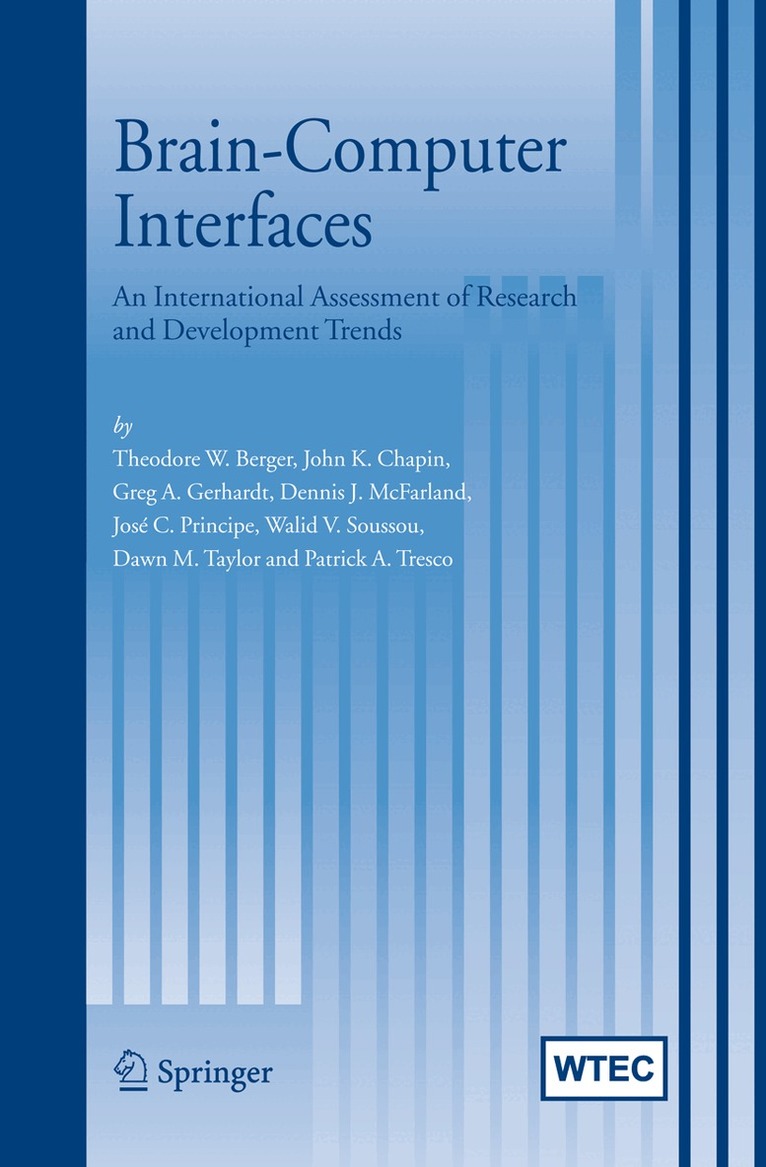
Brain-Computer Interfaces
An international assessment of research and development trends
Inbunden, Engelska, 2008
1 096 kr
Skickas inom 10-15 vardagar
We have come to know that our ability to survive and grow as a nation to a very large degree depends upon our scientific progress. Moreover, it is not enough simply to keep 1 abreast of the rest of the world in scientific matters. We must maintain our leadership. President Harry Truman spoke those words in 1950, in the aftermath of World War II and in the midst of the Cold War. Indeed, the scientific and engineering leadership of the United States and its allies in the twentieth century played key roles in the successful outcomes of both World War II and the Cold War, sparing the world the twin horrors of fascism and totalitarian communism, and fueling the economic prosperity that followed. Today, as the United States and its allies once again find themselves at war, President Truman’s words ring as true as they did a half-century ago. The goal set out in the Truman Administration of maintaining leadership in science has remained the policy of the U. S. Government to this day: Dr. John Marburger, the Director of the Office of Science and Technology (OSTP) in the Executive Office of the President, made remarks to that effect during his 2 confirmation hearings in October 2001. The United States needs metrics for measuring its success in meeting this goal of maintaining leadership in science and technology. That is one of the reasons that the National Science Foundation (NSF) and many other agencies of the U. S.
1 634 kr
Skickas inom 7-10 vardagar
In the foreword, Dr. Robert Burkard states, "If you are looking for a clinical cookbook on how to diagnose and treat those with (central) auditory processing disorders (CAPD), you should not read this book. This book is much less than a clinical cookbook, and much, much more." Featuring contributions from a stellar team of expert contributors in the areas of audiology, psychology, anatomy, neuroscience, imaging science, and epidemiology, this new book addresses major controversies in the field of auditory processing and its disorders. The contributors consider a range of topics including the history of the field, contemporary anatomical models, auditory processing streams, neuroplasticity, professional models, modality specificity, music perception and its disorders, speech recognition, aging, educational outcomes, tinnitus, and auditory neuropathy.
Brain-Computer Interfaces
An international assessment of research and development trends
Häftad, Engelska, 2010
1 096 kr
Skickas inom 10-15 vardagar
We have come to know that our ability to survive and grow as a nation to a very large degree depends upon our scientific progress. Moreover, it is not enough simply to keep 1 abreast of the rest of the world in scientific matters. We must maintain our leadership. President Harry Truman spoke those words in 1950, in the aftermath of World War II and in the midst of the Cold War. Indeed, the scientific and engineering leadership of the United States and its allies in the twentieth century played key roles in the successful outcomes of both World War II and the Cold War, sparing the world the twin horrors of fascism and totalitarian communism, and fueling the economic prosperity that followed. Today, as the United States and its allies once again find themselves at war, President Truman’s words ring as true as they did a half-century ago. The goal set out in the Truman Administration of maintaining leadership in science has remained the policy of the U. S. Government to this day: Dr. John Marburger, the Director of the Office of Science and Technology (OSTP) in the Executive Office of the President, made remarks to that effect during his 2 confirmation hearings in October 2001. The United States needs metrics for measuring its success in meeting this goal of maintaining leadership in science and technology. That is one of the reasons that the National Science Foundation (NSF) and many other agencies of the U. S.