Dennis Sherwood – författare
696 kr
Läs direkt efter köp
791 kr
Läs direkt efter köp
848 kr
Skickas inom 7-10 vardagar
1 839 kr
Skickas inom 5-8 vardagar
958 kr
Skickas inom 5-8 vardagar
1 670 kr
Skickas inom 5-8 vardagar
476 kr
Skickas inom 5-8 vardagar
429 kr
Skickas inom 5-8 vardagar
901 kr
Läs direkt efter köp
This book is about the behaviour of systems. Systems are important, for we interact with them all the time, and many of the actions we take are influenced by a system – for example, the system of performance measures in an organisation influences, often very strongly, how individuals within that organisation behave. Furthermore, sometimes we are involved in the design of systems, as is any manager contributing to the definition of what those performance measures might be. That manager will want to ensure that all the proposed performance measures will drive the ‘right’ behaviours rather than (inadvertently) encouraging dysfunctional ‘game playing’, and so anticipating how the performance measurement system will work in practice is a vital part of a wise design process.
Some of the systems with which we interact are local, such as your organisation’s performance measurement system. Some systems, however, are distant, but nonetheless very real, such as the healthcare system, the education system, the legal system and the climate system. Systems, therefore, exist on all scales, from the local to the global. And all systems are complex, some hugely so. That’s why understanding how systems behave can be very helpful.
Systems are complex for two main reasons. First, the manner in which they behave over time can be very hard to anticipate – and anticipating the future sensibly is of course a key objective of management. Second, the ‘entities’ within a system can be connected together in very complex ways, so that an intervention ‘here’ can result in an effect ‘there’, perhaps a long time afterward. Sometimes this can be surprising, and so we talk of ‘unintended consequences’ – but this is of course a euphemism for ‘because I didn’t understand how this system behaves, I had not anticipated that’.
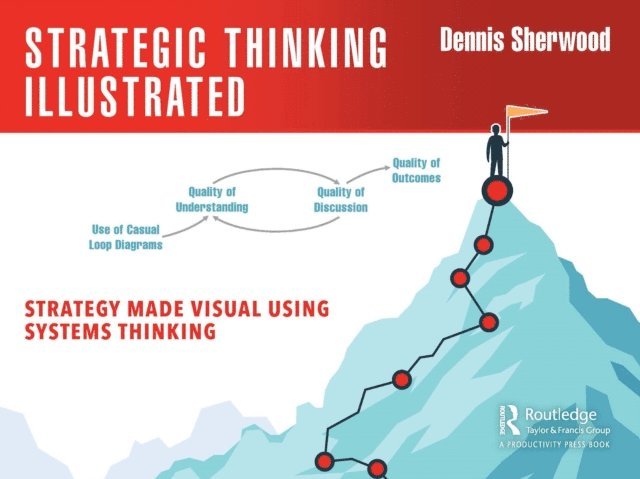
Systems thinking, the subject matter of this book, is the disciplined study of systems, and causal loop diagrams – the ‘pictures’ of this ‘picture book’ – are a very insightful way to represent the connectedness of the entities from which any system is composed, so taming that system’s complexity.
874 kr
Läs direkt efter köp
This book is about the behaviour of systems. Systems are important, for we interact with them all the time, and many of the actions we take are influenced by a system – for example, the system of performance measures in an organisation influences, often very strongly, how individuals within that organisation behave. Furthermore, sometimes we are involved in the design of systems, as is any manager contributing to the definition of what those performance measures might be. That manager will want to ensure that all the proposed performance measures will drive the ‘right’ behaviours rather than (inadvertently) encouraging dysfunctional ‘game playing’, and so anticipating how the performance measurement system will work in practice is a vital part of a wise design process.
Some of the systems with which we interact are local, such as your organisation’s performance measurement system. Some systems, however, are distant, but nonetheless very real, such as the healthcare system, the education system, the legal system and the climate system. Systems, therefore, exist on all scales, from the local to the global. And all systems are complex, some hugely so. That’s why understanding how systems behave can be very helpful.
Systems are complex for two main reasons. First, the manner in which they behave over time can be very hard to anticipate – and anticipating the future sensibly is of course a key objective of management. Second, the ‘entities’ within a system can be connected together in very complex ways, so that an intervention ‘here’ can result in an effect ‘there’, perhaps a long time afterward. Sometimes this can be surprising, and so we talk of ‘unintended consequences’ – but this is of course a euphemism for ‘because I didn’t understand how this system behaves, I had not anticipated that’.
Systems thinking, the subject matter of this book, is the disciplined study of systems, and causal loop diagrams – the ‘pictures’ of this ‘picture book’ – are a very insightful way to represent the connectedness of the entities from which any system is composed, so taming that system’s complexity.
350 kr
Skickas inom 5-8 vardagar
115 kr
Skickas inom 5-8 vardagar
94 kr
Skickas inom 5-8 vardagar
44 kr
Läs direkt efter köp
Systems thinking can help you tame the complexity of real-world problems by providing a structured way of balancing a broad, overall view with the selection of the right level of detail, truly allowing you to "see the forest for the trees". Only by taking a broad view can we avoid the twin dangers of a silo mentality-in which a fix ''here'' simply shifts the problem to ''there'', and organisational myopia-in which a fix ''now'' gives rise to a much bigger problem to fix ''then''. Seeing the Forest for the Trees will give you all the tools and techniques you need, with many practical examples as diverse as managing a busy back office, negotiating an outsourcing deal and formulating business strategy.
284 kr
Skickas