Di Luo – författare
Visar alla böcker från författaren Di Luo. Handla med fri frakt och snabb leverans.
10 produkter
10 produkter
Häftad, Tyska, 2024
169 kr
Skickas inom 3-6 vardagar
Häftad, Tyska, 2025
174 kr
Skickas inom 3-6 vardagar
Häftad, Tyska, 2025
171 kr
Skickas inom 3-6 vardagar
Häftad, Tyska, 2025
174 kr
Skickas inom 3-6 vardagar
Häftad, Tyska, 2026
174 kr
Skickas inom 3-6 vardagar
Häftad, Tyska, 2023
174 kr
Skickas inom 3-6 vardagar
Häftad, Tyska, 2023
174 kr
Skickas inom 3-6 vardagar
Häftad, Tyska, 2024
174 kr
Skickas inom 3-6 vardagar
Del 50 - China Studies
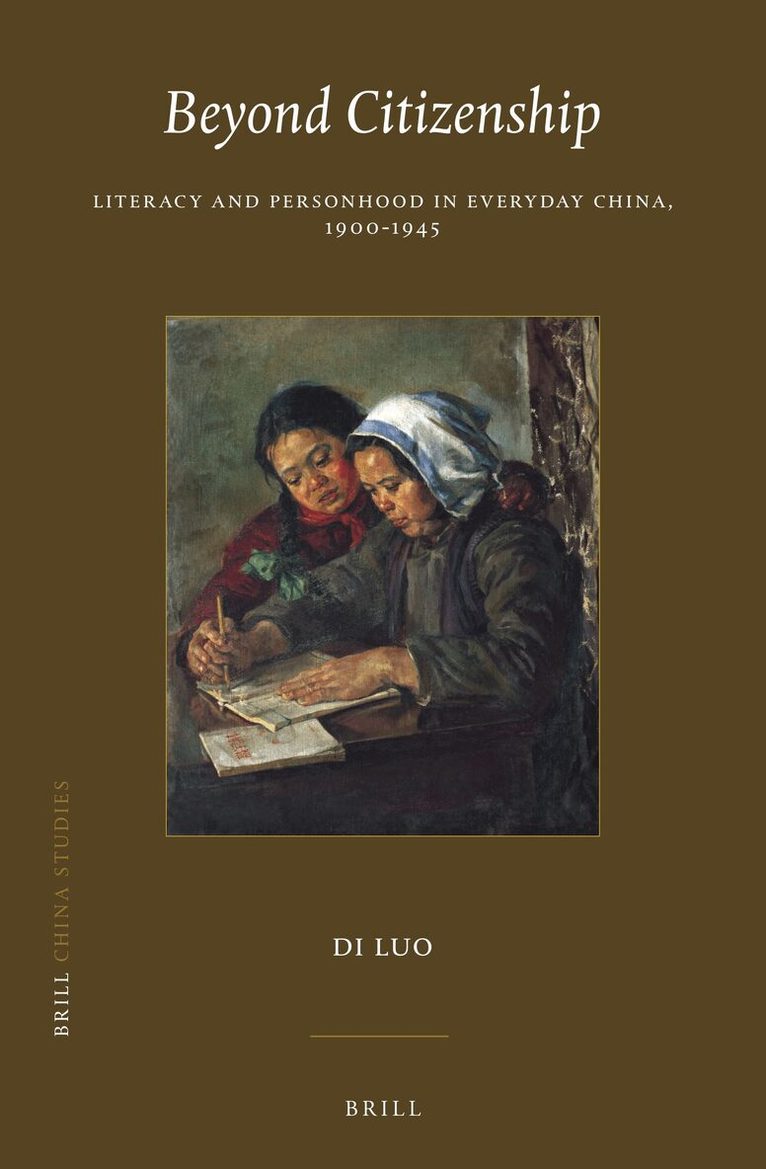
Beyond Citizenship: Literacy and Personhood in Everyday China, 1900-1945
Inbunden, Engelska, 2022
2 596 kr
Skickas inom 5-8 vardagar
Beyond Citizenship focuses on the role of literacy in building a modern nation-state by examining the government provision of adult literacy training in early twentieth-century China. Based on untapped archives and diaries, Di Luo uncovers people’s strategic use of literacy and illiteracy in social interactions and explores the impact of daily experiences on the expansion of state power. Highlighting interpersonal and intergroup relations, Beyond Citizenship suggests a new methodology of studying literacy which foregrounds the agentive role of historical actors and so moves away from a more traditional approach that treats literacy itself as the key factor enabling social change.
Inbunden, Engelska, 2026
818 kr
Kommande
Dome of Heaven enters the long-standing debate in architectural history on the origins and significance of the dome as both an idea and a building technique. Examining the material evidence and intellectual foundations of Buddhist ceilings in a trans-Eurasian context, Di Luo and Gerald Kozicz reveal the multiple genealogies and meanings of the Buddhist dome to unravel the deep-seated connections between the East and the West and the "in-between" in architectural and astronomical knowledge and practice during the first millennium. On the Indian subcontinent, the arched shape of the dome emerged from Śākyamuni’s "fragrant chamber," the first Buddhist temple and the embodiment of ascetism. As the Mahayana and Vajrayana schools spread across Asia along the Silk Road, this humble design evolved to incorporate increasingly complex cosmological diagrams, pictorial and calligraphic, in ceiling spaces, culminating in a mandalic universe pivoting around Mount Meru, the center of the Buddhist cosmos. Foregrounding areas often described as "peripheries" to the great Silk Road empires, Luo and Kozicz establish a geographical framework for the Buddhist Dome of Heaven. They identify three major channels of transmission: the trans-Hindukush, the trans-Taklamakan, and the trans-Himalayan. Along these routes, builders traded ideas and goods like architectural models and miniatures, facilitating exchanges that shaped Buddhist domes into vessels of the ethical universe, visual and kinesthetic aids to meditation, and roadmaps to enlightenment. Abundantly illustrated with more than eighty drawings, 3D models, maps, and photographs, Dome of Heaven offers a wealth of insights into the creation of a theological world order through spatial choreography, iconography, and pictorial storytelling.