Diana de Armas Wilson - Böcker
Visar alla böcker från författaren Diana de Armas Wilson. Handla med fri frakt och snabb leverans.
4 produkter
4 produkter
2 422 kr
Skickas inom 5-8 vardagar
Two sets of related issues prompt this study: the birth of the New World in European consciousness and the rise of the Cervantine novel in Spain. The conquest, exploration, and colonization of the Indies resonate through Cervantes's two novels, Don Quixote (1605, 1615) and the Persiles (1617), both fortified by imperialism. Cervantes begins publishing in the 1580s, just as the might of imperial Spain turned from Europe towards the Atlantic. Twice refused emigration papers to America - which he depicts as the 'refuge and haven of all the desperate men of Spain' - Cervantes turns to fiction. His novels internalize many colonial discourses and at least four genres implicated in Spain's New World enterprise: the Books of Chivalry, the utopias, the colonial war epic, and American ethnohistory. The first full-length study to move beyond an inventory of Cervantes's references to the Indies - to Mexico and Peru, cannibals and tobacco, parrots and alligators - this book interprets his novels as a transatlantic, cross-cultural, and multi-linguistic achievement.
237 kr
Skickas inom 7-10 vardagar
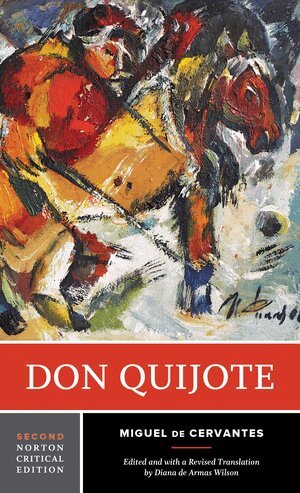
This Norton Critical Edition includes:Burton Raffel’s masterful translation (“Indeed, Raffel seems to have created a Cervantine English” — Javier Herrero, University of Virginia), lightly revised by Diana de Armas Wilson and including the translator’s note.A revised and expanded introduction as well as revised and expanded explanatory footnotes by Diana de Armas Wilson.A rich selection of contextual materials, including related writings by Cervantes and his contemporaries as well as a modern account of Don Quijote’s influence over five centuries.Fifteen critical essays—seven of them new to the Second Edition—thematically organised to maximise classroom discussion. The new essays are by Ilan Stavans, Anne J. Cruz, Paul Michael Johnson, Pablo Garci´a-Pin~ar, Anthony J. Cascardi, Barbara Fuchs and Andre´s Lema-Hincapie´.A chronology and a selected bibliography.
487 kr
Skickas inom 7-10 vardagar
In the work he considered his masterpiece, Persiles and Sigismunda, Cervantes finally explores the reality of woman--an abstraction largely idealized in his earlier writing. Traditional critics have perpetuated this disembodied ideal woman: "Every Man," claimed the translators of the 1706 Don Quixote, has "some darling Dulcinea of his Thoughts." As Diana de Armas Wilson shows, however, Cervantes himself envisioned the radical embodiment of "Dulcinea" in the later Persiles, a pan-European Renaissance allegory. Wilson illuminates Cervantes's strategic use of the ancient genre of Greek romance to contest various chivalric fictions about women, love, and marriage--fictions collapsing under the constraints of an emerging bourgeois culture. Taking as her subject Cervantes's erotic imperative--to leave behind "barbaric" notions of love in quest of a new conceptual space--Wilson demonstrates how the heroes of the Persiles, unlike Don Quixote, learn to cross the borders of difference. Their journey toward marriage is illustrated by thirteen inset "exemplary novels," perhaps the most exploratory of Cervantes's writings.Allegories of Love not only examines the fundamental importance of sexual and cultural difference in Cervantes's last romance, but also reveals the historical conditions of representation itself during the late Renaissance. Originally published in 1991. The Princeton Legacy Library uses the latest print-on-demand technology to again make available previously out-of-print books from the distinguished backlist of Princeton University Press. These editions preserve the original texts of these important books while presenting them in durable paperback and hardcover editions. The goal of the Princeton Legacy Library is to vastly increase access to the rich scholarly heritage found in the thousands of books published by Princeton University Press since its founding in 1905.
2 089 kr
Skickas inom 3-6 vardagar
In the work he considered his masterpiece, Persiles and Sigismunda, Cervantes finally explores the reality of woman--an abstraction largely idealized in his earlier writing. Traditional critics have perpetuated this disembodied ideal woman: "Every Man," claimed the translators of the 1706 Don Quixote, has "some darling Dulcinea of his Thoughts." As Diana de Armas Wilson shows, however, Cervantes himself envisioned the radical embodiment of "Dulcinea" in the later Persiles, a pan-European Renaissance allegory. Wilson illuminates Cervantes's strategic use of the ancient genre of Greek romance to contest various chivalric fictions about women, love, and marriage--fictions collapsing under the constraints of an emerging bourgeois culture. Taking as her subject Cervantes's erotic imperative--to leave behind "barbaric" notions of love in quest of a new conceptual space--Wilson demonstrates how the heroes of the Persiles, unlike Don Quixote, learn to cross the borders of difference. Their journey toward marriage is illustrated by thirteen inset "exemplary novels," perhaps the most exploratory of Cervantes's writings.Allegories of Love not only examines the fundamental importance of sexual and cultural difference in Cervantes's last romance, but also reveals the historical conditions of representation itself during the late Renaissance. Originally published in 1991. The Princeton Legacy Library uses the latest print-on-demand technology to again make available previously out-of-print books from the distinguished backlist of Princeton University Press. These editions preserve the original texts of these important books while presenting them in durable paperback and hardcover editions. The goal of the Princeton Legacy Library is to vastly increase access to the rich scholarly heritage found in the thousands of books published by Princeton University Press since its founding in 1905.