Diane Lillo-Martin – författare
Visar alla böcker från författaren Diane Lillo-Martin. Handla med fri frakt och snabb leverans.
5 produkter
5 produkter
Inbunden, Engelska, 1997
1 104 kr
Skickas inom 5-8 vardagar
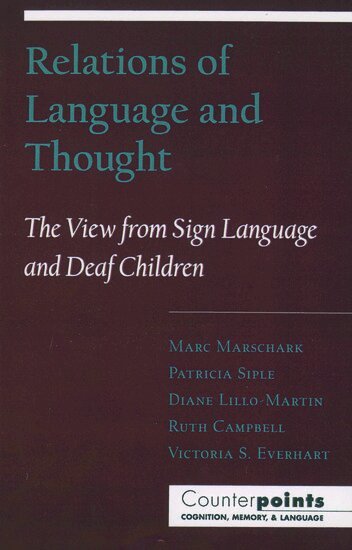
In recent years, the scientific study of signed languages and deaf individuals has greatly enhanced our understanding of deafness, language, and cognition. This volume considers the extent to which the use of sign language might affect the course and character of cognitive development.
Häftad, Engelska, 1997
607 kr
Skickas inom 5-8 vardagar
The relationship of language to cognition, especially in development, is an issue that has occupied philosophers, psychologists, and linguists for centuries. In recent years, the scientific study of signed languages and deaf individuals has greatly enhanced our understanding of deafness, language, and cognition. This Counterpoints volume will consider the extent to which the use of sign language might affect the course and character of cognitive development, and will present a variety of viewpoints in this debate.
E-bok
PDF, Engelska, 1997415 kr
Läs direkt efter köp
The relationship of language to cognition, especially in development, is an issue that has occupied philosophers, psychologists, and linguists for centuries. In recent years, the scientific study of sign languages and deaf individuals has greatly enhanced our understanding of deafness, language, and cognition. This Counterpoints volume considers the extent to which the use of sign language might affect the course and character of cognitive development, and presents a variety of viewpoints in this debate. This volume brings the language-thought discussion into a clearer focus, both theoretically and practically, by placing it in the context of children growing up deaf and the influences of having sign language as their primary form of communication. The discussion is also sharpened by having internationally recognized contributors, such as Patricia Siple, Diane Lillo-Martin, and Ruth Campbell, with specialties in varied areas, all converging on a common interest in which each has conducted empirical research. These contributors clarify and challenge the theoretical assumptions that have driven arguments in the language-thought debate for centuries. An introduction by the editors provides a historical overview of the issues as well as a review of empirical findings that have been offered in response to questions about language-thought relations in deaf children. The final chapters are structured in the form of "live" debate, in which each contributor is given the opportunity to respond to the other perspectives presented in this volume.
Inbunden, Engelska, 2006
1 495 kr
Skickas inom 7-10 vardagar
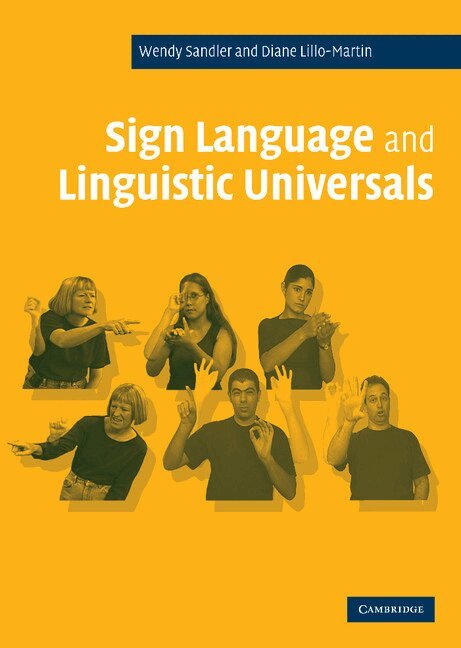
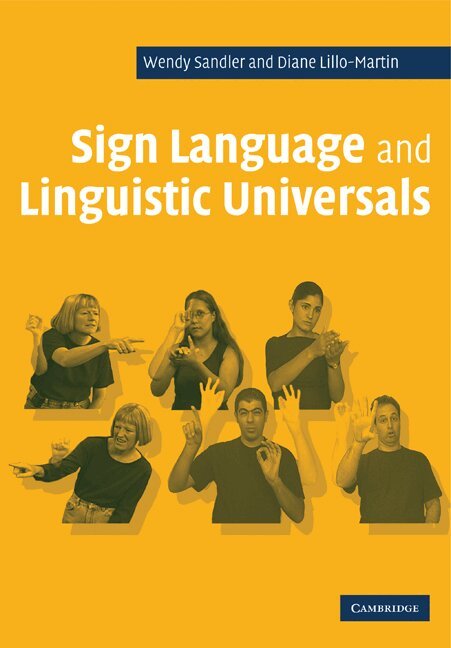
Sign languages are of great interest to linguists, because while they are the product of the same brain, their physical transmission differs greatly from that of spoken languages. In this 2006 study, Wendy Sandler and Diane Lillo-Martin compare sign languages with spoken languages, in order to seek the universal properties they share. Drawing on general linguistic theory, they describe and analyze sign language structure, showing linguistic universals in the phonology, morphology, and syntax of sign language, while also revealing non-universal aspects of its structure that must be attributed to its physical transmission system. No prior background in sign language linguistics is assumed, and numerous pictures are provided to make descriptions of signs and facial expressions accessible to readers. Engaging and informative, Sign Language and Linguistic Universals will be invaluable to linguists, psychologists, and all those interested in sign languages, linguistic theory and the universal properties of human languages.
Häftad, Engelska, 2006
732 kr
Skickas inom 7-10 vardagar
Sign languages are of great interest to linguists, because while they are the product of the same brain, their physical transmission differs greatly from that of spoken languages. In this 2006 study, Wendy Sandler and Diane Lillo-Martin compare sign languages with spoken languages, in order to seek the universal properties they share. Drawing on general linguistic theory, they describe and analyze sign language structure, showing linguistic universals in the phonology, morphology, and syntax of sign language, while also revealing non-universal aspects of its structure that must be attributed to its physical transmission system. No prior background in sign language linguistics is assumed, and numerous pictures are provided to make descriptions of signs and facial expressions accessible to readers. Engaging and informative, Sign Language and Linguistic Universals will be invaluable to linguists, psychologists, and all those interested in sign languages, linguistic theory and the universal properties of human languages.