Donald Bahr - Böcker
Visar alla böcker från författaren Donald Bahr. Handla med fri frakt och snabb leverans.
2 produkter
2 produkter
665 kr
Skickas inom 3-6 vardagar
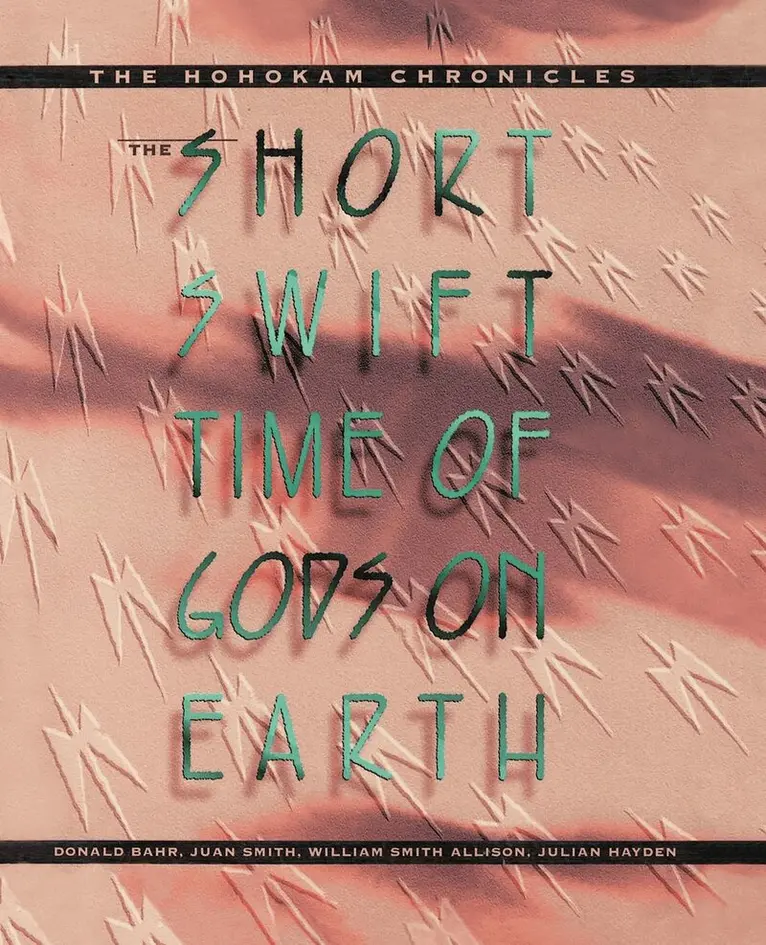
In the spring of 1935, at Snaketown, Arizona, two Pima Indians recounted and translated their entire traditional creation narrative. Juan Smith, reputedly the last tribesman with extensive knowledge of the Pima version of this story, spoke and sang while William Smith Allison translated into English and Julian Hayden, an archaeologist, recorded Allison's words verbatim. The resulting document, the "Hohokam Chronicles", is the most complete natively articulated Pima creation narrative ever written and a rare example of a single-narrator myth. Now this extraordinary work, composed of thirty-six separate stories, is presented in its entirety for the first time. Beautifully expressed, the narrative constitutes a kind of scripture for a native church, beginning with the creation of the universe out of the void and ending with the establishment in the sixteenth century of present-day villages. Central to the story is the murder/resurrection of a god-man, Siuuhu, who summoned the Pimas and Papagos (Tohono O'odham) as his army of vengeance and brought about the conquest of his murderers, the ancient Hohokam.Donald Bahr extensively annotates the text and supplements it with other Pima-Papago versions of similar stories. Important as a social and historic document, this book adds immeasurably to the growing body of Native American literature and to our knowledge of the development of Pima-Papago culture.
1 010 kr
Tillfälligt slut
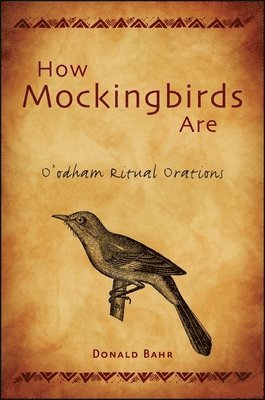
Brilliant analysis of the power of ritual orations in a southwestern American Indian community.The power of mockingbirds and the enduring significance of indigenous ceremonial speeches are deftly revealed in this brilliant analysis of ritual orations created and delivered by the O'odham people (also known as the Pima-Papago). Making their homes along the Akimel rivers and across the arid expanses and mountains of the desert of southern Arizona and northern Sonora, the O'odham people traditionally lived in small villages with scattered brush-walled round houses. Public ceremonies involved many villages and centered around small brush-walled "rainhouses."One hundred years ago, two very different versions of a speech delivered during rain ceremonies were heard at these rainhouses. The Pimas (Akimel O'odham) told of nearly silent and stately events-the calming of a heaving earth, the building of a house on the stilled land, the breathing out of smoke, and the coming of gentle rain. In marked contrast, the Papagos (Tohono O'odham) told of how raucous, drunken people caused clouds to rise and explode with rain like vomiting drunks. Both stories featured mockingbirds and both involved the coming of rain. Today, the gentler, Pima version is extinct while the wilder Papago story endures.Why? Drawing upon a rich reservoir of O'odham oral traditions and ceremonial performances, a meticulous deciphering of particular texts, and an insightful assessment of the impact of Christianity upon the O'odham people, Donald Bahr offers a brilliant analysis of why some indigenous stories cease to be relevant and told. The clues lie in the very different trajectories of the Pima and Papago communities in the late nineteenth and twentieth centuries, trajectories resulting in part with how Christianity fared in the respective communities.