Donald Matthew - Böcker
Visar alla böcker från författaren Donald Matthew. Handla med fri frakt och snabb leverans.
6 produkter
6 produkter
1 619 kr
Skickas inom 10-15 vardagar
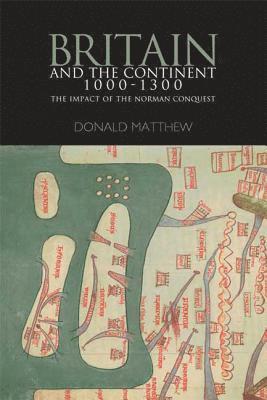
Matthew here describes the tangled web of interactions between the British kingdoms and Continental Europe during the period 1000-1300, and cogently assesses what advantage was taken of these opportunities on the broadest possible front
461 kr
Skickas inom 10-15 vardagar
Matthew here describes the tangled web of interactions between the British kingdoms and Continental Europe during the period 1000-1300, and cogently assesses what advantage was taken of these opportunities on the broadest possible front
1 116 kr
Skickas inom 7-10 vardagar
This book is an introductory account of the kingdom of Sicily established in 1130 by Roger II, a 'Norman' king, and ruled by Roger, his own son and grandsons until 1194 when the kingdom was conquered by his son-in-law, Henry VI of Hohenstaufen. The period covered does, however, extend from Charles of Anjou, a period roughly as long and as coherent as the 'Norman' monarchy of England between 1066 and 1204. Roger II's difficulties in creating an enduring kingdom needed continuous military effort. Even when these efforts were no longer required, the monarchy had still to learn how to function in lands where traditions of local government were strong. Yet when the monarchy itself faltered, the kingdom did not fall apart. Frederick II, the grandson of Roger II, showed that it could be revived and that his sons could maintain it. The ways in which the monarchy made itself indispensable cannot be traced in detail, but pointers to its success can be seen. The kingdom did not spring full-armed at birth - it took time and experience to hammer it into shape. When at last it looked capable of assuming the leadership of all Italy, its enemies combined to prevent it from doing so with the most profound consequences for Italy, the papacy and the west.
555 kr
Skickas inom 7-10 vardagar
This book is an introductory account of the kingdom of Sicily established in 1130 by Roger II, a 'Norman' king, and ruled by Roger, his own son and grandsons until 1194 when the kingdom was conquered by his son-in-law, Henry VI of Hohenstaufen. The period covered does, however, extend from Charles of Anjou, a period roughly as long and as coherent as the 'Norman' monarchy of England between 1066 and 1204. Roger II's difficulties in creating an enduring kingdom needed continuous military effort. Even when these efforts were no longer required, the monarchy had still to learn how to function in lands where traditions of local government were strong. Yet when the monarchy itself faltered, the kingdom did not fall apart. Frederick II, the grandson of Roger II, showed that it could be revived and that his sons could maintain it. The ways in which the monarchy made itself indispensable cannot be traced in detail, but pointers to its success can be seen. The kingdom did not spring full-armed at birth - it took time and experience to hammer it into shape. When at last it looked capable of assuming the leadership of all Italy, its enemies combined to prevent it from doing so with the most profound consequences for Italy, the papacy and the west.
326 kr
Skickas inom 3-6 vardagar
518 kr
Skickas inom 10-15 vardagar
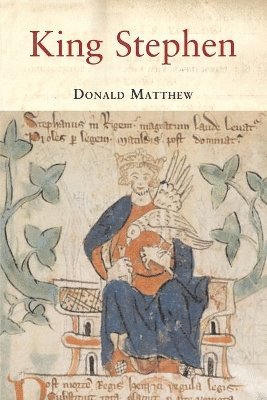
The reign of King Stephen (1135-54) has usually been seen as uniquely disastrous in the history of the medieval England - a country riven by a civil war between Stephen and his first cousin, the Empress Matilda, and by an anarchy during which barons laid waste the country and 'Christ and his saints slept'. Donald Matthew challenges this picture. By questioning such melodramatic assumptions, and by looking clearly at what can and cannot be known about Stephen, he brings new light to both the king and his reign. He shows that much of what has been written about Stephen has been based on the selective use of the testimony of hostile witnesses, and has been shot through by wishful thinking or by the political or historical prejudices of the day. "King Stephen" is an important, well-written and timely reinterpretation of the crisis of Norman government.