Douglas S. Bridges - Böcker
Visar alla böcker från författaren Douglas S. Bridges. Handla med fri frakt och snabb leverans.
8 produkter
8 produkter
694 kr
Skickas inom 10-15 vardagar
This book is an introduction to constructive mathematics with an emphasis on techniques and results obtained in the last twenty years. The text covers fundamental theory of the real line and metric spaces, focusing on locatedness in normed spaces and with associated results about operators and their adjoints on a Hilbert space. The first appendix gathers together some basic notions about sets and orders, the second gives the axioms for intuitionistic logic. No background in intuitionistic logic or constructive analysis is needed in order to read the book, but some familiarity with the classical theories of metric, normed and Hilbert spaces is necessary.
Del 146 - Graduate Texts in Mathematics
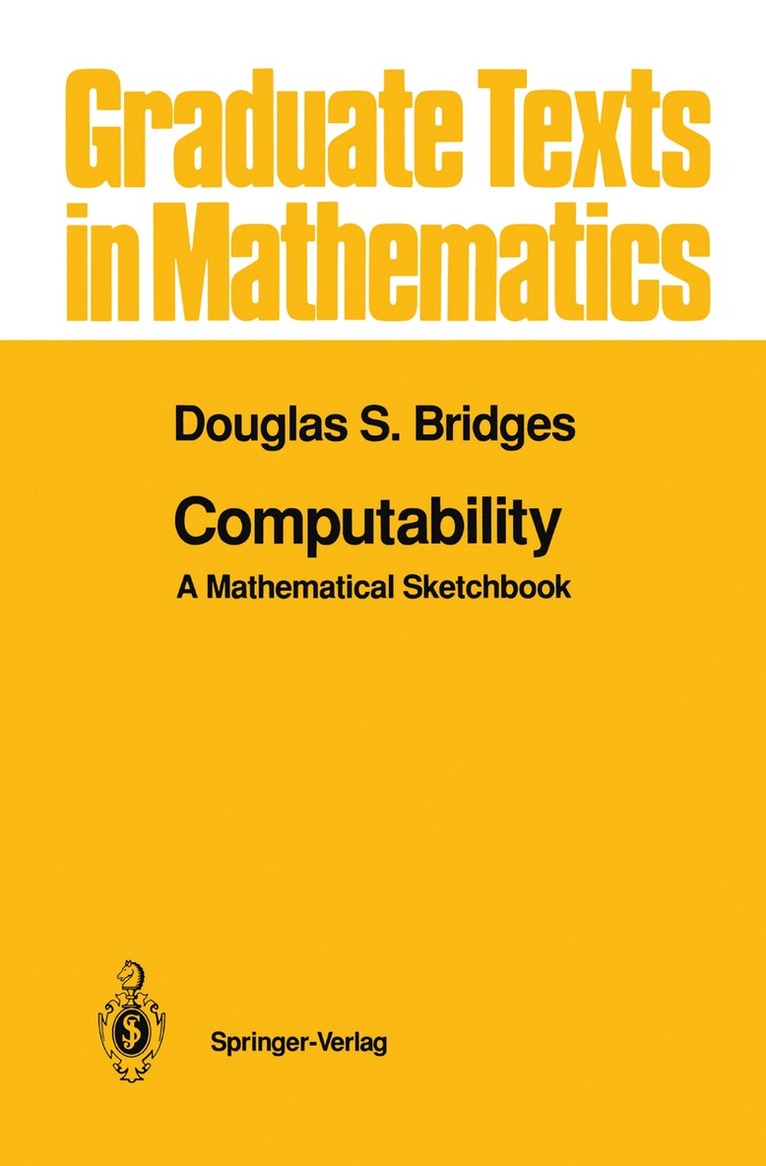
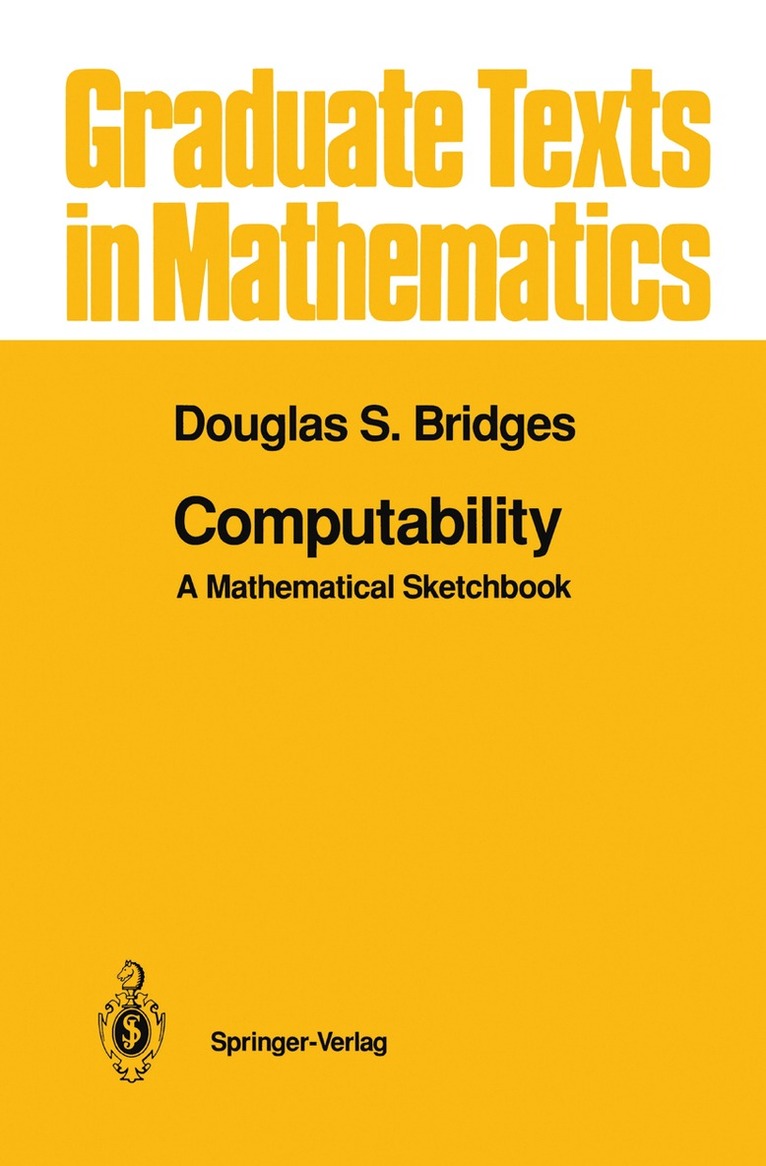
Computability
A Mathematical Sketchbook
Inbunden, Engelska, 1994
898 kr
Skickas inom 5-8 vardagar
Aimed at mathematicians and computer scientists who will only be exposed to one course in this area, Computability: A Mathematical Sketchbook provides a brief but rigorous introduction to the abstract theory of computation, sometimes also referred to as recursion theory. It develops major themes in computability theory, such as Rice's theorem and the recursion theorem, and provides a systematic account of Blum's complexity theory as well as an introduction to the theory of computable real numbers and functions. The book is intended as a university text, but it may also be used for self-study; appropriate exercises and solutions are included.
Del 174 - Graduate Texts in Mathematics
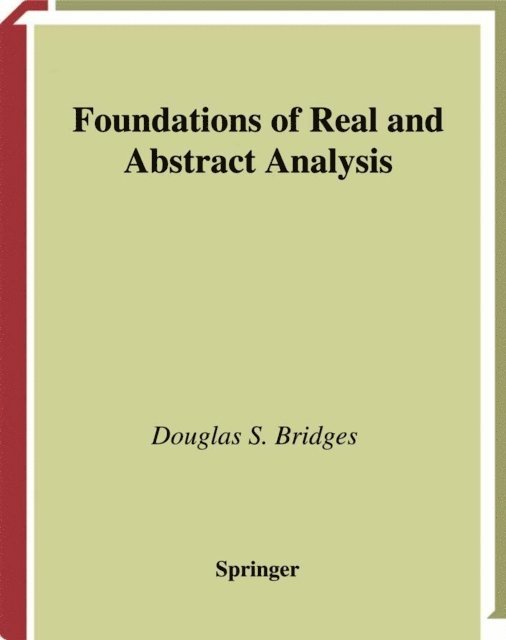
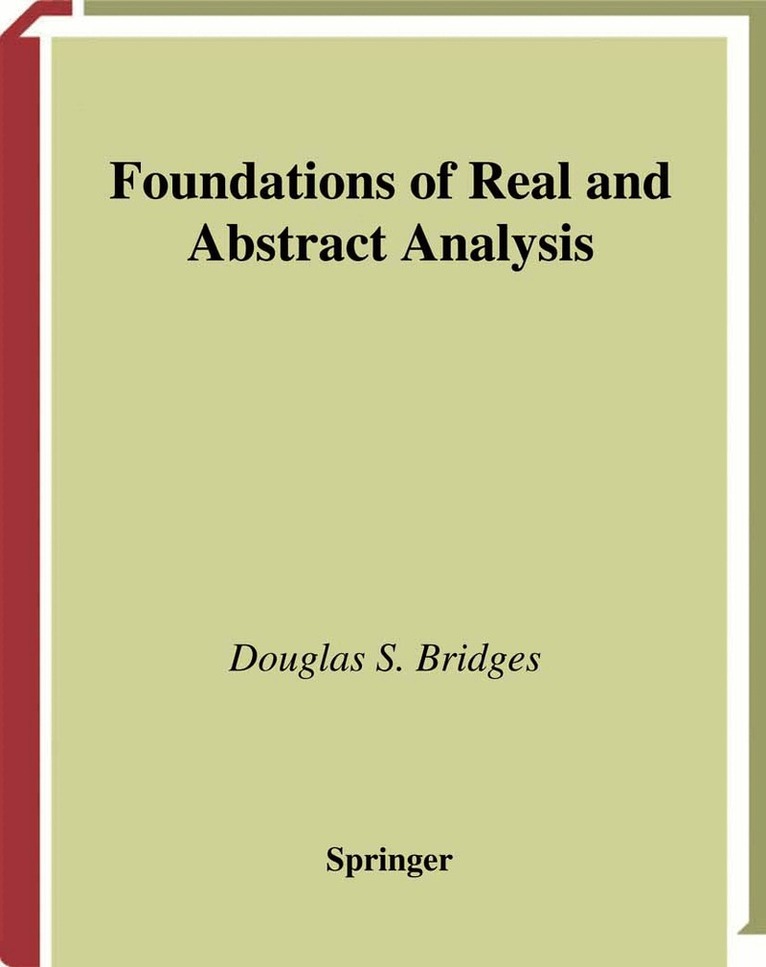
Foundations of Real and Abstract Analysis
Inbunden, Engelska, 1997
747 kr
Skickas inom 10-15 vardagar
The core chapters of this volume provide a complete course on metric, normed, and Hilbert spaces, and include many results and exercises seldom found in texts on analysis at this level. The author covers an unusually wide range of material in a clear and concise format including elementary real analysis, Lebesgue integration on R, and an introduction to functional analysis. This makes a versatile text also suited for courses on real analysis, metric spaces, abstract analysis, and modern analysis. The book begins with a comprehensive chapter providing a fast-paced course on real analysis, and is followed by an introduction to the Lebesgue integral. This provides a reference for later chapters as well as an introduction for students with only the typical sequence of undergraduate calculus courses as prerequisites. Other features include a chapter introducing functional analysis, the Hahn-Banach theorem and duality, separation theorems, the Baire Category Theorem, the Open Mapping Theorem and their consequences, and unusual applications such as weak solutions of the Dirichlet Problem and Pareto optimality in Mathematical Economics.Of special interest is the unique collection of nearly 750 exercises, many with guidelines for their solutions. The exercises include applications and extensions of the main propositions and theorems, results that fill in gaps in proofs or that prepare for proofs later in the book, pointers to new branches of the subject, and difficult challenges for the very best students.
694 kr
Skickas inom 10-15 vardagar
Aimed at mathematicians and computer scientists who will only be exposed to one course in this area, Computability: A Mathematical Sketchbook provides a brief but rigorous introduction to the abstract theory of computation, sometimes also referred to as recursion theory. It develops major themes in computability theory, such as Rice's theorem and the recursion theorem, and provides a systematic account of Blum's complexity theory as well as an introduction to the theory of computable real numbers and functions. The book is intended as a university text, but it may also be used for self-study; appropriate exercises and solutions are included.
Del 174 - Graduate Texts in Mathematics
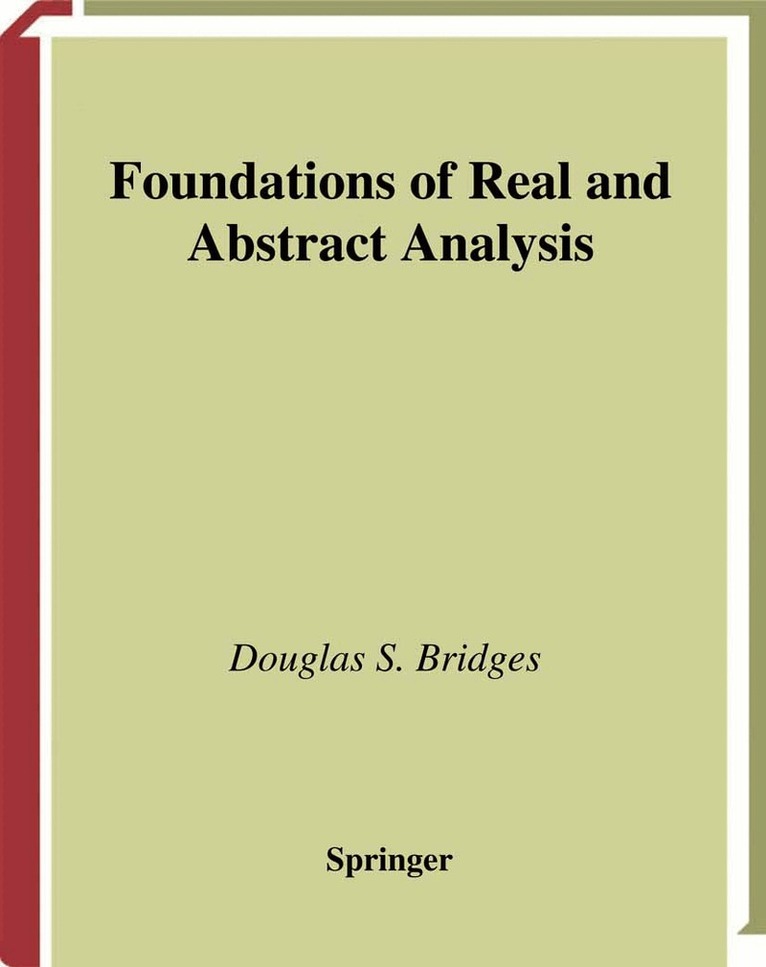
Foundations of Real and Abstract Analysis
Häftad, Engelska, 2013
536 kr
Skickas inom 10-15 vardagar
The core of this book, Chapters three through five, presents a course on metric, normed, and Hilbert spaces at the senior/graduate level. The motivation for each of these chapters is the generalisation of a particular attribute of the n Euclidean space R: in Chapter 3, that attribute is distance; in Chapter 4, length; and in Chapter 5, inner product. In addition to the standard topics that, arguably, should form part of the armoury of any graduate student in mathematics, physics, mathematical economics, theoretical statistics,. . . , this part of the book contains many results and exercises that are seldom found in texts on analysis at this level. Examples of the latter are Wong’s Theorem (3.3.12) showing that the Lebesgue covering property is equivalent to the uniform continuity property, and Motzkin’s result (5. 2. 2) that a nonempty closed subset of Euclidean space has the unique closest point property if and only if it is convex. The sad reality today is that, perceiving them as one of the harder parts of their mathematical studies, students contrive to avoid analysis courses at almost any cost, in particular that of their own educational and technical deprivation. Many universities have at times capitulated to the negative demand of students for analysis courses and have seriously watered down their expectations of students in that area. As a result, mathematics majors are graduating, sometimes with high honours, with little exposure to anything but a rudimentary course or two on real and complex analysis, often without even an introduction to the Lebesgue integral.
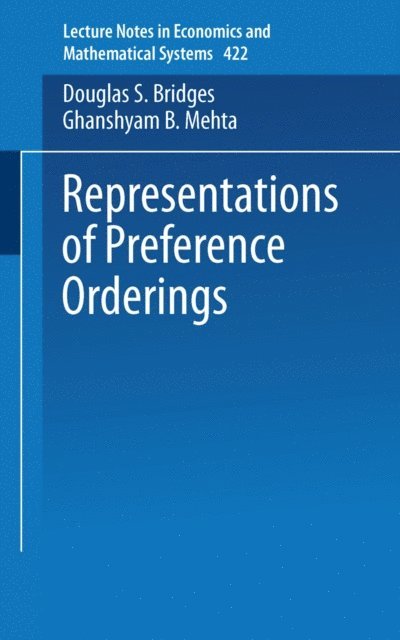
Del 422 - Lecture Notes in Economics and Mathematical Systems
Representations of Preferences Orderings
Häftad, Engelska, 1995
1 064 kr
Skickas inom 10-15 vardagar
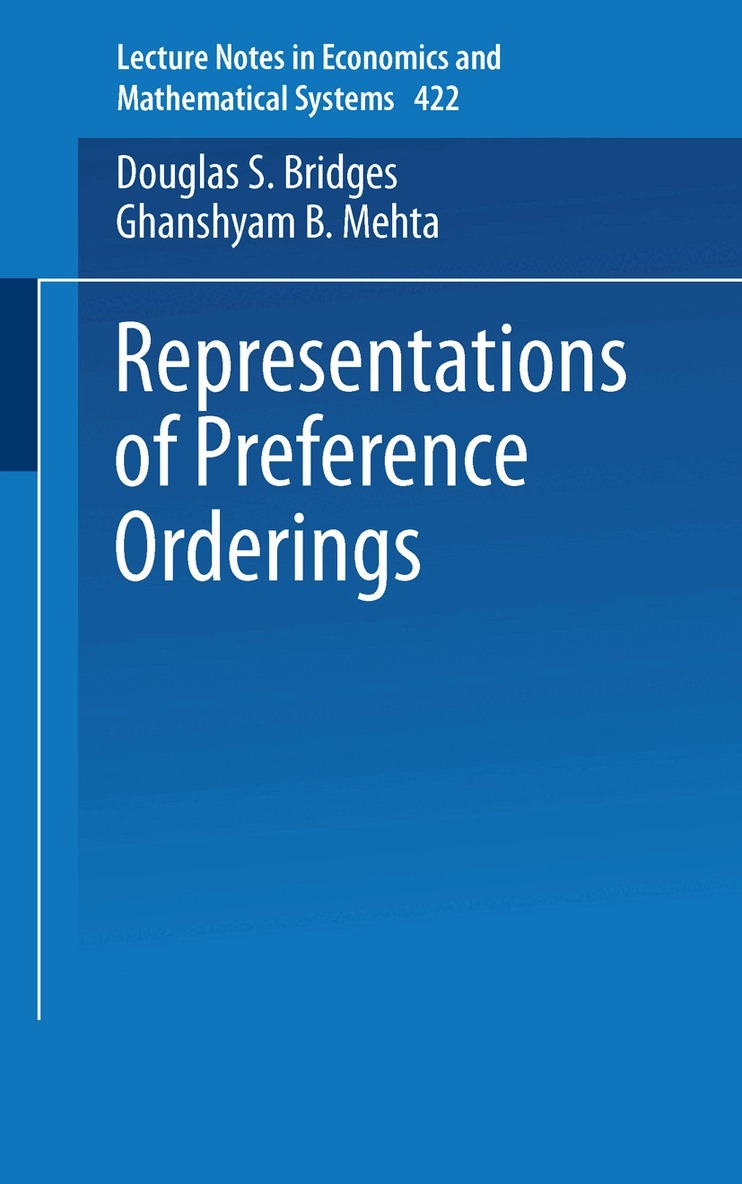
A basic assumption made by pioneers of classical microeconomics such as Edgeworth and Pareto was that the ranking of a consumer's preferences could always be measured numerically, by associating to each possible con- sumption bundle a real number that measured its utility: the greater the utility, the more preferred was the bundle, and conversely. It took several decades before the naivety of this assumption was seriously challenged by economists, such as Wold, attempting to find conditions under which it could be justified mathematically. Wold's work was the first in a long chain of results of that type, leading to the definitive theorems of Debreu and oth- ers in the 1960s, and subsequently to the refinements and generalisations that have appeared in the last twenty-five years. Out of this historical background there has appeared a general mathe- matical problem which, as well as having applications in economics, psy- chology, and measurement theory, arises naturally in the study of sets bear- ing order relations: Given some kind of ordenng t on a set 5, fina a real-valued mapping u on 5 such that for any elements x, y of 5, x t yif and only if u(x) 2: u(y).If also 5 has a topology (respective/y, differential structure), find conditions that ensure the continuity (respectively, differentiability) of the mapping u. A mapping *u of this kind is called a representation of the ordering C:::.
1 064 kr
Skickas inom 10-15 vardagar
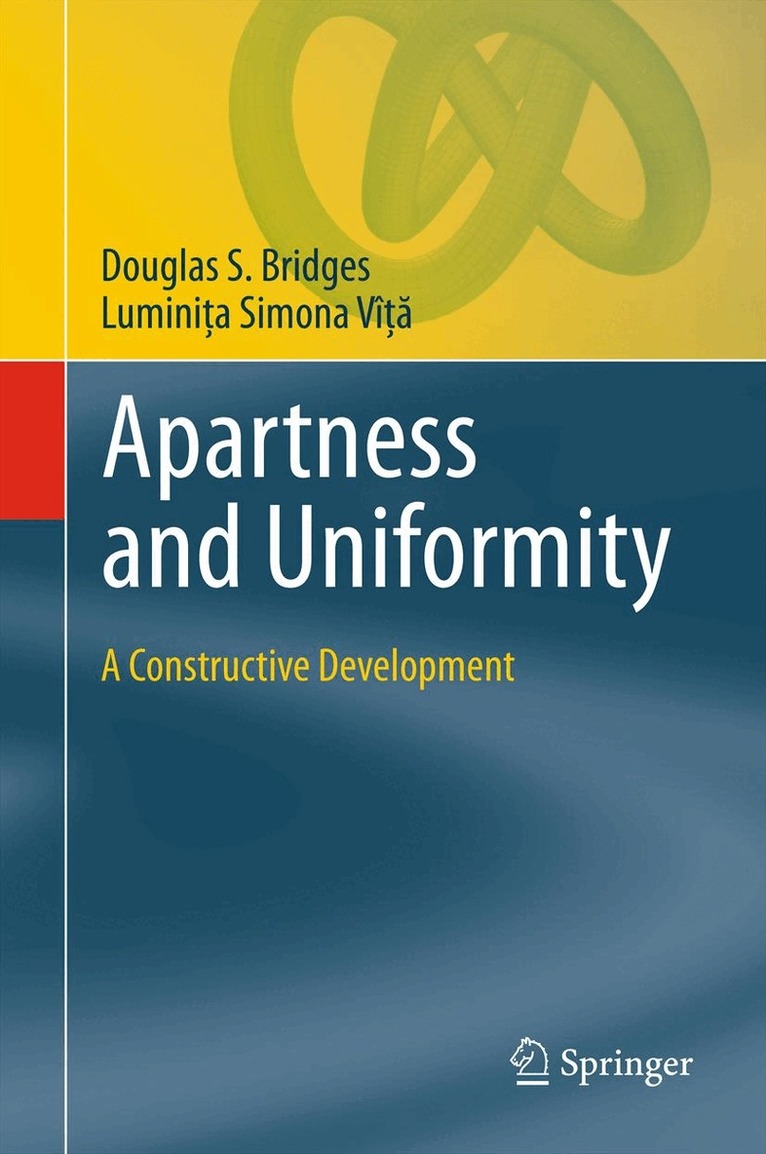
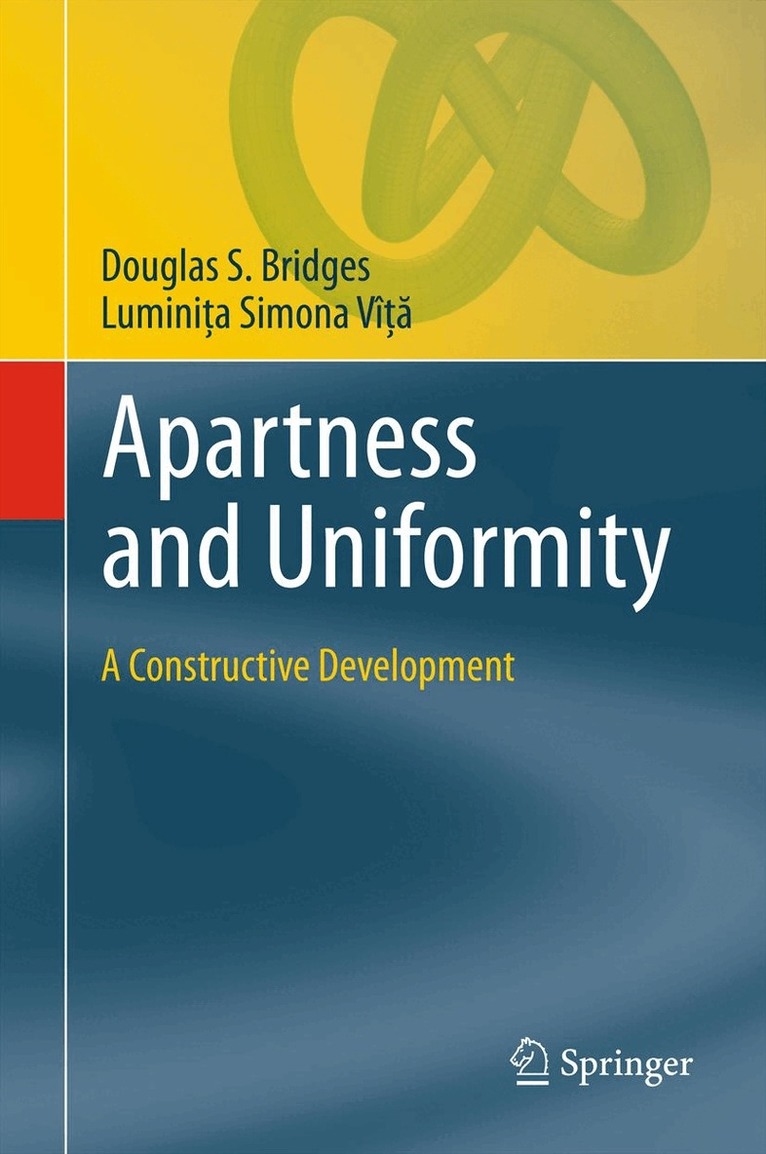
The theory presented in this book is developed constructively, is based on a few axioms encapsulating the notion of objects (points and sets) being apart, and encompasses both point-set topology and the theory of uniform spaces. While the classical-logic-based theory of proximity spaces provides some guidance for the theory of apartness, the notion of nearness/proximity does not embody enough algorithmic information for a deep constructive development. The use of constructive (intuitionistic) logic in this book requires much more technical ingenuity than one finds in classical proximity theory -- algorithmic information does not come cheaply -- but it often reveals distinctions that are rendered invisible by classical logic.In the first chapter the authors outline informal constructive logic and set theory, and, briefly, the basic notions and notations for metric and topological spaces. In the second they introduce axioms for a point-set apartness and then explore some of the consequences of those axioms. In particular, they examine a natural topology associated with an apartness space, and relations between various types of continuity of mappings. In the third chapter the authors extend the notion of point-set (pre-)apartness axiomatically to one of (pre-)apartness between subsets of an inhabited set. They then provide axioms for a quasiuniform space, perhaps the most important type of set-set apartness space. Quasiuniform spaces play a major role in the remainder of the chapter, which covers such topics as the connection between uniform and strong continuity (arguably the most technically difficult part of the book), apartness and convergence in function spaces, types of completeness, and neat compactness. Each chapter has a Notes section, in which are found comments on the definitions, results, and proofs, as well as occasional pointers to future work. The book ends with a Postlude that refers to other constructive approaches to topology, with emphasis on the relation between apartness spaces and formal topology.Largely an exposition of the authors' own research, this is the first book dealing with the apartness approach to constructive topology, and is a valuable addition to the literature on constructive mathematics and on topology in computer science. It is aimed at graduate students and advanced researchers in theoretical computer science, mathematics, and logic who are interested in constructive/algorithmic aspects of topology.
1 064 kr
Skickas inom 10-15 vardagar
The theory presented in this book is developed constructively, is based on a few axioms encapsulating the notion of objects (points and sets) being apart, and encompasses both point-set topology and the theory of uniform spaces. While the classical-logic-based theory of proximity spaces provides some guidance for the theory of apartness, the notion of nearness/proximity does not embody enough algorithmic information for a deep constructive development. The use of constructive (intuitionistic) logic in this book requires much more technical ingenuity than one finds in classical proximity theory -- algorithmic information does not come cheaply -- but it often reveals distinctions that are rendered invisible by classical logic.In the first chapter the authors outline informal constructive logic and set theory, and, briefly, the basic notions and notations for metric and topological spaces. In the second they introduce axioms for a point-set apartness and then explore some of the consequences of those axioms. In particular, they examine a natural topology associated with an apartness space, and relations between various types of continuity of mappings. In the third chapter the authors extend the notion of point-set (pre-)apartness axiomatically to one of (pre-)apartness between subsets of an inhabited set. They then provide axioms for a quasiuniform space, perhaps the most important type of set-set apartness space. Quasiuniform spaces play a major role in the remainder of the chapter, which covers such topics as the connection between uniform and strong continuity (arguably the most technically difficult part of the book), apartness and convergence in function spaces, types of completeness, and neat compactness. Each chapter has a Notes section, in which are found comments on the definitions, results, and proofs, as well as occasional pointers to future work. The book ends with a Postlude that refers to other constructive approaches to topology, with emphasis on the relation between apartness spaces and formal topology.Largely an exposition of the authors' own research, this is the first book dealing with the apartness approach to constructive topology, and is a valuable addition to the literature on constructive mathematics and on topology in computer science. It is aimed at graduate students and advanced researchers in theoretical computer science, mathematics, and logic who are interested in constructive/algorithmic aspects of topology.