• Fri frakt över 249 kr
  • •
  • Snabba leveranser
  • •
  • Billiga böcker
Kundservice

Du är på sajten för privatpersoner.

Företag, bibliotek eller offentlig verksamhet?

Du handlar på classic.bokus.com, där alla dina funktioner finns intakta.
Till classic.bokus.com
Bokus logotyp. Gå till startsidan.
  • Erbjudanden
  • Nyheter
  • Student
  • Topplistor
  • Barn & ungdom
  • Bokus Play
  • E-böcker
  • Pocketböcker
  • Spel & pussel

10% rabatt på allt med kod: NYSTART10 →

Sidfot

Mina sidor

    Hjälp

    • Kundservice
    • Vanliga frågor och svar
    • Frakt och leverans
    • Retur vid ångerrätt
    • Reklamera vara
    • Betalning
    • Köpvillkor
    • Allmänna villkor
    • Information om webbplatsens tillgänglighet

    Om Bokus

    • Om oss
    • Pressrum
    • För studenter
    • För företag
    • För bibliotek och offentlig verksamhet
    • För leverantörer
    • Hållbarhet

    Populärt

    • Aktuella erbjudanden
    • Presentkort
    • Studentlitteratur
    • Nya böcker
    • Topplistor
    • Signerade böcker
    • Engelska böcker

    Inspiration

    • Boktips
    • BookTok
    • Populära bokserier
    • Barnbokskaraktärer
    • Populära författare
    Logotyp för Bokus
    Följ oss på Facebook (extern länk)Följ oss på Instagram (extern länk)Följ oss på YouTube (extern länk)Följ oss på TikTok (extern länk)
    bokus @ CookiesAnpassa cookiesIntegritetspolicyKöpvillkor
    Till Citymail hemsida (extern länk)Till Budbee hemsida (extern länk)Till Postnord hemsida (extern länk)Till Schenker hemsida (extern länk)Till Early Bird hemsida (extern länk)Till Walleys hemsida (extern länk)
    1. Ekonomi och Ledarskap
    2. Nationalekonomi

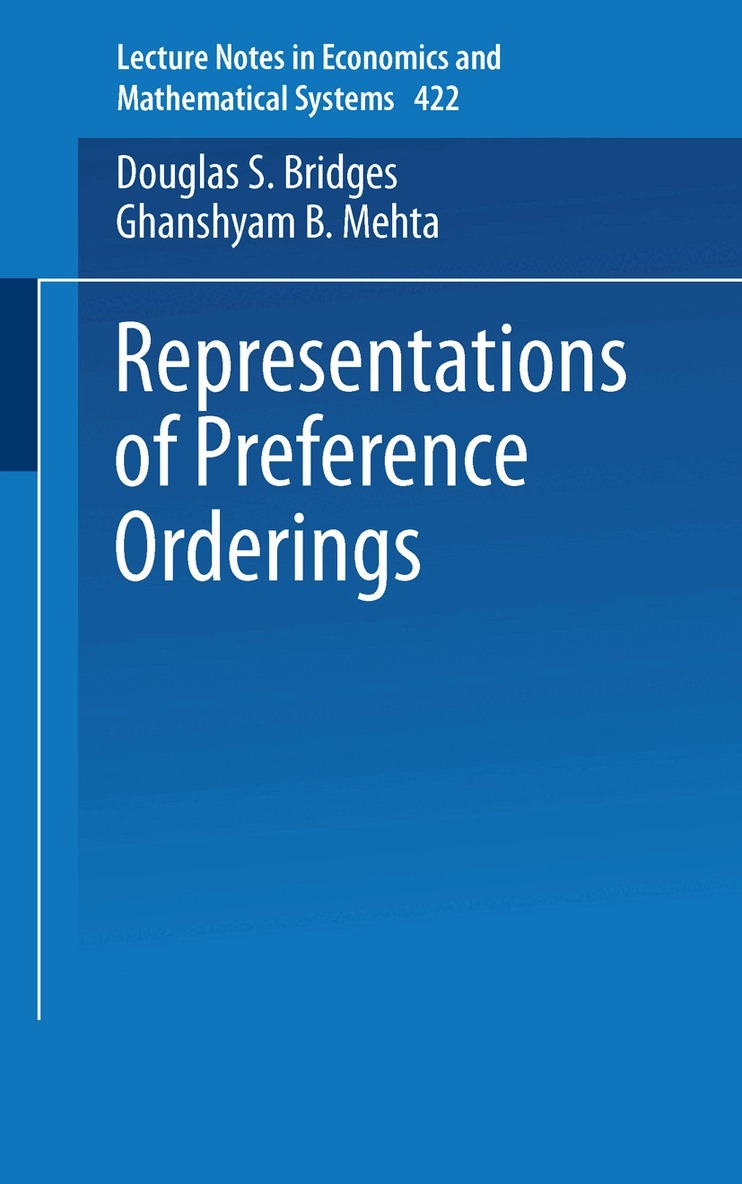
    Representations of Preferences Orderings

    AvDouglas S. Bridges,Ghanshyam B. Mehta

    Häftad, Engelska, 1995

    Del 422 i serien Lecture Notes in Economics and Mathematical Systems

    1 086 kr

    Beställningsvara. Skickas inom 10-15 vardagar. Fri frakt över 249 kr.

    Beskrivning

    A basic assumption made by pioneers of classical microeconomics such as Edgeworth and Pareto was that the ranking of a consumer's preferences could always be measured numerically, by associating to each possible con- sumption bundle a real number that measured its utility: the greater the utility, the more preferred was the bundle, and conversely. It took several decades before the naivety of this assumption was seriously challenged by economists, such as Wold, attempting to find conditions under which it could be justified mathematically. Wold's work was the first in a long chain of results of that type, leading to the definitive theorems of Debreu and oth- ers in the 1960s, and subsequently to the refinements and generalisations that have appeared in the last twenty-five years. Out of this historical background there has appeared a general mathe- matical problem which, as well as having applications in economics, psy- chology, and measurement theory, arises naturally in the study of sets bear- ing order relations: Given some kind of ordenng t on a set 5, fina a real-valued mapping u on 5 such that for any elements x, y of 5, x t yif and only if u(x) 2: u(y).If also 5 has a topology (respective/y, differential structure), find conditions that ensure the continuity (respectively, differentiability) of the mapping u. A mapping *u of this kind is called a representation of the ordering C:::.

    Produktinformation

    • Utgivningsdatum:1995-04-06
    • Mått:127 x 203 x 10 mm
    • Vikt:196 g
    • Format:Häftad
    • Språk:Engelska
    • Serie:Lecture Notes in Economics and Mathematical Systems
    • Antal sidor:165
    • Upplaga:1995
    • Förlag:Springer-Verlag Berlin and Heidelberg GmbH & Co. KG
    • ISBN:9783540588399

    Utforska kategorier

    • Nationalekonomi inom Ekonomi och Ledarskap
    • Tillämpad matematik inom Naturvetenskap och teknik
    • Företagsekonomi inom Ekonomi och Ledarskap

    Innehållsförteckning

    • 1 Ordered Sets and Order Homomorphisms.- 2 Order Homomorphisms in Euclidean Space.- 3 The Fundamental Theorems.- 4 A Miscellany of Representations.- 5 The Urysohn-Nachbin Approach.- 6 Interval Orders.- 7 Differentiable Order Homomorphisms.- 8 Jointly Continuous Order Homomorphisms.- References.