Duncan Richter - Böcker
Visar alla böcker från författaren Duncan Richter. Handla med fri frakt och snabb leverans.
6 produkter
6 produkter
1 276 kr
Skickas inom 10-15 vardagar
G.E.M. Anscombe (1919-2001) was one of the most important, outspoken, and misunderstood philosophers of the twentieth century. More than anyone else she revived virtue ethics and the philosophy of action. She was also almost alone in publicly opposing Oxford University's decision to award an honorary degree to President Truman. She regarded his decision to authorize bombing Hiroshima and Nagasaki as murderous. Some liberals admire her for this stand, but conservatives also admire her for her opposition to abortion, contraception, and same-sex marriage. Clearly her values were not those of her times. This led her to reflect on the differences, producing such works as Modern Moral Philosophy, in which she rejected all modern theories of ethics. In this paper she coins the term "consequentialism" to describe the dominant view, which she rejects, that what matters morally is the results of what one does. Put crudely, the ends can justify the means. If enough lives can be saved by targeting civilians, then civilians should be targeted. Against this, Anscombe insisted that certain actions are forbidden, which prompted her interest in the nature of action and its relation to a person's character. Whether one agrees with her or not, these are all issues that continue to be relevant and on which Anscombe's views are always strong and intelligently defended. Her presentation of these views, unfortunately, is often dense, and they are often badly misunderstood even by some very able minds. Anscombe's Moral Philosophy clarifies what Anscombe thought about ethics, showing how her different ideas connect and how she supported them. It also evaluates her reasoning, showing that it is stronger in some parts than in others. The five main chapters of the book deal in turn with her work on military ethics (including the so-called doctrine of double effect), her rejection of consequentialism, her attack on the modern, atheist notion of moral obligation, her analysis of intention and its relevance for ethics, an
608 kr
Skickas inom 10-15 vardagar
G.E.M. Anscombe (1919-2001) was one of the most important, outspoken, and misunderstood philosophers of the twentieth century. More than anyone else she revived virtue ethics and the philosophy of action. She was also almost alone in publicly opposing Oxford University's decision to award an honorary degree to President Truman. She regarded his decision to authorize bombing Hiroshima and Nagasaki as murderous. Some liberals admire her for this stand, but conservatives also admire her for her opposition to abortion, contraception, and same-sex marriage. Clearly her values were not those of her times. This led her to reflect on the differences, producing such works as Modern Moral Philosophy, in which she rejected all modern theories of ethics. In this paper she coins the term "consequentialism" to describe the dominant view, which she rejects, that what matters morally is the results of what one does. Put crudely, the ends can justify the means. If enough lives can be saved by targeting civilians, then civilians should be targeted. Against this, Anscombe insisted that certain actions are forbidden, which prompted her interest in the nature of action and its relation to a person's character. Whether one agrees with her or not, these are all issues that continue to be relevant and on which Anscombe's views are always strong and intelligently defended. Her presentation of these views, unfortunately, is often dense, and they are often badly misunderstood even by some very able minds. Anscombe's Moral Philosophy clarifies what Anscombe thought about ethics, showing how her different ideas connect and how she supported them. It also evaluates her reasoning, showing that it is stronger in some parts than in others. The five main chapters of the book deal in turn with her work on military ethics (including the so-called doctrine of double effect), her rejection of consequentialism, her attack on the modern, atheist notion of moral obligation, her analysis of intention and its relevance for ethics, an
675 kr
Skickas inom 10-15 vardagar
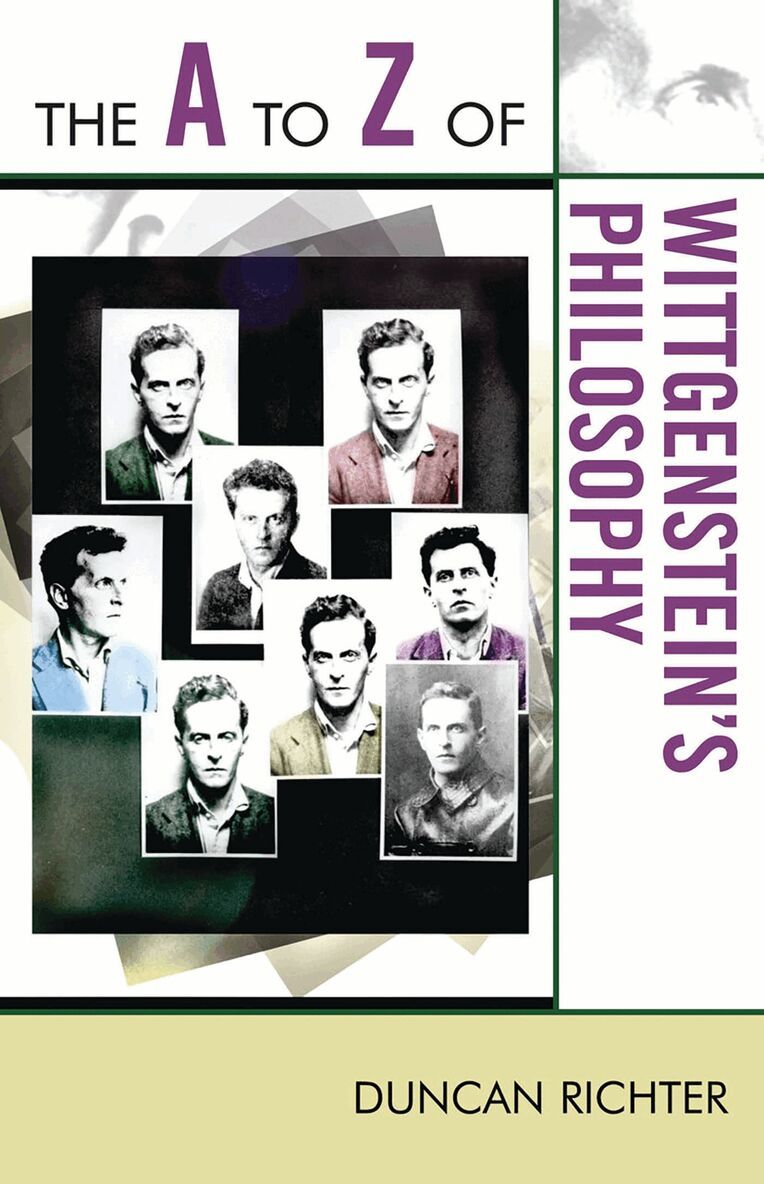
Ludwig Wittgenstein (1889-1951) was undoubtedly one of the most important philosophers of the 20th century, and perhaps of any century. He was also a fascinating, charismatic, and irritating man. His philosophical ability was recognized almost immediately by Bertrand Russell, and during his lifetime his work influenced first logical positivism and then ordinary language philosophy. Since then it has also become central in post-analytical philosophical thought. Beyond the world of academic philosophy it has inspired playwrights, poets, novelists, architects, filmmakers, and biographers. The A to Z of Wittgenstein's Philosophy is intended for anyone who wants to know more about the philosophy and the life of this enigmatic thinker. The book contains an introductory overview of his life and work, a timeline of the major relevant events in and after his life, an extensive bibliography, and, above all, an A-Z of ideas, people, and places that have been involved in his philosophy and its reception. The dictionary is written with no particular agenda and includes entries on philosophers (and others) who influenced Wittgenstein, those he influenced in turn, and some of the main figures in contemporary Wittgenstein scholarship. Suggestions for further reading are also included, as well as a guide to the literature on Wittgenstein and a bibliography broken down by subject area.
2 355 kr
Skickas inom 10-15 vardagar
Wittgenstein's work is notoriously difficult to understand and, at least superficially, deals almost exclusively with obscure and technical problems in logic and the philosophy of language. He has been blamed for leading philosophers away from the problems of the real world. Wittgenstein, however, was certainly a man of the real world. He once asked rhetorically: 'What is the use of philosophy...if it does not improve your thinking about the important questions of everyday life?' From this and other remarks it is clear that his philosophical work was meant to have real, practical value. Wittgenstein at his Word explains how Wittgenstein's idea of the value of philosophy shaped his philosophical method and led him to talk and write about the abstruse questions he dealt with in most of his work. Unlike many books, it examines not only the Tractatus and Philosophical Investigations, but also Wittgenstein's work on epistemology, ethics, and religion: Showing for the first time the real connections between Wittgenstein the man and Wittgenstein the philosopher, Richter's book will change the way in which he is read in the twenty-first century.
1 703 kr
Skickas inom 10-15 vardagar
Ludwig Wittgenstein was the most influential, and arguably the greatest, philosopher of the 20th century. This fact about his influence is not only a matter of how much he influenced people but also of how many people he influenced. His early work was taken up by some of the pioneers of analytical philosophy. His later work helped spawn another movement within analytic philosophy, that of ordinary language philosophy (sometimes called Oxford philosophy). He is also considered by some to be a key postmodern thinker, and an interest in his work is a distinguishing feature of many post-analytical philosophers who seek to bridge the gap between analytical and so-called continental philosophy.This second edition of Historical Dictionary of Wittgenstein's Philosophy covers the history of this philosophy through a chronology, an introductory essay, and an extensive bibliography. The dictionary section has over 300 cross-referenced entries on every aspect of his work. This book is an excellent access point for students, researchers, and anyone wanting to know more about Wittgenstein’s philosophy.
1 142 kr
Skickas inom 10-15 vardagar
Ludwig Wittgenstein (1889–1951) and Elizabeth Anscombe (1919–2001) are two of the most interesting and influential philosophers of the twentieth century, and their lives intersected in various ways. Anscombe was Wittgenstein’s friend and student, chosen by him to be his translator and editor, but the two had very different views on ethics and religion. Anscombe was a devout Catholic, while Wittgenstein was much less traditional. Each cared passionately about living the right way, and each was noted for their eccentricity. Why did they live as they did? What did they have to say about how one ought to live? And what, if anything, can we learn from them? This book explores their different beliefs about killing in war, about sexuality, about politics, about God, and about the meaning of life. Drawing on previously unpublished work by Anscombe, Duncan Richter explains where these beliefs came from, how they affected the lives of these two great philosophers, and some of the strengths and weaknesses of their divergent positions. If we understand these two thinkers better, we may improve our own chances of living a good life.