Dylan Dodd - Böcker
Visar alla böcker från författaren Dylan Dodd. Handla med fri frakt och snabb leverans.
2 produkter
2 produkter
1 539 kr
Skickas inom 5-8 vardagar
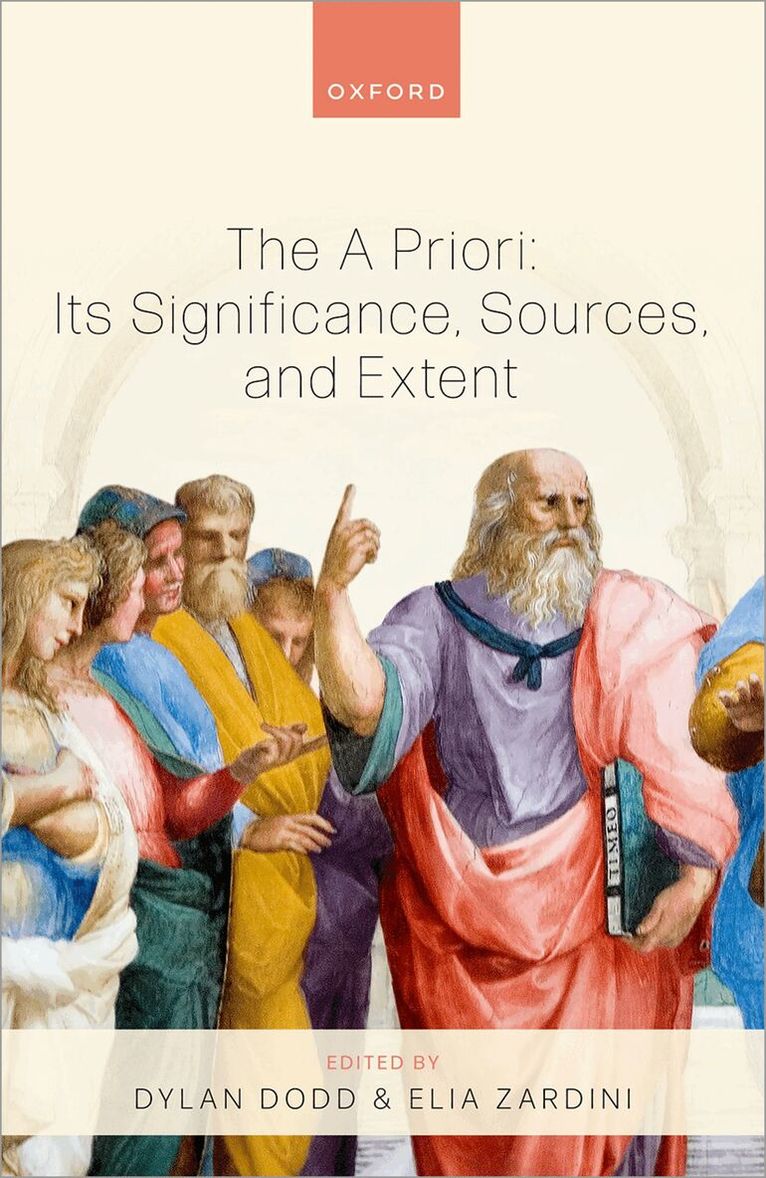
Traditionally, a justification for believing something is a priori is if, and only if, it is independent of experience. Throughout Western philosophy since Plato, some of the most divisive questions have been whether a priori justification exists, how it is possible, and how far it reaches. This book is structured around these three main questions. The first question has recently been modulated as to concern the significance of a priori justification: given the unclarities and presuppositions attached to standard explications of the notion of a priori justification, is it still a useful notion for epistemology? In a tight dialectic, the chapters in this part either attack or defend the theoretical importance of that notion. The second part concerns the sources of a priori justification: since a priori justification is not grounded in experience--our arguably best understood source of justification--in what can it be grounded? The chapters in this part explore the possibility that a priori justification is grounded either in intuition or in understanding. The third part concerns the extent of a priori justification: beyond core cases like mathematical proof, what methods can yield a priori justification? The chapters in this part investigate to what degree and why methods like introspection, testimony, and others have an import on a priori justification. Overall, the book showcases and furthers some of the latest contemporary trends in thinking about these questions.
1 705 kr
Skickas inom 5-8 vardagar
One of the hardest problems in the history of Western philosophy has been to explain whether and how experience can provide knowledge (or even justification for belief) about the objective world outside the experiencer's mind. A prominent brand of scepticism has precisely denied that experience can provide such knowledge. How, for instance (these sceptics ask) can I know that my experiences are not produced in me by a powerful demon (or, in a modern twist on that traditional Cartesian scenario, by a supercomputer)? This volume, originating from the research project on Basic Knowledge recently concluded at the Northern Institute of Philosophy, presents new essays on scepticism about the senses written by some of the most prominent contemporary epistemologists. They approach the sceptical challenge by discussing such topics as the conditions for perceptual justification, the existence of a non-evidential kind of warrant and the extent of one's evidence, the epistemology of inference, the relations between justification, probability and certainty, the relevance of subjective appearances to the epistemology of perception, the role that broadly pragmatic considerations play in epistemic justification, the contents of perception, and the function of attention. In all these cases, the papers show how philosophical progress on foundational issues can improve our understanding of and possibly afford a solution to a historically prominent problem like scepticism.