E. Zwicker – författare
Visar alla böcker från författaren E. Zwicker. Handla med fri frakt och snabb leverans.
7 produkter
7 produkter
Häftad, Tyska, 1982
615 kr
Skickas inom 10-15 vardagar
E-bok
PDF, Engelska, 20131 328 kr
Läs direkt efter köp
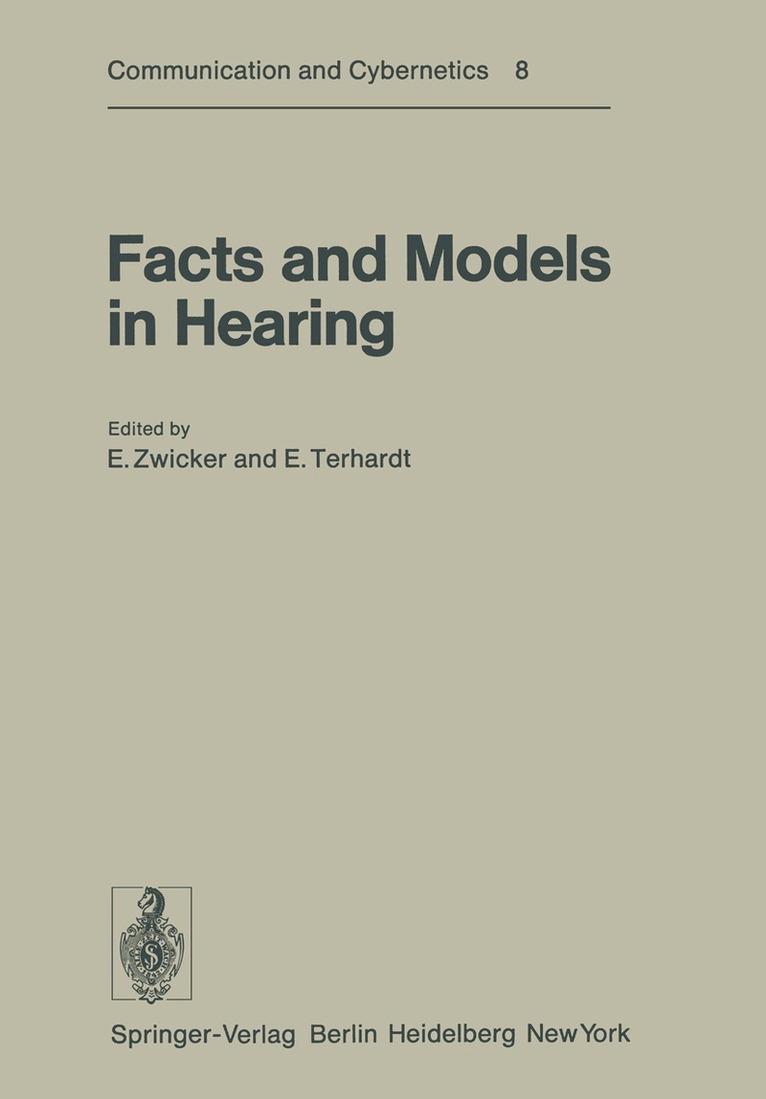
During recent years auditory research has advanced quite rapidly in the area of experimental psychology as well as in that of physiology. Scientists working in both areas have in cornrnon the study of the process in HEARING, yet different scientific areas always tend to diverge. A SYMPOSIUM ON PSY CHOPHYSICAL MODELS AND PHYSIOLOGICAL FACTS IN HEARING was or ganized for the exchange of information and to stimulate dis cussion between research workers in psychoacoustics, neurophy siology, anatomy, morphology and hydromechanics. The basic aim of holding this syrnposium was to halt the divergence and to initiate the kind of multi-disciplinary research that will be need ed to elucidate the hearing process as a whole. The present proceedings comprise the papers, which were circulated to the participants two months before the syrnposium and discussed during the syrnposium, together with some cornrnents and additional re marks. These cornrnents and rernarks do not, however, represent the full discussions but only the parts available in written form. We have arranged the material in five sections: I. Structure and Neurobiology of the Inner Ear II. Cochlear Mechanisms III. Auditory Frequency Analysis IV. Auditory Time Analysis V. Nonlinear Effects Within the limits of a syrnposium, none of these topics could be treated comprehensively; moreover, most of the papers concerned problems having several aspects.
Häftad, Engelska, 2011
1 061 kr
Skickas inom 10-15 vardagar
During recent years auditory research has advanced quite rapidly in the area of experimental psychology as well as in that of physiology. Scientists working in both areas have in cornrnon the study of the process in HEARING, yet different scientific areas always tend to diverge. A SYMPOSIUM ON PSY CHOPHYSICAL MODELS AND PHYSIOLOGICAL FACTS IN HEARING was or ganized for the exchange of information and to stimulate dis cussion between research workers in psychoacoustics, neurophy siology, anatomy, morphology and hydromechanics. The basic aim of holding this syrnposium was to halt the divergence and to initiate the kind of multi-disciplinary research that will be need ed to elucidate the hearing process as a whole. The present proceedings comprise the papers, which were circulated to the participants two months before the syrnposium and discussed during the syrnposium, together with some cornrnents and additional re marks. These cornrnents and rernarks do not, however, represent the full discussions but only the parts available in written form. We have arranged the material in five sections: I. Structure and Neurobiology of the Inner Ear II. Cochlear Mechanisms III. Auditory Frequency Analysis IV. Auditory Time Analysis V. Nonlinear Effects Within the limits of a syrnposium, none of these topics could be treated comprehensively; moreover, most of the papers concerned problems having several aspects.
E-bok
PDF, Engelska, 20121 408 kr
Läs direkt efter köp
nerve; subsequently, however, they concluded that the recordings had been from aberrant cells of the cochlear nucleus lying central to the glial margin of the VIII nerve (GALAMBOS and DAVIS, 1948). The first successful recordmgs from fibres of the cochlear nerve were made by TASAKI (1954) in the guinea pig. These classical but necessarily limited results were greatly extended by ROSE, GALAMBOS, and HUGHES (1959) in the cat cochlear nucleus and by KATSUKI and co-workers (KATSUKI et at. , 1958, 1961, 1962) in the cat and monkey cochlear nerve. Perhaps the most significant developments have been the introduction of techniques for precise control of the acoustic stimulus and the quantitative analysis of neuronal response patterns, notably by the laboratories of KIANG (e. g. GERSTEIN and KIANG, 1960; KIANG et at. , 1962b, 1965a, 1967) and ROSE (e. g. ROSE et at. , 1967; HIND et at. , 1967). These developments have made possible a large number of quanti tative investigations of the behaviour of representative numbers of neurons at these levels of the peripheral auditory system under a wide variety of stimulus conditions. Most of the findings discussed herein have been obtained on anaesthetized cats. Where comparative data are available, substantially similar results have been obtained in other mammalian species (e. g. guinea pig, monkey, rat). Certain significant differences have been noted in lizards, frogs and fish as would be expect ed from the different morphologies of their organs of hearing (e. g.
Häftad, Engelska, 2011
1 124 kr
Skickas inom 10-15 vardagar
nerve; subsequently, however, they concluded that the recordings had been from aberrant cells of the cochlear nucleus lying central to the glial margin of the VIII nerve (GALAMBOS and DAVIS, 1948). The first successful recordmgs from fibres of the cochlear nerve were made by TASAKI (1954) in the guinea pig. These classical but necessarily limited results were greatly extended by ROSE, GALAMBOS, and HUGHES (1959) in the cat cochlear nucleus and by KATSUKI and co-workers (KATSUKI et at. , 1958, 1961, 1962) in the cat and monkey cochlear nerve. Perhaps the most significant developments have been the introduction of techniques for precise control of the acoustic stimulus and the quantitative analysis of neuronal response patterns, notably by the laboratories of KIANG (e. g. GERSTEIN and KIANG, 1960; KIANG et at. , 1962b, 1965a, 1967) and ROSE (e. g. ROSE et at. , 1967; HIND et at. , 1967). These developments have made possible a large number of quanti tative investigations of the behaviour of representative numbers of neurons at these levels of the peripheral auditory system under a wide variety of stimulus conditions. Most of the findings discussed herein have been obtained on anaesthetized cats. Where comparative data are available, substantially similar results have been obtained in other mammalian species (e. g. guinea pig, monkey, rat). Certain significant differences have been noted in lizards, frogs and fish as would be expect ed from the different morphologies of their organs of hearing (e. g.
E-bok
PDF, Tyska, 2013611 kr
Läs direkt efter köp
E-bok
PDF, Tyska, 2013519 kr
Läs direkt efter köp