Eda Goldstein - Böcker
Visar alla böcker från författaren Eda Goldstein. Handla med fri frakt och snabb leverans.
8 produkter
8 produkter
215 kr
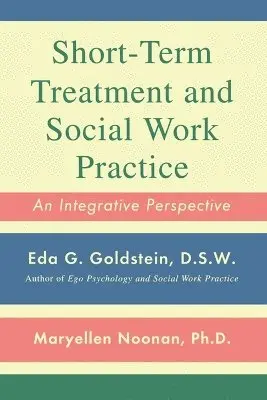
The growing need for time-limited treatment, propelled by the widening influence of managed care in the mental health field, has produced a renewed focus on short-term therapy. But, until now, there has not been an integrated framework designed for the short-term intervention problems and diverse populations that social workers encounter.In Short-Term Treatment and Social Work Practice: An Integrative Perspective, Eda G. Goldstein and Maryellen Noonan take the best of theories that social workers have relied on for decades, including ego psychology, other psychodynamic and psychosocial frameworks, and the cognitive-behavioral approach, to create a new short-term practice model for social workers. Short-Term Treatment and Social Work Practice introduces the authors' integrative short-term treatment (ISTT), and demonstrates in detail each aspect of the approach. Their book is replete with case examples that illustrate ISTT's principles and techniques and their use in a variety of situations -- including crisis intervention, family- and group-oriented therapy, treatment of clients with emotional disorders, and treatment of nonvoluntary and hard-to-reach clients.As the first social work textbook describing an integrated framework for short-term treatment and practice, Short-Term Treatment and Social Work Practice fills a void the mental health field. Offering a comprehensive, practical, in-depth discussion, this book promises to become a vital new resource for students and practitioners alike.
2 712 kr
Skickas inom 3-6 vardagar
Advanced Clinical Social Work Practice traces the development of relational ideas from their origin in object relations and self psychology to their evolution in current relational, intersubjectivity, and attachment theory. Relational treatment emphasizes openness and collaboration between client and therapist, mutual impact, the client's subjectivity, and the therapist's empathy, genuineness, and use of the self in therapeutic interaction. The approach treats the relationship and dialogue between client and therapist as crucial to the change process and shows how the therapeutic relationship can be used to help clients and therapists bridge differences, examine similarities, overcome impasses, and manage enactments. The relational emphasis on the subjective experience of both client and therapist is beautifully illustrated throughout this book as the authors draw from their clinical work with clients from diverse backgrounds, including gay and lesbian clients, immigrants, and clients of color.They demonstrate how relational principles and techniques can be applied to multiple problems in social work practice--for example, life crises and transitions, physical and sexual abuse, mental disorders, drug addiction, and the loss of a loved one. The authors also discuss the integration of relational constructs in short-term treatment and with families and groups. This volume opens with a historical perspective on the role of relational thinking in social work and the evolution of relational theory. It presents an overview of the key concepts in relational theory and its application throughout the treatment process with diverse clients and in different practice modalities. The book concludes with a discussion of the challenges in learning and teaching new theoretical and practice paradigms, particularly in creating a more mutual exchange in the classroom and during supervision.
532 kr
Skickas inom 7-10 vardagar
Advanced Clinical Social Work Practice traces the development of relational ideas from their origin in object relations and self psychology to their evolution in current relational, intersubjectivity, and attachment theory. Relational treatment emphasizes openness and collaboration between client and therapist, mutual impact, the client's subjectivity, and the therapist's empathy, genuineness, and use of the self in therapeutic interaction. The approach treats the relationship and dialogue between client and therapist as crucial to the change process and shows how the therapeutic relationship can be used to help clients and therapists bridge differences, examine similarities, overcome impasses, and manage enactments. The relational emphasis on the subjective experience of both client and therapist is beautifully illustrated throughout this book as the authors draw from their clinical work with clients from diverse backgrounds, including gay and lesbian clients, immigrants, and clients of color.They demonstrate how relational principles and techniques can be applied to multiple problems in social work practice--for example, life crises and transitions, physical and sexual abuse, mental disorders, drug addiction, and the loss of a loved one. The authors also discuss the integration of relational constructs in short-term treatment and with families and groups. This volume opens with a historical perspective on the role of relational thinking in social work and the evolution of relational theory. It presents an overview of the key concepts in relational theory and its application throughout the treatment process with diverse clients and in different practice modalities. The book concludes with a discussion of the challenges in learning and teaching new theoretical and practice paradigms, particularly in creating a more mutual exchange in the classroom and during supervision.
428 kr
Skickas inom 5-8 vardagar
815 kr
Skickas inom 10-15 vardagar
There are common midlife events that account for the special narcissistic vulnerabilities of this period of life, and Eda Goldstein ably reviews these events and the theoretical perspectives commonly brought to bear on them. In When the Bubble Bursts, however, Goldstein's special concern is those individuals who come to midlife with heightened narcissistic vulnerabilities that make the navigation of this stage of life more difficult still. In understanding the latter such patients and devising a treatment approach appropriate to their "self" issues, Goldstein adopts a broadly self-psychological frame of reference. It is a matter, she finds again and again, of understanding how current stressors frustrate healthy self needs and trigger narcissistic vulnerabilities. Self-psychologically informed treatment, which, in Goldstein's pragmatic purview, embraces modalities that are, to varying degrees, supportive, psychodynamic, and psychoanalytic, reworks and strengthens self structures in helping patients find new ways of affirming their sense of self. Her substantive case studies, which accompany the reader through all the chapters in her study, draw on personal and supervisory experiences to illustrate crucial foci of the treatment process with a range of midlife patients in psychotherapy. Eda Goldstein presents a study that comprises an admirable blend of theoretical astuteness, clinical wisdom, and personal honesty. Her clinical study of midlife narcissistic pathology is bracketed by her balanced discussion of theoretical perspectives on adult development and her concluding consideration of the countertransference issues elicited by midlife patients in midlife therapists. When the Bubble Bursts is an edifying contribution to the literatures of psychodynamic psychotherapy, self psychology, and adult development.
Lesbian Identity and Contemporary Psychotherapy
A Framework for Clinical Practice
Inbunden, Engelska, 2003
1 848 kr
Skickas inom 10-15 vardagar
This book describes a treatment approach that is affirmative for lesbians. It illustrates how contemporary psychoanalytic psychotherapy can provide women with the opportunity to validate their personal struggles and journey.
815 kr
Skickas inom 10-15 vardagar
There are common midlife events that account for the special narcissistic vulnerabilities of this period of life, and Eda Goldstein ably reviews these events and the theoretical perspectives commonly brought to bear on them. In When the Bubble Bursts, however, Goldstein's special concern is those individuals who come to midlife with heightened narcissistic vulnerabilities that make the navigation of this stage of life more difficult still. In understanding the latter such patients and devising a treatment approach appropriate to their "self" issues, Goldstein adopts a broadly self-psychological frame of reference. It is a matter, she finds again and again, of understanding how current stressors frustrate healthy self needs and trigger narcissistic vulnerabilities. Self-psychologically informed treatment, which, in Goldstein's pragmatic purview, embraces modalities that are, to varying degrees, supportive, psychodynamic, and psychoanalytic, reworks and strengthens self structures in helping patients find new ways of affirming their sense of self. Her substantive case studies, which accompany the reader through all the chapters in her study, draw on personal and supervisory experiences to illustrate crucial foci of the treatment process with a range of midlife patients in psychotherapy. Eda Goldstein presents a study that comprises an admirable blend of theoretical astuteness, clinical wisdom, and personal honesty. Her clinical study of midlife narcissistic pathology is bracketed by her balanced discussion of theoretical perspectives on adult development and her concluding consideration of the countertransference issues elicited by midlife patients in midlife therapists. When the Bubble Bursts is an edifying contribution to the literatures of psychodynamic psychotherapy, self psychology, and adult development.
Lesbian Identity and Contemporary Psychotherapy
A Framework for Clinical Practice
Häftad, Engelska, 2014
769 kr
Skickas inom 10-15 vardagar
Recent contributions to the psychoanalytic and psychotherapeutic literature have moved beyond traditional views of lesbianism, but they have tended to address lesbian identity from one theoretical vantage point or another. Rarely have new ideas been linked to the process issues that arise in actual clinical situations. Lesbian Identity and Contemporary Psychotherapy undertakes this very task, and, in so doing, documents the therapeutic gains that result from validating lesbian sexual identity and life experience. Drawing on contemporary relational thinking and new perspectives on gender and sexuality, Goldstein and Horowitz describe and illustrate an affirmative approach to clinical work with lesbians at various stages of the life cycle. Adolescent, young adult, and family issues are all brought within their compass. Making ample use of case vignettes, they demonstrate the ways in which therapists can elicit their patients' personal narratives of self-acceptance as lesbians and coming out experiences; work with the transference and countertransference dynamics subsequent to such disclosures; and finally explore the collaborative process through which therapist and patient seek to understand their therapeutic interaction. A range of life circumstances are brought within the authors' refreshingly "hands-on" clinical approach. Special consideration is given to issues arising when lesbians date and initiate romantic relationships and to the relationship problems that develop in ongoing partnerships during the middle and later years. The book concludes by discussing the issues faced by lesbian therapists in treating lesbian patients and in interacting with heterosexual colleagues. An exemplary overview of newer views of lesbian identity and of the challenges of lesbian life, Lesbian Identity and Contemporary Psychotherapy is equally valuable as an up to date, relationally informed guide to clinical work with lesbian patients.