Edward F. Mooney - Böcker
Visar alla böcker från författaren Edward F. Mooney. Handla med fri frakt och snabb leverans.
9 produkter
9 produkter
128 kr
Skickas
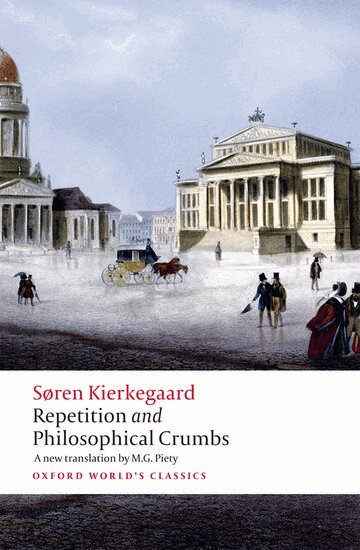
'The love of repetition is in truth the only happy love'So says Constantine Constantius on the first page of Kierkegaard's Repetition. Life itself, according to Kierkegaard's pseudonymous narrator, is a repetition, and in the course of this witty, playful work Constantius explores the nature of love and happiness, the passing of time and the importance of moving forward (and backward). The ironically entitled Philosophical Crumbs pursues the investigation of faith and love and their tense relationship with reason.Written only a year apart, these two works complement each other and give the reader a unique insight into the breadth and substance of Kierkegaard's thought. The first reads like a novel and the second like a Platonic dialogue, but both engage, in different ways, the same challenging issues. These are the first translations to convey the literary quality and philosophical precision of the originals. They were not intended, however, for philosophers, but for anyone who feels drawn to the question of the ultimate truth of human existence and the source of human happiness. ABOUT THE SERIES: For over 100 years Oxford World's Classics has made available the widest range of literature from around the globe. Each affordable volume reflects Oxford's commitment to scholarship, providing the most accurate text plus a wealth of other valuable features, including expert introductions by leading authorities, helpful notes to clarify the text, up-to-date bibliographies for further study, and much more.
313 kr
Skickas inom 10-15 vardagar
Ethics, Love, and Faith in Kierkegaard collects essays from 13 leading scholars that center on key themes that characterize Kierkegaard's philosophy of religion. With their unique focus on notions of the self, views on the command to love one's neighbor, thoughts on melancholy and despair, and the articulation of religious vision, the essays in this volume cover the breadth and depth of Kierkegaard's philosophical and religious writings. Poised at the intersection of Kierkegaard's moral psychology and its religious significance, they offer vivid testimony to the ongoing power of his unique and fervent religious spirit. Students and scholars alike will find new light shed on questions that define Kierkegaard's philosophy and religion today.
670 kr
Skickas inom 10-15 vardagar
Tracing a path through Kierkegaard's writings, this book brings the reader into close contact with the texts and purposes of this remarkable 19th century Danish writer and thinker. Kierkegaard writes in a number of voices and registers: as a sharp observer and critic of Danish culture, or as a moral psychologist, and as a writer concerned to evoke the religious way of life of Socrates, Abraham, or a Christian exemplar. In developing these themes, Mooney sketches Kierkegaard's Socratic vocation, gives a close reading of several central texts, and traces 'The Ethical Sublime' as a recurrent theme. He unfolds an affirmative relationship between philosophy and theology and the potentialities for a religiousness that defies dogmatic creeds, secular chauvinisms, and restrictive philosophies.
382 kr
Tillfälligt slut
Knights of Faith and Resignation brings out the richness of Kierkegaard's creative invention, the contemporary relevance of his contrasts between resignation and faith, and his probing conceptual analysis of aesthetic, moral, and religious psychology and life-perspectives. And in tracing Kierkegaard's analysis of objectivity, subjectivity, virtue ethics, passion, dilemmas, commitment, and self-reflection, Mooney brings out a striking convergence between Kierkegaard and analytic philosophy — the tradition of Socrates, Kant, and Wittgenstein, and its more contemporary practitioners, writers like Charles Taylor, Thomas Nagel, Stanley Cavell, Bernard Williams, and Harry Frankfurt.
1 703 kr
Skickas inom 10-15 vardagar
Noted Kierkegaard scholar Edward Mooney guides the reader through the major themes of the Danish philosopher's life and thought. Each chapter frames a striking issue, usually encapsulated in a short passage from Kierkegaard, and pursues it directly and deeply. Kierkegaard speaks to our need for self-understanding, our need to negotiate the tensions between surprisingly subtle capacities for communication and surprisingly easy descent into clichés and banality. The chapter of this book follow and re-animate Kierkegaard's brilliant and humorous discussions of death and authenticity, of the maternal and paternal in faith and self-transformations, of self-deception and obsessive judgmentalism, of love and the search for stable centers, of subjectivity as refinement of responsiveness to others, the world, and all we can value. These evocative explications aim to match his stride in tracking deep human concerns that evade academic and cultural pigeonholes. Like Hamlet, Kierkegaard gives us a "poem unlimited" that is open to endless reflection. Mooney's aim is to bring his matchless impulse and aspiration once more alive.
Lost Intimacy in American Thought
Recovering Personal Philosophy From Thoreau to Cavell
Inbunden, Engelska, 2009
1 964 kr
Skickas inom 10-15 vardagar
This title offers a critique of rationalism in contemporary American thought by recovering a lost tradition of intimacy in the writings of Thoreau, Bugbee, James, Arendt, Dickinson, Fuller, Wilshire and Cavell. "The Loss of Intimacy in American Thought" focuses on a number of American philosophers whose work overlaps the religious and the literary. Henry David Thoreau, Henry Bugbee, Hannah Arendt, Bruce Wilshire and Stanley Cavell are included, as well as Henry James, whose novels are treated as presenting an implicit moral philosophy. The chapters are linked by a concern for lost intimacy with the natural world and others. The early Marx would see this as the alienations in industrial societies of persons from nature, from the processes of work, from each other, and from themselves. Weber might call it the disenchantment of the world. In any case, it is a condition that forms a focus of concern for Thoreau, Bugbee, Arendt, Cavell and Wilshire as well as writers such Henry James, Dickinson and Margaret Fuller.These writers hold out a hope for closing the gaps that sustain alienations of multiple sorts and Mooney brings them into critical discourse with the secularised and constricted rationalism of contemporary analytic philosophy. The latter exalts 'objectivity' and encourages the approach that one should adopt a third person view on everything, dividing the world into rigid binary oppositions: self/other; mind/matter; human/animal; religious/secular; fact/value; rational/irrational; and, enlightened/indigenous. By contrast, each of the thinkers that Mooney discusses see writing as a way of saving the object of attention from neglect or misplaced appropriation, outright attack, or occlusion. His aim is to recognise the importance of non-argumentative forms of address in these American thinkers. The method he employs is analysis of particular texts and passages that exhibit a generous, often poetic or lyrical discernment of worth in the world. It is not meant to be an exhaustive treatment of any one thinker or theme, but a set of case studies, as it were, or a set of particular explorations, each self-sufficient yet resonating with its companion pieces.Mooney's objective is to spark interest in those who are ready to recover Thoreau and Emerson and Bugbee for the sort of American tradition that Cavell has sought to discover and rejuvenate; the tradition, as Mooney puts it, of 'American Intimates'.
488 kr
Skickas inom 10-15 vardagar
Noted Kierkegaard scholar Edward Mooney guides the reader through the major themes of the Danish philosopher's life and thought. Each chapter frames a striking issue, usually encapsulated in a short passage from Kierkegaard, and pursues it directly and deeply. Kierkegaard speaks to our need for self-understanding, our need to negotiate the tensions between surprisingly subtle capacities for communication and surprisingly easy descent into clichés and banality. The chapter of this book follow and re-animate Kierkegaard's brilliant and humorous discussions of death and authenticity, of the maternal and paternal in faith and self-transformations, of self-deception and obsessive judgmentalism, of love and the search for stable centers, of subjectivity as refinement of responsiveness to others, the world, and all we can value. These evocative explications aim to match his stride in tracking deep human concerns that evade academic and cultural pigeonholes. Like Hamlet, Kierkegaard gives us a "poem unlimited" that is open to endless reflection. Mooney's aim is to bring his matchless impulse and aspiration once more to life.
764 kr
Skickas inom 3-6 vardagar
2 258 kr
Skickas inom 10-15 vardagar
Excursions with Thoreau is a major new exploration of Thoreau’s writing and thought that is philosophical yet sensitive to the literary and religious. Edward F. Mooney’s excursions through passages from Walden, Cape Cod, and his late essay “Walking” reveal Thoreau as a miraculous writer, artist, and religious adept. Of course Thoreau remains the familiar political activist and environmental philosopher, but in these fifteen excursions we discover new terrain. Among the notable themes that emerge are Thoreau’s grappling with underlying affliction; his pursuit of wonder as ameliorating affliction; his use of the enigmatic image of “a child of the mist”; his exalting “sympathy with intelligence” over plain knowledge; and his preferring “befitting reverie”—not argument—as the way to be carried to better, cleaner perceptions of reality.Mooney’s aim is bring alive Thoreau’s moments of reverie and insight, and to frame his philosophy as poetic and episodic rather than discursive and systematic.