Edward McWhinney - Böcker
Visar alla böcker från författaren Edward McWhinney. Handla med fri frakt och snabb leverans.
9 produkter
9 produkter
257 kr
Skickas inom 7-10 vardagar
The Quiet Revolution and two major language bills have transformed Quebec society. Ottawa’s response to Quebec’s constitutional demands has been slow and erratic. Today Ottawa’s bilingualism policies are under heavy criticism. To complicate matters, the English-speaking provinces are seeking more autonomy; and the centralizing economics of John Maynard Keynes – our modern ‘father of Confederation’ – are being challenged. Can our constitution cope with these stresses? Should it be amended, rewritten – or perhaps simply ignored? Edward McWhinney offers the first thorough analysis of nearly two decades of constitutional development. His book examines Quebec’s demands since 1960 for social, economic, linguistic, and political self-determination, and the implications of these demands for our federal system. It also looks at the new pressures on such federal institutions as the Senate and the Supreme Court coming from the constitutional proposals of the English-speaking premiers. The responses of successive federal governments, up to the Constitutional Amendment Bill of 1978, are studied.Since the election in 1976 of a Quebec government officially committed to separatism, the province has begun, without constitutional challenge, to transfer power to new social and economic elite. Edward McWhinney scrutinizes the mechanisms of Quebec’s transformation and, in his general survey of constitutional evolution, suggests new possibilities for a truly ‘cooperative federalism’ and ‘renewed’ Confederation.
273 kr
Skickas inom 7-10 vardagar
The debate over ‘renewing’ Canadian federalism in response to the ‘Quiet Revolution’ in Quebec and the more recent economic demands of English-speaking provinces forms part of a great response to the challenging problem of rebuilding the federal system and the Canadian constitution in an attempt to meet new cultural, social, and economic demands. This volume follows on Professor McWhinney’s Quebec and the Constitution 1960-1978 but is more than a mere sequel. McWhinney draws on wide knowledge and extensive personal contacts to portray the players and the events in this last, complex chapter in the patriation drama. He shows how Quebec’s special claims have given way to a regional approach; how the prime minister sacrificed the possibility of a genuine Canadian-made constitution by trying the old ‘made-in-Britain’ amending route one last time; how the British government properly and firmly resisted the meddling in Canadian matters proposed by the Kershaw committee; how the Supreme court has taken an increasingly activist role in interpreting constitutional law; and how the people of Canada may yet take a major role in the coming second phase of constitution-making now that the BNA Act has finally come home.Extensive appendixes provide invaluable primary material: various versions of the constitutional resolution, including the complete final version approved by the Canadian and British parliaments; the Guy Fawkes Day accord between the prime minister and the nine premiers; and extracts from the Supreme Court’s decision on Senate reform, from the decisions on patriation by the courts of appeal of Manitoba, Newfoundland, and Quebec, and from the Supreme Court’s famous ruling on the ‘legality’ and ‘conventionality’ of unilateral patriation, which produced the final round of constitutional negotiations between Ottawa and the provinces.
189 kr
Skickas inom 7-10 vardagar
In contrast to the views current only a few years ago, when federalism as a system of government was regarded, in academic circles in North America at least, as passe and even reactionary, there is today throughout the world, and especially in Western Europe, a tremendous interest in the federal idea. It is seen as a dynamic, even revolutionary idea, and it has been seized on as the best institutional device available for assisting and promoting the integration of the Western European countries—one which offers, moreover, the best opportunities for preserving liberal, pluralistic ideals in an era of strong centralized governments. The interest in federalism and in supranational integration makes essential a definitive study of the working practice of federal law and government in those societies where federalism has been long in operation. In these stimulating and thoughtful essays Professor McWhinney brings a fresh and up-to-date view to bear on the nature of federalism, the problems of such a system of government in the complications of modern times, and the role of the reviewing courts within that system. He has focused his discussion on those countries where the federal form does mirror genuine social divisions and conflicts—in particular the United States and Canada as classical models of the federal idea, and the Federal Republic of Germany as an area where the federal idea is being worked out freshly, with a special new court, and against a different social background. In thus treating of federalism on a comparative basis, Professor McWhinney has been concerned with the frequent shifts and accommodations of governmental policy and actions, with the actual processes of resolving conflicts and competitions of interests, and with the systematic, settled practices of self-restraint and mutual give-and-take, all of which are necessary for the functioning, and for the life itself, of a federal state. In this emphasis on basic social and political problems, which are reflected in the decision of the highest courts, rather than on a narrow and abstract interpretation of the distribution of powers between different jurisdictions, Professor McWhinney has brought into new relationship matters of perennial occurrence and importance within any federal system. His study will be of interest and value not only to students of federalism but to all those concerned with public affairs.
322 kr
Skickas inom 7-10 vardagar
This is the third edition of a comparative analysis of the constitution of the United Kingdom, the Commonwealth, and the United States, giving particular attention to the effect of judicial interpretation of legislation in each of these countries. Professor McWhinney has added a new Preface and a new final chapter on "Judicial Policymaking in an Era of Revolution." To his task Professor McWhinney brings a wide experience as teacher, lawyer, and consultant in some of these countries, and further experience in teacher and research supervisor for a number of years to students from all the countries covered by the survey.There are of course, many works that deal with judicial review in Canada, Australia, and the United States. Professor McWhinney’s distinctive contribution lies in his application of the comparative method to all the Commonwealth constitutions, and his extensive use of analogies and comparisons with the experience of the United States. He explores the factors that have made judicial review in the Commonwealth countries rather different from that in the United States, particularly those factors relating to legal education and the traditions of judicial appointment in the various countries under discussion. His emphasis is on the law in action as distinct from the law in books, and on the constant adjustment of legal doctrine to changing conditions of society. Both as an area study of many countries, and as a study in theory of law and government, the work should commend itself to students and teachers of constitutional law, political science and government, political history, and legal theory.
274 kr
Skickas inom 7-10 vardagar
In response to the general crisis in law and society in contemporary western and communist nations alike, and to the need for new relations between man and the state, Professor McWhinney presents a comparative study of constitutions and constitution-making. This book begins with a discussion of constitutional government in western societies – the United States, France, Germany, and Great Britain – the challenges it faces, its philosophy, and its practice. It then draws comparisons to major non-western societies such as Japan and India and to the major powers of the communist world – the Soviet Union and China. McWhinney discusses in detail the essential aspects of constitution-making – when, why, and by whom it is done, as well as the art of drafting a constitution. He presents the various options: presidential executive or government by assembly, centralization or decentralization, the rule of law and emergency powers, the open society and affirmative action, and direct and indirect elections. All are examined against an empirical record of the experience of major countries. In conclusion, McWhinney enquires into the claimed socio-economic limits to contemporary constitutionalism, its alleged western ethnocentricity, and the effective political limits to constitutional government today. He offers canons of prudence for contemporary constitution-making.
303 kr
Skickas inom 3-6 vardagar
Del 61 - Nijhoff Law Specials
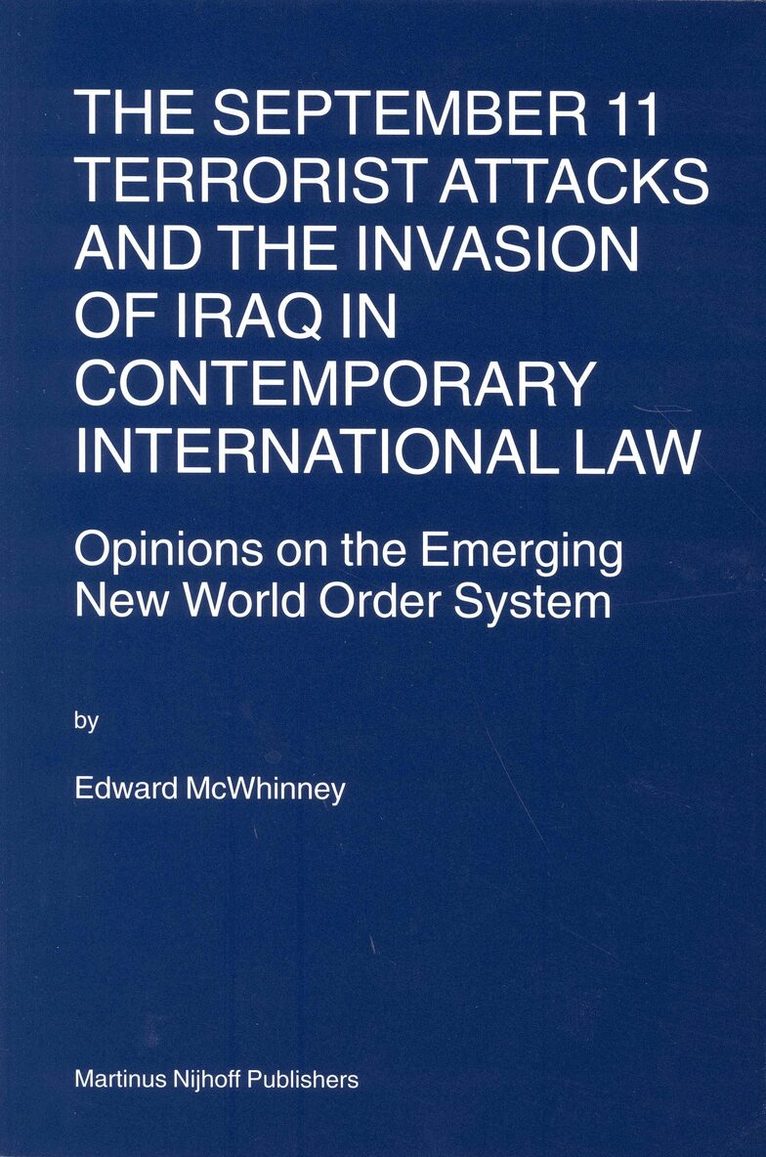
September 11 Terrorist Attacks and the Invasion of Iraq in Contemporary International Law
Opinions on the Emerging New World Order System
Häftad, Engelska, 2004
1 176 kr
Skickas inom 5-8 vardagar
The US administration’s pursuit of the Al-Qaeda organisation and Taliban régime in Afghanistan, responsible for the September 11, 2001 international terrorist attacks, was supported by an international “coalition of the willing” and backed by the full legal authority of UN Security Council Resolutions. The US bid to follow this successful multilateral initiative with similar armed intervention against Saddam Hussein’s government failed to rally support in the Security Council. The US then proceeded to act unilaterally, and with British military support, to invade Iraq. The problems for contemporary international law and the UN Charter based World Order system posed by the conflicts within the Security Council and the assorted legal claims advanced, such as a revived doctrine of Humanitarian Intervention; régime change as a justification for intervention; Preemptive military strikes as an exercise in Self-defence; and Multilateralism versus Unilateralism in the exercise of the Peace and Security powers under the UN Charter, are canvassed in the present collection of legal opinions.
Supreme Courts and Judicial Law-Making: Constitutional Tribunals and Constitutional Review
Constitutional Tribunals and Constitutional Review
Inbunden, Engelska, 1986
5 035 kr
Tillfälligt slut
274 kr
Kommande