Edward R. Zartler – författare
2 487 kr
Skickas inom 5-8 vardagar
2 867 kr
Läs direkt efter köp
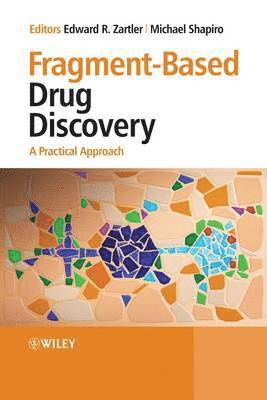
Fragment-Based Drug Discovery: A Practical Approach is a guide to the techniques and practice of using fragments in drug screening. The emphasis is on practical guidance, with procedures, case studies, practical tips, and contributions from industry. Topics covered include:
an introduction to fragment based drug discovery, why using fragments is a more efficient process than predominant models, and what it means to have a successful FBDD effort. setting up an FBDD project library building and production NMR in fragment screening and follow up application of protein-ligand NOE matching to the rapid evaluation of fragment binding poses target immobilized NMR screening: validation and extension to membrane proteins in situ fragment-based medicinal chemistry: screening by mass spectrometry computational approaches to fragment and substructure discovery and evaluation virtual fragment scanning: current trends, applications and web based tools fragment-based lead discovery using covalent capture methods case study from industry: the identification of high affinity beta-secretase inhibitors using fragment-based lead generationWith contributions from industry experts who have successfully set up an industrial fragment-based research program, Fragment-Based Drug Discovery: A Practical Approach offers essential advice to anyone embarking on drug discovery using fragments and those looking for a new approach to screening for drugs.
1 872 kr
Skickas inom 5-8 vardagar
2 199 kr
Läs direkt efter köp
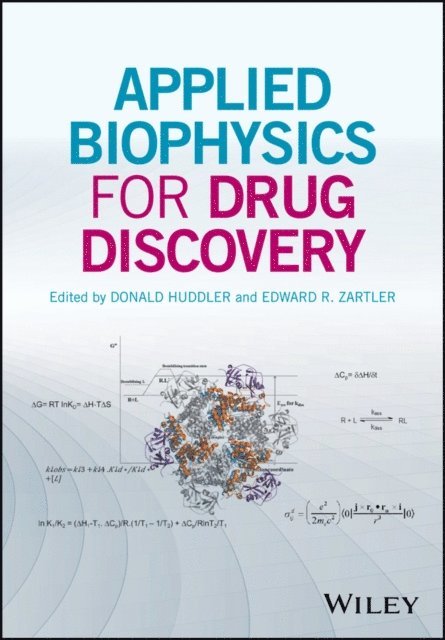
Applied Biophysics for Drug Discovery is a guide to new techniques and approaches to identifying and characterizing small molecules in early drug discovery. Biophysical methods are reasserting their utility in drug discovery and through a combination of the rise of fragment-based drug discovery and an increased focus on more nuanced characterisation of small molecule binding, these methods are playing an increasing role in discovery campaigns.
This text emphasizes practical considerations for selecting and deploying core biophysical method, including but not limited to ITC, SPR, and both ligand-detected and protein-detected NMR.
Topics covered include:
• Design considerations in biophysical-based lead screening
• Thermodynamic characterization of protein-compound interactions
• Characterizing targets and screening reagents with HDX-MS
• Microscale thermophoresis methods (MST)
• Screening with Weak Affinity Chromatography
• Methods to assess compound residence time
• 1D-NMR methods for hit identification
• Protein-based NMR methods for SAR development
• Industry case studies integrating multiple biophysical methods
This text is ideal for academic investigators and industry scientists planning hit characterization campaigns or designing and optimizing screening strategies.
2 199 kr
Läs direkt efter köp
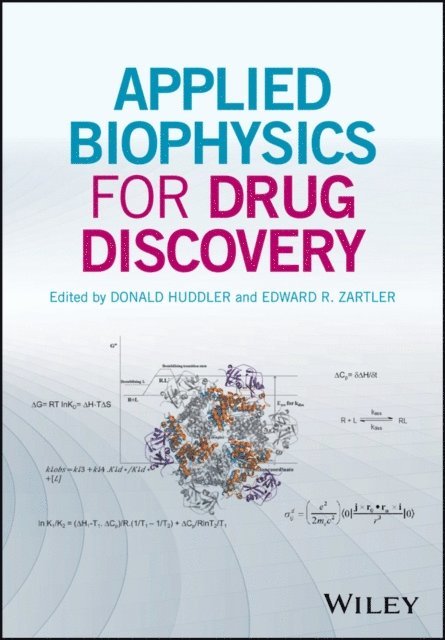
Applied Biophysics for Drug Discovery is a guide to new techniques and approaches to identifying and characterizing small molecules in early drug discovery. Biophysical methods are reasserting their utility in drug discovery and through a combination of the rise of fragment-based drug discovery and an increased focus on more nuanced characterisation of small molecule binding, these methods are playing an increasing role in discovery campaigns.
This text emphasizes practical considerations for selecting and deploying core biophysical method, including but not limited to ITC, SPR, and both ligand-detected and protein-detected NMR.
Topics covered include:
• Design considerations in biophysical-based lead screening
• Thermodynamic characterization of protein-compound interactions
• Characterizing targets and screening reagents with HDX-MS
• Microscale thermophoresis methods (MST)
• Screening with Weak Affinity Chromatography
• Methods to assess compound residence time
• 1D-NMR methods for hit identification
• Protein-based NMR methods for SAR development
• Industry case studies integrating multiple biophysical methods
This text is ideal for academic investigators and industry scientists planning hit characterization campaigns or designing and optimizing screening strategies.