Edward W. Soja – författare
Visar alla böcker från författaren Edward W. Soja. Handla med fri frakt och snabb leverans.
11 produkter
11 produkter
Häftad, Engelska, 1997
444 kr
Skickas inom 5-8 vardagar
Los Angeles has grown from a scattered collection of towns and villages to one of the largest megacities in the world. In the process, it has inspired controversy among critics and scholars, as well as among its residents. Seeking original perspectives rather than consensus, the editors of The City have assembled a variety of essays examining the built environment and human dynamics of this extraordinary modern city, emphasizing the dramatic changes that have occurred since 1960. Together the essays--by experts in urban planning, architecture, geography, and sociology--create a new kind of urban analysis, one that is open to diversity but strongly committed to collective theoretical and practical understanding.
Inbunden, Engelska, 2014
792 kr
Skickas inom 5-8 vardagar
Fighting the distorted imagery attached to Los Angeles, Edward Soja uses LA to rekindle our urban imagination about major issues affecting the world today. Here is a Los Angeles worthy to be learned from, an exemplary city region consisting of a network of at least forty cities with populations greater than 100,000. This polycentric regional city, once the least dense American metropolis, is now the country's densest urbanized area. Traditionally seen as one of the most business-centered environments, Los Angeles has become a major focus for the American labor movement and generator of some of the most innovative urban social movements in the country. A model in the past of unrooted "placeless" urbanism, it has become a hive of neighborhood organizations practicing sophisticated forms of location-based politics. Once the most WASP metropolis in the country, LA is now among the most culturally heterogeneous cities the world has ever seen. Soja takes us through his evolving interpretations of this urban metamorphosis, combining varying doses of radical political economy, critical postmodernism, comparative urban studies, and the new regionalism.He reaches the confident conclusion that over the past thirty years Los Angeles has been experiencing a profound deconstruction and reconstitution, a breakdown of the familiar model of metropolitan growth and the formation of a new mode of regional urbanization that is spreading to many other megacity regions in the world. Soja's highly personal and assertively spatial look at Los Angeles inspires, informs, challenges, and entertains.
Häftad, Engelska, 2014
296 kr
Skickas inom 5-8 vardagar
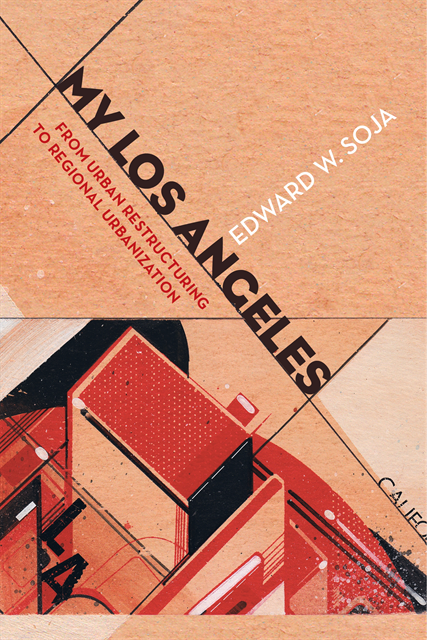
Fighting the distorted imagery attached to Los Angeles, Edward Soja uses LA to rekindle our urban imagination about major issues affecting the world today. Here is a Los Angeles worthy to be learned from, an exemplary city region consisting of a network of at least forty cities with populations greater than 100,000. This polycentric regional city, once the least dense American metropolis, is now the country's densest urbanized area. Traditionally seen as one of the most business-centered environments, Los Angeles has become a major focus for the American labor movement and generator of some of the most innovative urban social movements in the country. A model in the past of unrooted "placeless" urbanism, it has become a hive of neighborhood organizations practicing sophisticated forms of location-based politics. Once the most WASP metropolis in the country, LA is now among the most culturally heterogeneous cities the world has ever seen. Soja takes us through his evolving interpretations of this urban metamorphosis, combining varying doses of radical political economy, critical postmodernism, comparative urban studies, and the new regionalism.He reaches the confident conclusion that over the past thirty years Los Angeles has been experiencing a profound deconstruction and reconstitution, a breakdown of the familiar model of metropolitan growth and the formation of a new mode of regional urbanization that is spreading to many other megacity regions in the world. Soja's highly personal and assertively spatial look at Los Angeles inspires, informs, challenges, and entertains.
E-bok
Engelska, 2014502 kr
Läs direkt efter köp
At once informative and entertaining, inspiring and challenging, My Los Angeles provides a deep understanding of urban development and change over the past forty years in Los Angeles and other city regions of the world. Once the least dense American metropolis, Los Angeles is now the country’s densest urbanized area and one of the most culturally heterogeneous cities in the world. Soja takes us through this urban metamorphosis, analyzing urban restructuring, deindustrialization and reindustrialization, the globalization of capital and labor, and the formation of an information-intensive New Economy. By examining his own evolving interpretations of Los Angeles and the debates on the so-called Los Angeles School of urban studies, Soja argues that a radical shift is taking place in the nature of the urbanization process, from the familiar metropolitan model to regional urbanization. By looking at such concepts as new regionalism, the spatial turn, the end of the metropolis era, the urbanization of suburbia, the global spread of industrial urbanism, and the transformative urban-industrialization of China, Soja offers a unique and remarkable perspective on critical urban and regional studies.
Häftad, Engelska, 2010
266 kr
Skickas inom 5-8 vardagar
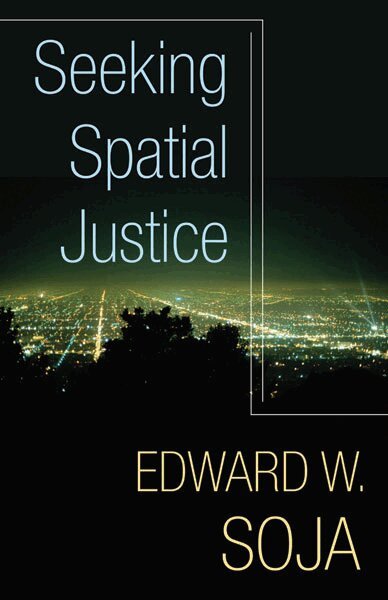
In 1996, the Los Angeles Bus Riders Union, a grassroots advocacy organization, won a historic legal victory against the city’s Metropolitan Transit Authority. The resulting consent decree forced the MTA for a period of ten years to essentially reorient the mass transit system to better serve the city’s poorest residents. A stunning reversal of conventional governance and planning in urban America, which almost always favors wealthier residents, this decision is also, for renowned urban theorist Edward W. Soja, a concrete example of spatial justice in action. In Seeking Spatial Justice, Soja argues that justice has a geography and that the equitable distribution of resources, services, and access is a basic human right. Building on current concerns in critical geography and the new spatial consciousness, Soja interweaves theory and practice, offering new ways of understanding and changing the unjust geographies in which we live. After tracing the evolution of spatial justice and the closely related notion of the right to the city in the influential work of Henri Lefebvre, David Harvey, and others, he demonstrates how these ideas are now being applied through a series of case studies in Los Angeles, the city at the forefront of this movement. Soja focuses on such innovative labor–community coalitions as Justice for Janitors, the Los Angeles Alliance for a New Economy, and the Right to the City Alliance; on struggles for rent control and environmental justice; and on the role that faculty and students in the UCLA Department of Urban Planning have played in both developing the theory of spatial justice and putting it into practice. Effectively locating spatial justice as a theoretical concept, a mode of empirical analysis, and a strategy for social and political action, this book makes a significant contribution to the contemporary debates about justice, space, and the city.
Inbunden, Engelska, 1996
1 423 kr
Skickas inom 5-8 vardagar
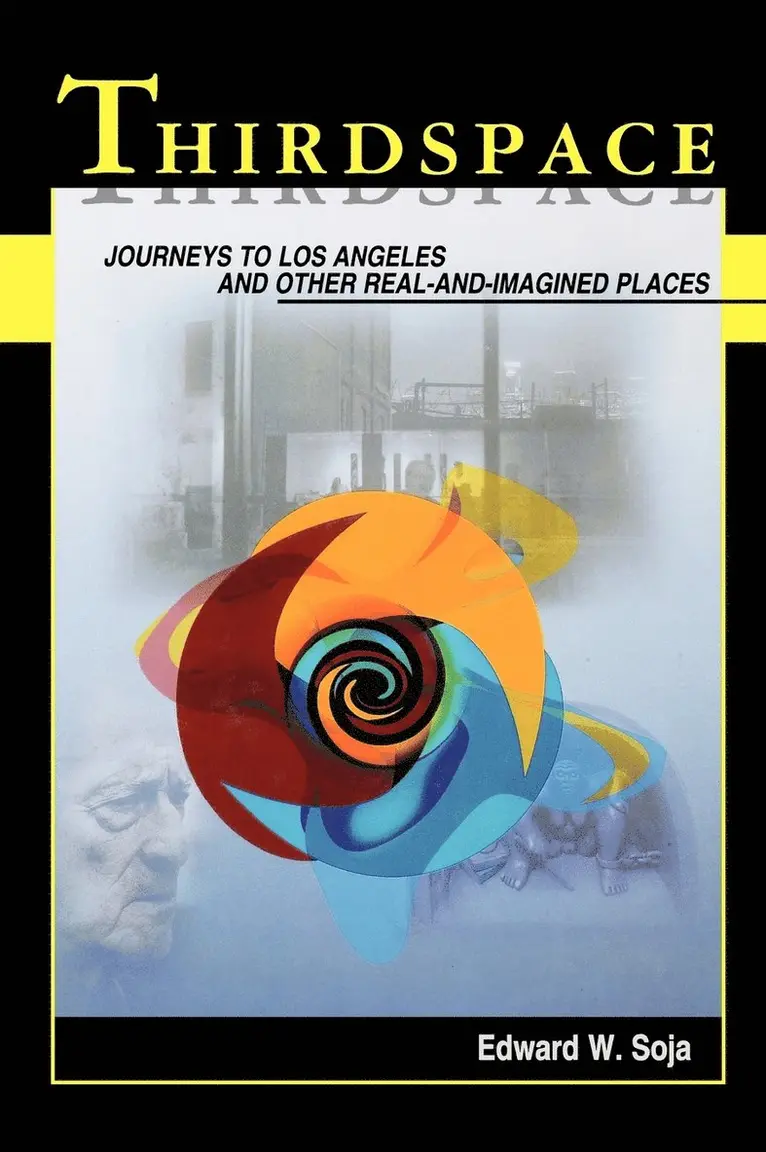
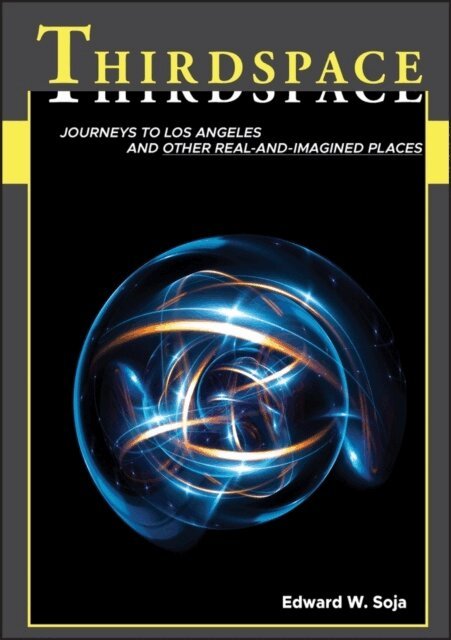
Contemporary critical studies have recently experienced a significant spatial turn. In what may eventually be seen as one of the most important intellectual and political developments in the late twentieth century, scholars have begun to interpret space and the embracing spatiality of human life with the same critical insight and emphasis that has traditionally been given to time and history on the one hand, and social relations and society on the other. Thirdspace is both an enquiry into the origins and impact of the spatial turn and an attempt to expand the scope and practical relevance of how we think about space and such related concepts as place, location, landscape, architecture, environment, home, city, region, territory, and geography. The book's central argument is that spatial thinking, or what has been called the geographical or spatial imagination, has tended to be bicameral, or confined to two approaches. Spatiality is either seen as concrete material forms to be mapped, analyzed, and explained; or as mental constructs, ideas about and representations of space and its social significance. Edward Soja critically re-evaluates this dualism to create an alternative approach, one that comprehends both the material and mental dimensions of spatiality but also extends beyond them to new and different modes of spatial thinking. Thirdspace is composed as a sequence of intellectual and empirical journeys, beginning with a spatial biography of Henri Lefebvre and his adventurous conceptualization of social space as simultaneously perceived, conceived, and lived. The author draws on Lefebvre to describe a trialectics of spatiality that threads though all subsequent journeys, reappearing in many new forms in bell hooks evocative exploration of the margins as a space of radical openness; in post-modern spatial feminist interpretations of the interplay of race, class, and gender; in the postcolonial critique and the new cultural politics of difference and identity; in Michel Foucault's heterotopologies and trialectics of space, knowledge, and power; and in interpretative tours of the Citadel of downtown Los Angeles, the Exopolis of Orange County, and the Centrum of Amsterdam.
Häftad, Engelska, 1996
487 kr
Skickas
Contemporary critical studies have recently experienced a significant spatial turn. In what may eventually be seen as one of the most important intellectual and political developments in the late twentieth century, scholars have begun to interpret space and the embracing spatiality of human life with the same critical insight and emphasis that has traditionally been given to time and history on the one hand, and social relations and society on the other. Thirdspace is both an enquiry into the origins and impact of the spatial turn and an attempt to expand the scope and practical relevance of how we think about space and such related concepts as place, location, landscape, architecture, environment, home, city, region, territory, and geography. The book's central argument is that spatial thinking, or what has been called the geographical or spatial imagination, has tended to be bicameral, or confined to two approaches. Spatiality is either seen as concrete material forms to be mapped, analyzed, and explained; or as mental constructs, ideas about and representations of space and its social significance. Edward Soja critically re-evaluates this dualism to create an alternative approach, one that comprehends both the material and mental dimensions of spatiality but also extends beyond them to new and different modes of spatial thinking. Thirdspace is composed as a sequence of intellectual and empirical journeys, beginning with a spatial biography of Henri Lefebvre and his adventurous conceptualization of social space as simultaneously perceived, conceived, and lived. The author draws on Lefebvre to describe a trialectics of spatiality that threads though all subsequent journeys, reappearing in many new forms in bell hooks evocative exploration of the margins as a space of radical openness; in post-modern spatial feminist interpretations of the interplay of race, class, and gender; in the postcolonial critique and the new cultural politics of difference and identity; in Michel Foucault's heterotopologies and trialectics of space, knowledge, and power; and in interpretative tours of the Citadel of downtown Los Angeles, the Exopolis of Orange County, and the Centrum of Amsterdam.
Häftad, Engelska, 2000
610 kr
Skickas inom 5-8 vardagar
This completes Ed Soja's trilogy on urban studies, which began with Postmodern Geographies and continued with Thirdspace. It is the first comprehensive text in the growing field of critical urban studies to deal with the dramatically restructured megacities that have emerged world-wide over the last half of the twentieth-century.
E-bok
Engelska, 2024127 kr
Läs direkt efter köp
Postmodern Geographies stands as the cardinal broadcast and defence of theory''s "spatial turn." From the suppression of space in modern social science and the disciplinary aloofness of geography to the spatial returns of Foucault and Lefebvre and the construction of Marxist geographies alert to urbanization and global development, renowned geographer Edward W. Soja details the trajectory of this turn and lays out its key debates. An expanded critique of historicism and a refined grasp of materialist dialectics bolster Soja''s attempt to introduce geography to postmodernity, animating a series of engagements with Heidegger, Giddens, Castells, and others. Two exploratory essays on the postfordist landscapes of Los Angeles complete the book, offering a glimpse of Soja''s new geography carried into its highest register.
Häftad, Engelska, 2011
145 kr
Skickas inom 7-10 vardagar
Postmodern Geographies stands as the cardinal broadcast and defence of theory's "spatial turn." From the suppression of space in modern social science and the disciplinary aloofness of geography to the spatial returns of Foucault and Lefebvre and the construction of Marxist geographies alert to urbanization and global development, renowned geographer Edward W. Soja details the trajectory of this turn and lays out its key debates. An expanded critique of historicism and a refined grasp of materialist dialectics bolster Soja's attempt to introduce geography to postmodernity, animating a series of engagements with Heidegger, Giddens, Castells, and others. Two exploratory essays on the postfordist landscapes of Los Angeles complete the book, offering a glimpse of Soja's new geography carried into its highest register.
E-bok
Spanska, 2014148 kr
Läs direkt efter köp
En busca de la justicia espacial es un título que, ciertamente, suena extraño para oídos acostumbrados a la nítida separación de aproximaciones, de teorías, de ciencias incluso. ¿Justicia? De acuerdo. ¿Espacial? Muy bien, pero ¿las dos cosas juntas? Y eso que adjetivar el concepto de justicia tiene una cierta tradición que se remonta a los movimientos por la justicia social o a los más recientes a favor de la justicia ambiental o de una justicia global. Algo debería revisarse en la idea de justicia cuando se tiene que adjetivar explicando su contenido. Pero volvamos a aquella entrevista. Tras declarar su extrañeza ante el título, la periodista, con instinto didáctico, reproducía el ejemplo que el geógrafo Edward Soja suele explicar siempre que se dirige a públicos amplios. Pensemos en una gran ciudad, con sus barrios, sus centros económicos, sus movimientos, sus flujos de personas y de mercancías?, pensemos en Valencia, en Madrid, en Barcelona, en México DF, en Bogotá, en Buenos Aires, en Medellín. Para que la ciudad funcione se precisa una red de transporte público que permita a sus vecinos y visitantes desplazarse de un lugar a otro.