E.E. Harris - Böcker
Visar alla böcker från författaren E.E. Harris. Handla med fri frakt och snabb leverans.
3 produkter
3 produkter
1 064 kr
Skickas inom 10-15 vardagar
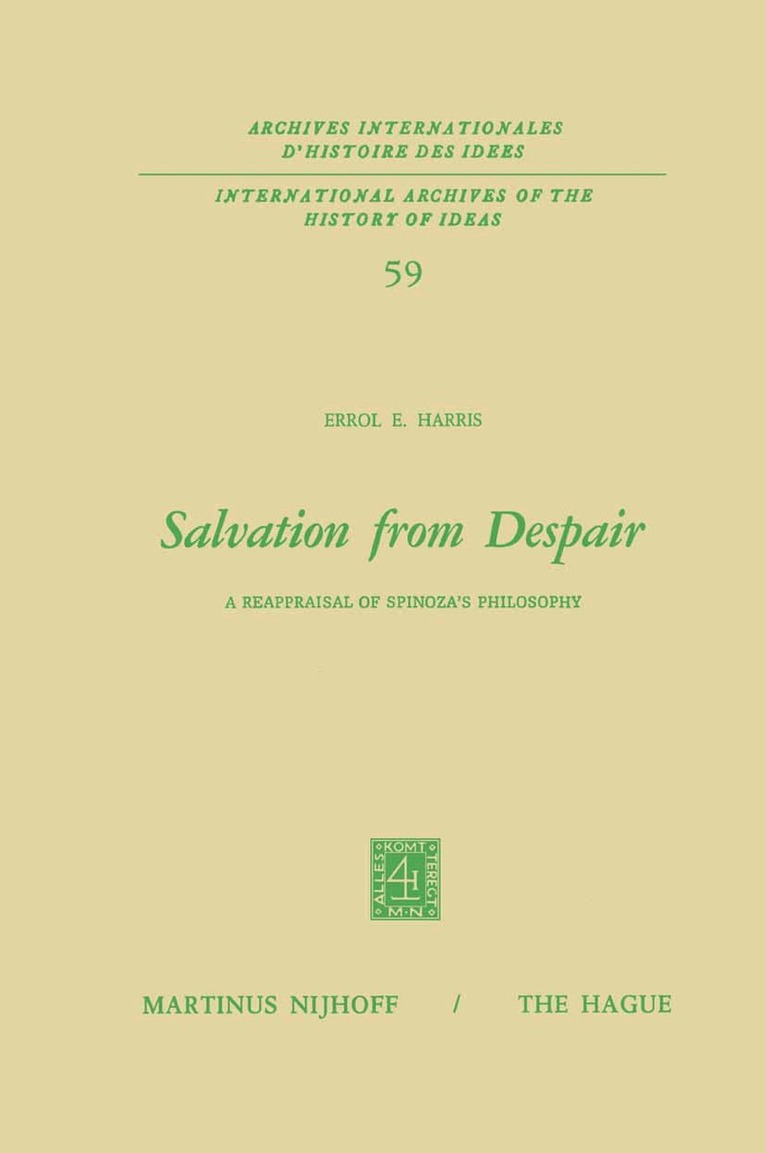
My purpose in this book is to re-interpret the philosophy of Spinoza to a new generation. I make no attempt to compete with the historical scholar ship of A. H. Wolfson in tracing back Spinoza's ideas to his Ancient, Hebrew and Mediaeval forerunners, or the meticulous philosophical scrutiny of Harold Joachim, which I could wish to emulate but cannot hope to rival. I have simply relied upon the text of Spinoza's own writings in an effort to grasp and to make intelligible to others the precise meaning of his doctrine, and to decide whether, in spite of numerous apparent and serious internal conflicts, it can be understood as a consistent whole. In so doing I have found it necessary to correct what seem to me t0' be mis conceptions frequently entertained by commentators. Whether or not I am right in my re-interpretation, it will, I hope, contribute something fresh, if not to the knowledge of Spinoza, at least to the discussion of what he really meant to say. The limits within which I am constrained to write prevent me from drawing fully upon the great mass of scholarly writings on Spinoza, his life and times, his works and his philosophical ideas. I can only try to make amends for omissions by listing the most important works in the Spinoza bibliography, for reference by those who would seek to know more about his philosophy. This list I have added as an appendix.
1 064 kr
Skickas inom 10-15 vardagar
My purpose in this book is to re-interpret the philosophy of Spinoza to a new generation. I make no attempt to compete with the historical scholar ship of A. H. Wolfson in tracing back Spinoza's ideas to his Ancient, Hebrew and Mediaeval forerunners, or the meticulous philosophical scrutiny of Harold Joachim, which I could wish to emulate but cannot hope to rival. I have simply relied upon the text of Spinoza's own writings in an effort to grasp and to make intelligible to others the precise meaning of his doctrine, and to decide whether, in spite of numerous apparent and serious internal conflicts, it can be understood as a consistent whole. In so doing I have found it necessary to correct what seem to me t0' be mis conceptions frequently entertained by commentators. Whether or not I am right in my re-interpretation, it will, I hope, contribute something fresh, if not to the knowledge of Spinoza, at least to the discussion of what he really meant to say. The limits within which I am constrained to write prevent me from drawing fully upon the great mass of scholarly writings on Spinoza, his life and times, his works and his philosophical ideas. I can only try to make amends for omissions by listing the most important works in the Spinoza bibliography, for reference by those who would seek to know more about his philosophy. This list I have added as an appendix.
536 kr
Skickas inom 10-15 vardagar
Professor Errol E. Harris presented the first three chapters of Atheism and Theism as public lectures at Tulane University on January 20-22, 1975. The lecture series was made possible by a grant from the Franklin J. Matchette Foundation of New York City. Those of us who had the pleasure of hearing the lectures formed the judgment that they deserved publication to reach a wider audience and to assure a more permanent reeord. We invited Professor Harris to allow us to publish his lectures in Tulane Studies in Philosophy. On his part, he de veloped the themes of the lectures into a more comprehensive and lasting work. With Professor Harris's approval, we are taking the unprecedented step of devoting Volume XXVI of Tulane Studies in Philosophy to the publication of Atheism and Theism. We are certain that it will advance the fundamentally philosophical argument surrounding theism and Christianity. We are also convinced that it will add substantialIy to the prestige of our series of annua1 volumes of philosophy, now in its twenty-sixth year. 'Ve wish to express our thanks to the Franklin J. Matchette Foundation for the original grant sup porting the lectures and to Professor Harris for presenting first the lectures and then the book. R. C. W. A. J. R.