E.G. Ballard - Böcker
Visar alla böcker från författaren E.G. Ballard. Handla med fri frakt och snabb leverans.
4 produkter
4 produkter
1 548 kr
Skickas inom 10-15 vardagar
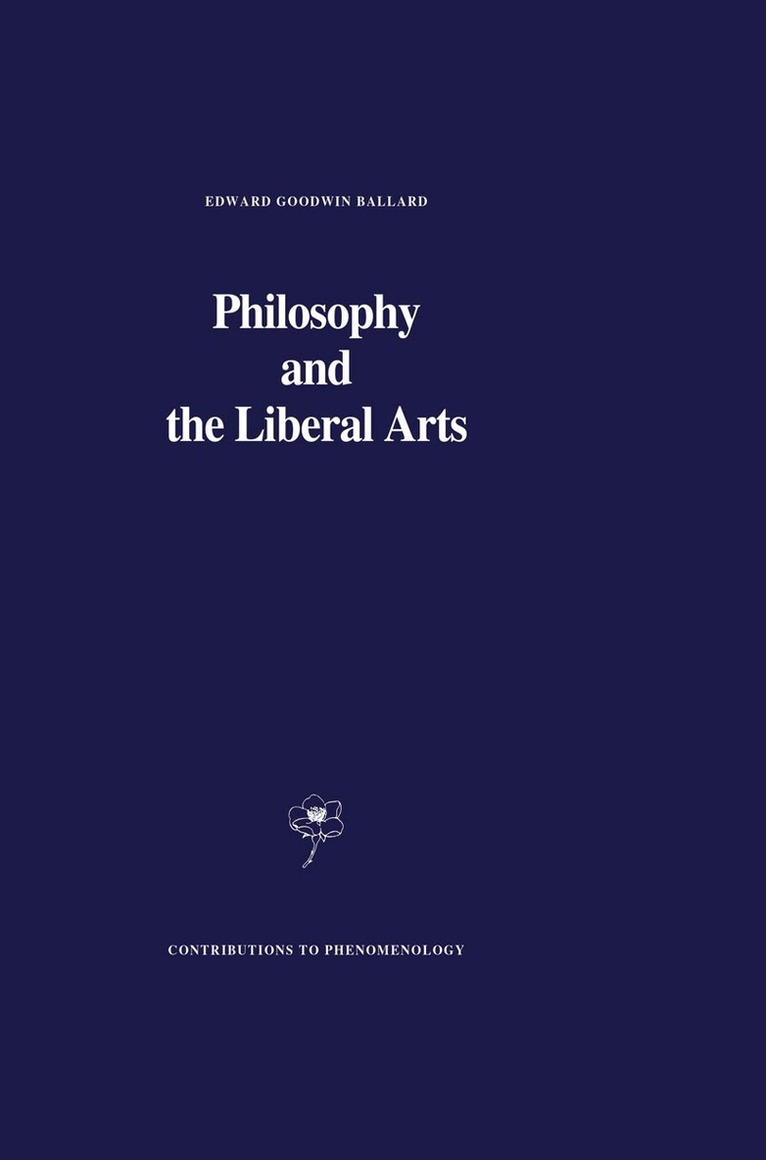
As this collection of essays demonstrates, over a long career Edward Goodwin Ballard has written on a wide range of topics of philosophical interest. Although the present volume can be enjoy ably browsed, it is not simply a sampling of his writings. Rather, herein Professor Ballard has chosen and organized essays which pertain to the major concerns of his philosophic life. He has long held that the function of philosophy, particularly in a time such as ours, is the discernment and analysis of basic principles (archai) and their consequences. Indeed, in Philosophy at the Crossroads. he recommended focusing upon the history of philosophy understood as the movement of recognizing and interpreting the shifts in first principles as they reflect and determine human change. For Ballard, the study of the history of philosophy, like philosophy itself, is not so much a body of knowledge as an exercise (an art) whiQh moves the practitioner towards social and individual maturity. He holds, along with Plato and Husserl, that philosophy is a process of conversion to the love of wisdom as well as a grasp of the means for its attainment. Throughout his writings, Ballard has maintained that the difficulties of this journey have to do with the limitations of the pilgrim. Human being is perspectival, finite, and inevitably ignorant. Philosophic command and self -recognition reside in the just assessment of the limits of human knowledge.
Contributions by E.G.Ballard; R.L.Barber; J.K.Feibleman; C.H.Hamburg; H.N.Lee; P.G.Morrison; L.N.Roberts; R.C.Whittemore
Häftad, Engelska, 1967
1 064 kr
Skickas inom 10-15 vardagar
1 064 kr
Skickas inom 10-15 vardagar
When Heidegger's influence was at its zenith in Gennany from the early fifties to the early sixties, most serious students of philosophy in that country were deeply steeped in his thought. His students or students of his students filled many if not most of the major chairs in philosophy. A cloud of reputedly Black Forest mysticism veiled the perspective of many of his critics and admirers at home and abroad. Droves of people flocked to hear lectures by him that most could not understand, even on careful reading, much less on one hearing. He loomed so large that Being and Time frequently could not be seen as a highly imaginative, initial approach to a strictly limited set of questions, but was viewed either as an all-embracing fmt order catastrophy incorporating at once the most feared consequences of Boehme, Kierkegaard, RiIke, and Nietzsche, or as THE ANSWER. But most of that has past. Heidegger's dominance of Gennan philosophy has ceased. One can now brush aside the larger-than-life images of Heidegger, the fears that his language was creating a cult phenomenon, the convictions that only those can understand him who give their lives to his thought. His language is at times unusually difficult, at times simple and beautiful. Some of his insights are obscure and not helpful, others are exciting and clarifying. One no longer expects Heidegger to interpret literature like a literary critic or an academic philologist.
1 640 kr
Skickas inom 10-15 vardagar
As this collection of essays demonstrates, over a long career Edward Goodwin Ballard has written on a wide range of topics of philosophical interest. Although the present volume can be enjoy ably browsed, it is not simply a sampling of his writings. Rather, herein Professor Ballard has chosen and organized essays which pertain to the major concerns of his philosophic life. He has long held that the function of philosophy, particularly in a time such as ours, is the discernment and analysis of basic principles (archai) and their consequences. Indeed, in Philosophy at the Crossroads. he recommended focusing upon the history of philosophy understood as the movement of recognizing and interpreting the shifts in first principles as they reflect and determine human change. For Ballard, the study of the history of philosophy, like philosophy itself, is not so much a body of knowledge as an exercise (an art) whiQh moves the practitioner towards social and individual maturity. He holds, along with Plato and Husserl, that philosophy is a process of conversion to the love of wisdom as well as a grasp of the means for its attainment. Throughout his writings, Ballard has maintained that the difficulties of this journey have to do with the limitations of the pilgrim. Human being is perspectival, finite, and inevitably ignorant. Philosophic command and self -recognition reside in the just assessment of the limits of human knowledge.