Elizabeth Theiss-Morse - Böcker
Visar alla böcker från författaren Elizabeth Theiss-Morse. Handla med fri frakt och snabb leverans.
12 produkter
12 produkter
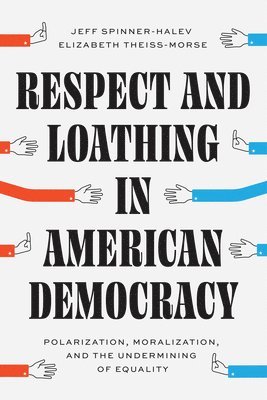
Respect and Loathing in American Democracy
Polarization, Moralization, and the Undermining of Equality
Inbunden, Engelska, 2024
785 kr
Skickas inom 7-10 vardagar
A deep examination of why respect is in short supply in politics today and why it matters.Respect is in trouble in the United States. Many Americans believe respecting others is a necessary virtue, yet many struggle to respect opposing partisans. Surprisingly, it is liberal citizens, who hold respect as central to their view of democratic equality, who often have difficulty granting respect to others. Drawing on evidence from national surveys, focus groups, survey experiments, and the views of political theorists, Jeff Spinner-Halev and Elizabeth Theiss-Morse explain why this is and why respect is vital to—and yet so lacking in—contemporary US politics. Respect and Loathing in American Democracy argues that liberals and conservatives are less divided than many believe, but alienate one another because they moralize different issues. Liberals moralize social justice, conservatives champion national solidarity, and this worldview divide keeps them at odds. Respect is both far-reaching and vital, yet it is much harder to grant than many recognize, partly because of the unseen tension between respect, social justice, and national solidarity. Respect and Loathing in American Democracy proposes a path forward that, while challenging, is far from impossible for citizens to traverse.
Respect and Loathing in American Democracy
Polarization, Moralization, and the Undermining of Equality
Häftad, Engelska, 2024
203 kr
Skickas inom 7-10 vardagar
A deep examination of why respect is in short supply in politics today and why it matters.Respect is in trouble in the United States. Many Americans believe respecting others is a necessary virtue, yet many struggle to respect opposing partisans. Surprisingly, it is liberal citizens, who hold respect as central to their view of democratic equality, who often have difficulty granting respect to others. Drawing on evidence from national surveys, focus groups, survey experiments, and the views of political theorists, Jeff Spinner-Halev and Elizabeth Theiss-Morse explain why this is and why respect is vital to—and yet so lacking in—contemporary US politics. Respect and Loathing in American Democracy argues that liberals and conservatives are less divided than many believe, but alienate one another because they moralize different issues. Liberals moralize social justice, conservatives champion national solidarity, and this worldview divide keeps them at odds. Respect is both far-reaching and vital, yet it is much harder to grant than many recognize, partly because of the unseen tension between respect, social justice, and national solidarity. Respect and Loathing in American Democracy proposes a path forward that, while challenging, is far from impossible for citizens to traverse.
334 kr
Skickas inom 7-10 vardagar
Americans often complain about the operation of their government, but scholars have never developed a complete picture of people's preferred type of government. In this provocative and timely book, Hibbing and Theiss-Morse, employing an original national survey and focus groups, report the governmental procedures Americans desire. Contrary to the prevailing view that people want greater involvement in politics, most citizens do not care about most policies and therefore are content to turn over decision-making authority to someone else. People's wish for the political system is that decision makers be empathetic and, especially, non-self-interested, not that they be responsive and accountable to the people's largely nonexistent policy preferences or, even worse, that the people be obligated to participate directly in decision making. Hibbing and Theiss-Morse conclude by cautioning communitarians, direct democrats, social capitalists, deliberation theorists, and all those who think that greater citizen involvement is the solution to society's problems.
1 192 kr
Skickas inom 7-10 vardagar
With Malice toward Some: How People Make Civil Liberties Judgments addresses an issue integral to democratic societies: how people faced with a complex variety of considerations decide whether or not to tolerate extremist groups. Relying on several survey-experiments, Marcus, Sullivan, Theiss-Morse, and Wood identify and compare the impact on decision making of contemporary information, long-standing predispositions, and enduring values and beliefs. Citizens react most strongly to information about a group's violations of behavioral norms and information about the implications for democracy of the group's actions. The authors conclude that democratic citizens should have a strong baseline of tolerance yet be attentive to and thoughtful about current information.
428 kr
Skickas inom 7-10 vardagar
With Malice toward Some: How People Make Civil Liberties Judgments addresses an issue integral to democratic societies: how people faced with a complex variety of considerations decide whether or not to tolerate extremist groups. Relying on several survey-experiments, Marcus, Sullivan, Theiss-Morse, and Wood identify and compare the impact on decision making of contemporary information, long-standing predispositions, and enduring values and beliefs. Citizens react most strongly to information about a group's violations of behavioral norms and information about the implications for democracy of the group's actions. The authors conclude that democratic citizens should have a strong baseline of tolerance yet be attentive to and thoughtful about current information.
Congress as Public Enemy
Public Attitudes toward American Political Institutions
Inbunden, Engelska, 1995
744 kr
Skickas inom 7-10 vardagar
This timely book describes and explains the American people's alleged hatred of their own branch of government, the US Congress. Intensive focus group sessions held across the country and a specially designed national survey indicate that much of the negativity is generated by popular perceptions of the processes of governing visible in Congress. John Hibbing and Elizabeth Theiss-Morse argue that, although the public is deeply disturbed by debate, compromise, delicate pace, the presence of interest groups, and the professionalization of politics, many of these traits are actually endemic to modern democratic government. Congress is an enemy of the public partially because it is so public. Calls for reform, such as term limitations, reflect the public's desire to attack these disliked features. But the authors conclude, the public's unwitting desire to reform democracy out of a democratic legislature is a cure more dangerous than the disease.
Congress as Public Enemy
Public Attitudes toward American Political Institutions
Häftad, Engelska, 1995
428 kr
Skickas inom 7-10 vardagar
This timely book describes and explains the American people's alleged hatred of their own branch of government, the US Congress. Intensive focus group sessions held across the country and a specially designed national survey indicate that much of the negativity is generated by popular perceptions of the processes of governing visible in Congress. John Hibbing and Elizabeth Theiss-Morse argue that, although the public is deeply disturbed by debate, compromise, delicate pace, the presence of interest groups, and the professionalization of politics, many of these traits are actually endemic to modern democratic government. Congress is an enemy of the public partially because it is so public. Calls for reform, such as term limitations, reflect the public's desire to attack these disliked features. But the authors conclude, the public's unwitting desire to reform democracy out of a democratic legislature is a cure more dangerous than the disease.
297 kr
Skickas inom 7-10 vardagar
Why is national identity such a potent force in people's lives? And is the force positive or negative? In this thoughtful and provocative book, Elizabeth Theiss-Morse develops a social theory of national identity and uses a national survey, focus groups, and experiments to answer these important questions in the American context. Her results show that the combination of group commitment and the setting of exclusive boundaries on the national group affects how people behave toward their fellow Americans. Strong identifiers care a great deal about their national group. They want to help and to be loyal to their fellow Americans. By limiting who counts as an American, though, these strong identifiers place serious limits on who benefits from their pro-group behavior. Help and loyalty are offered only to 'true Americans,' not Americans who do not count and who are pushed to the periphery of the national group.
639 kr
Skickas inom 7-10 vardagar
Why is national identity such a potent force in people's lives? And is the force positive or negative? In this thoughtful and provocative book, Elizabeth Theiss-Morse develops a social theory of national identity and uses a national survey, focus groups, and experiments to answer these important questions in the American context. Her results show that the combination of group commitment and the setting of exclusive boundaries on the national group affects how people behave toward their fellow Americans. Strong identifiers care a great deal about their national group. They want to help and to be loyal to their fellow Americans. By limiting who counts as an American, though, these strong identifiers place serious limits on who benefits from their pro-group behavior. Help and loyalty are offered only to 'true Americans,' not Americans who do not count and who are pushed to the periphery of the national group.
995 kr
Skickas inom 7-10 vardagar
The American public's level of hostility toward government became a major issue in the 1990s. In this edited volume, first published in 2001, 24 of the country's leading students of public attitudes toward government in the United States address the reasons for this hostility. In 14 original articles, the authors explain why people's approval of government dropped so precipitously in the late 1960s, why some parts of the government (such as the Supreme Court) are better liked than others (such as the Congress), and why certain actions by political elites are particularly upsetting to much of the American public. Uniting several of the contributions is the theme that dissatisfaction with government occurs not just when people dislike governmental policies but also when they dislike the manner in which those policies are made. Another unifying theme is the potential danger of a public with nothing but its own disdain for its own political system.
334 kr
Skickas inom 7-10 vardagar
The American public's level of hostility toward government became a major issue in the 1990s. In this edited volume, first published in 2001, 24 of the country's leading students of public attitudes toward government in the United States address the reasons for this hostility. In 14 original articles, the authors explain why people's approval of government dropped so precipitously in the late 1960s, why some parts of the government (such as the Supreme Court) are better liked than others (such as the Congress), and why certain actions by political elites are particularly upsetting to much of the American public. Uniting several of the contributions is the theme that dissatisfaction with government occurs not just when people dislike governmental policies but also when they dislike the manner in which those policies are made. Another unifying theme is the potential danger of a public with nothing but its own disdain for its own political system.
995 kr
Skickas inom 7-10 vardagar
Americans often complain about the operation of their government, but scholars have never developed a complete picture of people's preferred type of government. In this provocative and timely book, Hibbing and Theiss-Morse, employing an original national survey and focus groups, report the governmental procedures Americans desire. Contrary to the prevailing view that people want greater involvement in politics, most citizens do not care about most policies and therefore are content to turn over decision-making authority to someone else. People's wish for the political system is that decision makers be empathetic and, especially, non-self-interested, not that they be responsive and accountable to the people's largely nonexistent policy preferences or, even worse, that the people be obligated to participate directly in decision making. Hibbing and Theiss-Morse conclude by cautioning communitarians, direct democrats, social capitalists, deliberation theorists, and all those who think that greater citizen involvement is the solution to society's problems.