Elizabeth Weed - Böcker
Visar alla böcker från författaren Elizabeth Weed. Handla med fri frakt och snabb leverans.
9 produkter
9 produkter
235 kr
Skickas inom 10-15 vardagar
". . . innovative and important thinking about the various relations between feminist theory, queer theory, and lesbian theory, as well as the possibility that liberation can be mutual rather than mutually exclusive." —Lambda Book ReportWhen feminism meets queer theory, no introductions seem necessary. The two share common political interests—a concern for women's and gay and lesbian rights—and many of the same academic and intellectual roots. And yet, they can also seem like strangers, needing mediation, translation, clarification. This volume focuses on the encounters of feminist and queer theories, on the ways in which basic terms such as "male" and "female," "man" and "woman," "black," "white," "sex," "gender," and "sexuality" change meaning as they move from one body of theory to another. Along with essays by Judith Butler, Evelynn Hammonds, Biddy Martin, Kim Michasiw, Carole-Anne Tyler, and Elizabeth Weed, there are interviews: Judith Butler engages Rosi Braidotti and Gayle Rubin in separate revealing discussions. And there are critical exchanges: Rosi Braidotti and Trevor Hope exchange comments on his reading of her work; and Teresa de Lauretis responds to Elizabeth Grosz's review of her recent book.
285 kr
Skickas inom 7-10 vardagar
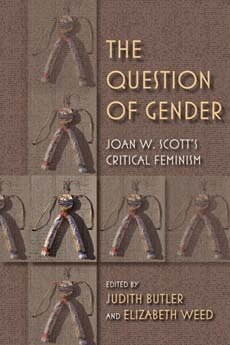
A generation after the publication of Joan W. Scott's influential essay, "Gender: A Useful Category of Historical Analysis," this volume explores the current uses of the term—and the ongoing influence of Scott's agenda-setting work in history and other disciplines. How has the study of gender, independently or in conjunction with other axes of difference—such as race, class, and sexuality—inflected existing fields of study and created new ones? To what extent has this concept modified or been modified by related paradigms such as women's and queer studies? With what discursive politics does the term engage, and with what effects? In what settings, and through what kinds of operations and transformations, can gender remain a useful category in the 21st century? Leading scholars from history, philosophy, literature, art history, and other fields examine how gender has translated into their own disciplinary perspectives.
155 kr
Skickas inom 10-15 vardagar
What is essentialism? What is anti-essentialism? The Essential Difference attempts to answer questions at the heart of current feminist theory and cultural study. The book deals with origins and contexts of the debate; relationships between essentialism, anti-essentialism, and the power of language; reasons for the demonization of essentialism within the academy; the relationship between essentialism and Third World studies. The essays also speculate about whether there can be an anti-essentialist feminism, whether there can in fact be a feminist politics that dispenses with the notion of Woman. This long-awaited volume questions the bases of feminism itself. The contributors are Teresa de Lauretis, Diana Fuss, Elizabeth Grosz, Luce Irigaray, Leslie Wahl Rabine, Ellen Rooney, Robert Scholes, Naomi Schor, and Gayatri Chakravorty Spivak.
2 170 kr
Skickas inom 10-15 vardagar
For over a decade, feminist studies have occupied an extraordinary position in the United States. On the one hand, they have contributed to the development of a strong ‘identity’ politics; on the other, they have been part of the post-structuralist critique of the unified subject – its experience, truth and presence – and of the massive challenge to Western metaphysics and humanism. Along with race and ethnic studies, feminist enquiry has moved beyond the fiction of a unitary feminism to address the differences within the study of difference.The essays in this volume all address feminism’s relationships to theory and politics at the level of the criticism and production of knowledge. Readers and students of politics, history, literature, philosophy, sociology and the sciences – anyone with a stake in theory and politics – will benefit from this powerful book.
153 kr
Skickas inom 7-10 vardagar
Most readers of Louis Althusser first enter his work through his writings on ideology. In an important new essay Étienne Balibar, friend and colleague of Althusser, offers an original reading of Althusser’s idea of ideology, drawing on both recently published posthumous writing and Althusser's work on the Piccolo Teatro di Milano. Balibar’s essay uncovers the intricate workings of interpellation through Althusser’s essays on the theater. If debates on dialectical materialism belong to a distant history, Balibar suggests, the question of ideology remains crucial for thinking the present.The issue includes commentaries on Balibar’s essay from five influential scholars who engage critically with Althusser’s philosophy: Judith Butler, Banu Bargu, Adi Ophir, Warren Montag, and Bruce Robbins. This issue reanimates Althusser’s concept of ideology as an analytic tool for contemporary cultural and political critique.
175 kr
Skickas inom 7-10 vardagar
Before her death in 2001, Naomi Schor was a leading scholar in feminist and critical theory and a founding coeditor of differences: A Journal of Feminist Cultural Studies. This issue takes as its starting point Schor’s book Bad Objects: Essays Popular and Unpopular (1995), in which she discussed her attraction to the “bad objects” the academy had overlooked or ignored: universalism, essentialism, and feminism. Underpinning these bad objects was her mourning of the literary, a sense that her work-and feminist theory more generally-had departed from the textual readings in which they were grounded. Schor’s question at the time was “Will a new feminist literary criticism arise that will take literariness seriously while maintaining its vital ideological edge?” The contributors take literariness-the “bad object” of this issue-seriously. They do not necessarily engage in debates about reading, theorize new formalisms, or thematize language; rather, they invigorate and unsettle the reading experience, investigating the relationship between language and meaning.Contributors. Lee Edelman, Frances Ferguson, Peggy Kamuf, Ramsey McGlazer, Thangam Ravindranathan, Denise Riley, Ellen Rooney, Elizabeth Weed
671 kr
Skickas inom 10-15 vardagar
For over a decade, feminist studies have occupied an extraordinary position in the United States. On the one hand, they have contributed to the development of a strong ‘identity’ politics; on the other, they have been part of the post-structuralist critique of the unified subject – its experience, truth and presence – and of the massive challenge to Western metaphysics and humanism. Along with race and ethnic studies, feminist enquiry has moved beyond the fiction of a unitary feminism to address the differences within the study of difference.The essays in this volume all address feminism’s relationships to theory and politics at the level of the criticism and production of knowledge. Readers and students of politics, history, literature, philosophy, sociology and the sciences – anyone with a stake in theory and politics – will benefit from this powerful book.
1 120 kr
Skickas inom 10-15 vardagar
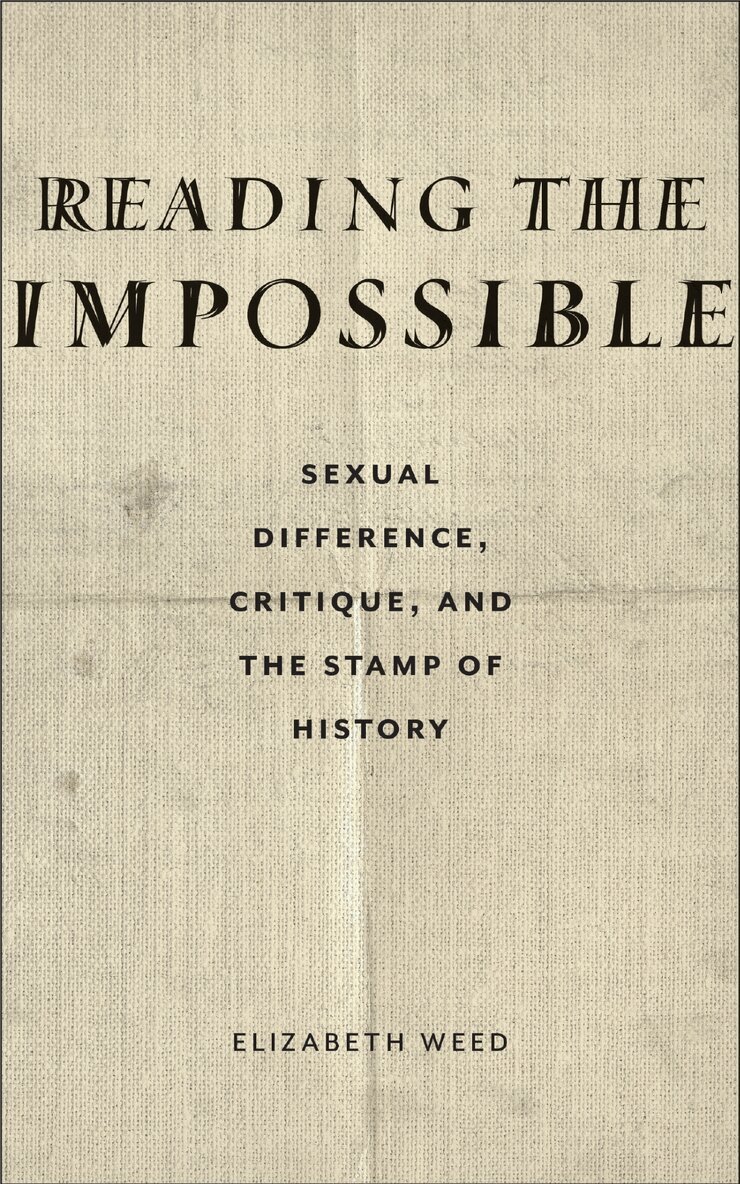
Reading the impossible has never seemed less possible. A few decades ago, critical readings could view the collapse of foundationalism optimistically. With meaning no longer soldered onto being, there was hope for all those beings whose meaning had been forever ordained by Nature or the Divine. Critical reading thus became a way of exploring the devious workings of knowledge and power. But as non-foundational systems of meaning have proven to be so perfectly suited to the transactional logics of the market, reading for the impasses of meaning has come to be seen as quixotic, impractical, and dated. To concur with that view, Elizabeth Weed argues, is to embrace the fantasy told by the neoliberal order. To read the impossible is to disrupt that fantasy, with its return to stable categories of marketable identity, in order to contest the inexorable workings of misogyny and racism. This book seeks to disturb the positivity of identity in the hope of retrieving the impossibility of sexual difference, an impossibility that has its effects in the Real of misogyny.A return to the famous debate between Derrida and Lacan on the impossibility of sexual difference yields two different readings of the impossible. In reconsidering these questions, Weed shows how the practice of reading can powerfully stage the wiles of language and the unconscious. In returning to that earlier moment in the context of current debates on the role of reading and interpretation, Weed offers a fresh perspective on what is at stake for critical reading in the neoliberal university.
297 kr
Skickas inom 7-10 vardagar
Reading the impossible has never seemed less possible. A few decades ago, critical readings could view the collapse of foundationalism optimistically. With meaning no longer soldered onto being, there was hope for all those beings whose meaning had been forever ordained by Nature or the Divine. Critical reading thus became a way of exploring the devious workings of knowledge and power. But as non-foundational systems of meaning have proven to be so perfectly suited to the transactional logics of the market, reading for the impasses of meaning has come to be seen as quixotic, impractical, and dated. To concur with that view, Elizabeth Weed argues, is to embrace the fantasy told by the neoliberal order. To read the impossible is to disrupt that fantasy, with its return to stable categories of marketable identity, in order to contest the inexorable workings of misogyny and racism. This book seeks to disturb the positivity of identity in the hope of retrieving the impossibility of sexual difference, an impossibility that has its effects in the Real of misogyny.A return to the famous debate between Derrida and Lacan on the impossibility of sexual difference yields two different readings of the impossible. In reconsidering these questions, Weed shows how the practice of reading can powerfully stage the wiles of language and the unconscious. In returning to that earlier moment in the context of current debates on the role of reading and interpretation, Weed offers a fresh perspective on what is at stake for critical reading in the neoliberal university.