Emma Borg - Böcker
Visar alla böcker från författaren Emma Borg. Handla med fri frakt och snabb leverans.
7 produkter
7 produkter
126 kr
Skickas inom 5-8 vardagar
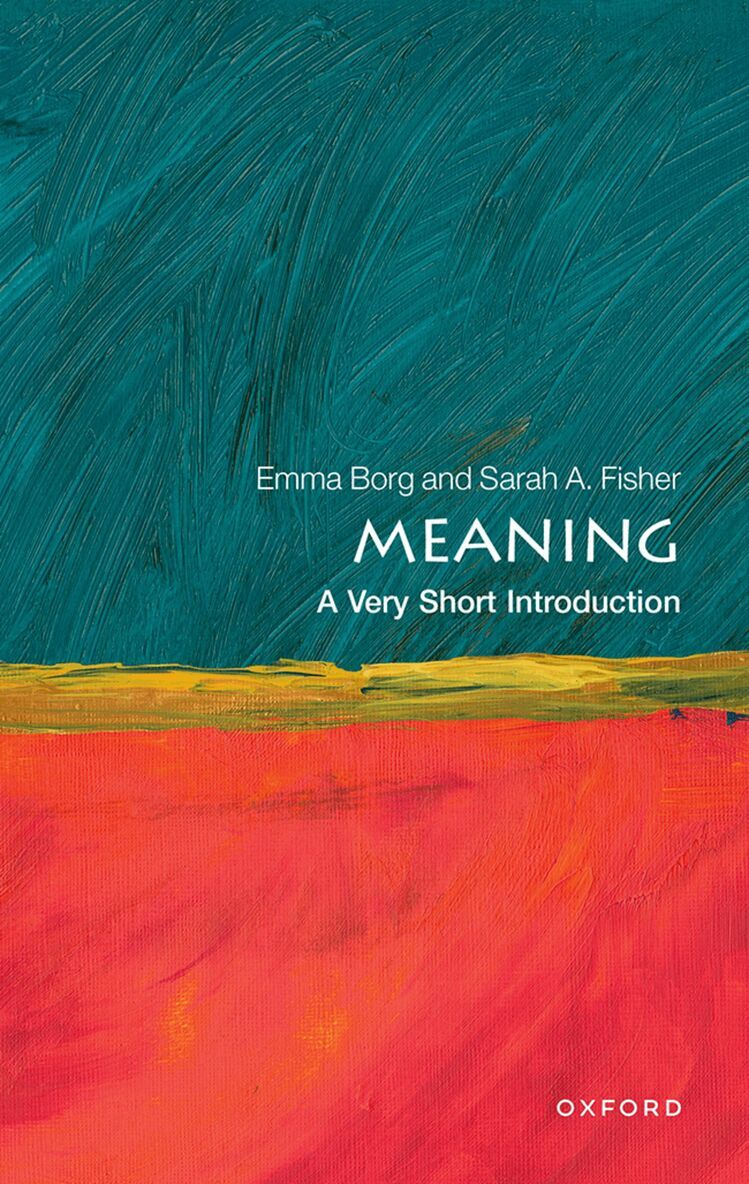
Very Short Introductions: Brilliant, Sharp, InspiringOur ability to find meaning in things is one of the most important aspects of human life. But it is also one of the most mysterious. Where does meaning come from? What sorts of things have meaning? And how do we grasp the meaning others want to convey? This Very Short Introduction is shaped by exploring possible answers to these questions.Human societies have one particularly important device for expressing and sharing meaning: language. Since our words are paradigm examples of things which have meaning, in this book, Emma Borg and Sarah Fisher use meaning in language as a case study for exploring meaning more generally. They focus on three possible sources for word meaning: things in the world, things in the mind, and social practices, exploring the key approaches thinkers have put forward in each of these arenas. Finally, they end by looking at some concrete applications of the ideas and approaches introduced in the book.ABOUT THE SERIES: The Very Short Introductions series from Oxford University Press contains hundreds of titles in almost every subject area. These pocket-sized books are the perfect way to get ahead in a new subject quickly. Our expert authors combine facts, analysis, perspective, new ideas, and enthusiasm to make interesting and challenging topics highly readable.
420 kr
Skickas inom 7-10 vardagar
Emma Borg examines the relation between semantics (roughly, features of the literal meaning of linguistic items) and pragmatics (features emerging from the context within which such items are being used), and assesses recent answers to the fundamental questions of how and where to draw the divide between the two. In particular, she offers a defence of what is commonly known as 'minimal semantics'. Minimal semantics, as the name suggests, wants to offer a minimal account of the interrelation between semantics and pragmatics. Specifically, it holds that while context can affect literal semantic content in the case of genuine (i.e. lexically or syntactically marked) context-sensitive expressions, this is the limit of pragmatic input to semantic content. On all other occasions where context of utterance appears to affect content, the minimalist claims that what it affects is not literal, semantic content but what the speaker conveys by the use of this literal content--it affects what a speaker says but not what a sentence means. As Borg makes clear, the minimalist must allow some contextual influence on semantic content, but her claim is that this influence can be limited to 'tame' pragmatics--the kind of rule-governed appeals to context which won't scare formally minded horses. Pursuing Meaning aims to make good on this claim. The book also contains an overview of all the main positions in the area, clarification of its often complex terminology, and an exploration of key themes such as word meaning, mindreading, and the relationship between semantics and psychology.
1 200 kr
Skickas inom 5-8 vardagar
Acting for Reasons is about why we do what we do. It's also about how we arrive at an understanding of other people's actions. A traditional view in philosophy - 'Common-sense Psychology' - holds that mental states like beliefs and desires (states which provide a person's reasons for doing what they do) lie at the heart of intentional action and social cognition. According to this view, typically, what people do is a rational response to the reasons they have: I open the cookie jar because I'd like a cookie and believe there is one in there. As a corollary, understanding someone else's actions is held to depend on attributing them plausible mental states and reasoning: I think you opened the cookie jar because you wanted a cookie and believed there was one in there. This reasons-responsive understanding of action lies at the heart of crucial social notions like agency and responsibility. However, it has been thrown into doubt by experimental findings which apparently show that the common-sense appeal to reasons and reasoning is overly demanding and overly intellectualising, painting an idealised picture of decision-making which is rarely borne out by the evidence. If we get out of our armchairs and examine how people actually make decisions, the claim is, what we find is that people don't do what they do, typically, based on the reasons they have. Instead, people are swayed by biases and flaws in their reasoning systems, using cognitive heuristics (intuitive, gut-feel decision-making processes) which bypass the proper consultation of reasons. Furthermore, if we look at how animals, infants, and adults under time or other pressures understand the actions of others, what we find is that they appeal to simpler systems (e.g. looking only at environmental factors and overt behaviour), providing a route to action understanding that circumvents attribution of reasons and reasoning. In short, then, experimental findings show that common-sense psychology is wrong. This book is an attempt to reject that line of argument and defend the common-sense perspective, vindicating the core philosophical idea that, in the typical case, people do what they do for the reasons they have.
703 kr
Skickas inom 5-8 vardagar
Minimal Semantics asks what a theory of literal linguistic meaning is for - if you were to be given a working theory of meaning for a language right now, what would you be able to do with it? Emma Borg sets out to defend a formal approach to semantic theorizing from a powerful contemporary opponent - advocates of what she call 'dual pragmatics'. According to dual pragmatists, rich pragmatic processes play two distinct roles in linguistic comprehension: as well as operating in a post-semantic capacity to determine the implicatures of an utterance, they also operate prior to the determination of truth-conditional content for a sentence. That is to say, they have an integral role to play within what is usually thought of as the semantic realm. Borg believes dual pragmatic accounts constitute the strongest challenge to standard formal approaches to semantics since they challenge the formal theorist to show not merely that there is some role for formal processes on route to determination of semantic content, but that such processes are alone sufficient for determining content. Minimal Semantics provides a detailed examination of this dual pragmatic position, introducing readers who are unfamiliar with the topic to key ideas like relevance theory and contextualism, and looking in detail at where these accounts diverge from the formal approach.Borg's defence of formal semantics has two main parts: first, she argues that the formal approach is most naturally compatible with an important and well-grounded psychological theory, namely the Fodorian modular picture of the mind. Then she argues that the main arguments adduced by dual pragmatists against formal semantics - concerning apparent contextual intrusions into semantic content - can in fact be countered by a formal theory. The defence holds, however, only if we are sensitive to the proper conditions of success for a semantic theory. Specifically, we should reject a range of onerous constraints on semantic theorizing (e.g., that it resolve epistemic or metaphysical questions, or that it explain our communicative skills). So Borg's answer to the question of what a semantic theory is for has a particular, minimal slant.
1 740 kr
Skickas inom 5-8 vardagar
Minimal Semantics asks what a theory of literal linguistic meaning is for - if you were to be given a working theory of meaning for a language right now, what would you be able to do with it? Emma Borg sets out to defend a formal approach to semantic theorising from a relatively new type of opponent - advocates of what she call 'dual pragmatics'. According to dual pragmatists, rich pragmatic processes play two distinct roles in linguistic comprehension: as well as operating in a post-semantic capacity to determine the implicatures of an utterance, they also operate prior to the determination of truth-conditional content for a sentence. That is to say, they have an integral role to play within what is usually thought of as the semantic realm. Borg believes dual pragmatic accounts constitute the strongest contemporary challenge to standard formal approaches to semantics since they challenge the formal theorist to show not merely that there is some role for formal processes on route to determination of semantic content, but that such processes are sufficient for determining content. Minimal Semantics provides a detailed examination of this school of thought, introducing readers who are unfamiliar with the topic to key ideas like relevance theory and contextualism, and looking in detail at where these accounts diverge from the formal approach.Borg's defence of formal semantics has two main parts: first, she argues that the formal approach is most naturally compatible with an important and well-grounded psychological theory, namely the Fodorian modular picture of the mind. Then she argues that the main arguments adduced by dual pragmatists against formal semantics - concerning apparent contextual intrusions into semantic content - can in fact be countered by a formal theory. The defence holds, however, only if we are sensitive to the proper conditions of success for a semantic theory. Specifically, we should reject a range of onerous constraints on semantic theorizing (e.g., that it answer epistemic or metaphysical questions, or that it explain our communicative skills) and instead adopt a quite minimal picture of semantics.
991 kr
Skickas inom 5-8 vardagar
Emma Borg examines the relation between semantics (roughly, features of the literal meaning of linguistic items) and pragmatics (features emerging from the context within which such items are being used), and assesses recent answers to the fundamental questions of how and where to draw the divide between the two. In particular, she offers a defence of what is commonly known as 'minimal semantics'. Minimal semantics, as the name suggests, wants to offer a minimal account of the interrelation between semantics and pragmatics. Specifically, it holds that while context can affect literal semantic content in the case of genuine (i.e. lexically or syntactically marked) context-sensitive expressions, this is the limit of pragmatic input to semantic content. On all other occasions where context of utterance appears to affect content, the minimalist claims that what it affects is not literal, semantic content but what the speaker conveys by the use of this literal content--it affects what a speaker says but not what a sentence means. As Borg makes clear, the minimalist must allow some contextual influence on semantic content, but her claim is that this influence can be limited to 'tame' pragmatics--the kind of rule-governed appeals to context which won't scare formally minded horses. Pursuing Meaning aims to make good on this claim. The book also contains an overview of all the main positions in the area, clarification of its often complex terminology, and an exploration of key themes such as word meaning, mindreading, and the relationship between semantics and psychology.
269 kr
Skickas inom 7-10 vardagar
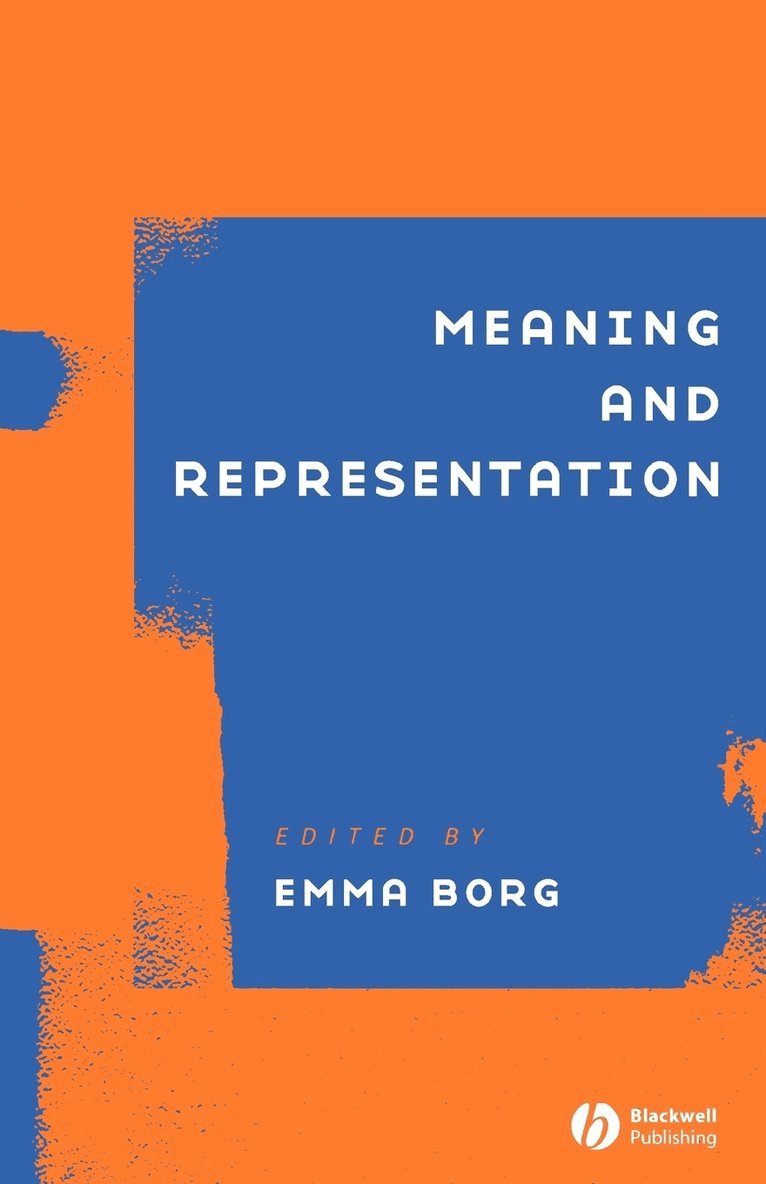
This prestigious collection of papers discusses the relationship between meaning and representation. Illustrates the differences that exist on the question of how formal representations relate to semantic representations. Includes contributions by Tim Crane, Jerry Fodor, Paul Horwich, John Hyman, Ernie Lepore, Gregory McCulloch and Mark Sainsbury.