Erwin Engeler - Böcker
Visar alla böcker från författaren Erwin Engeler. Handla med fri frakt och snabb leverans.
5 produkter
5 produkter
1 064 kr
Skickas inom 10-15 vardagar
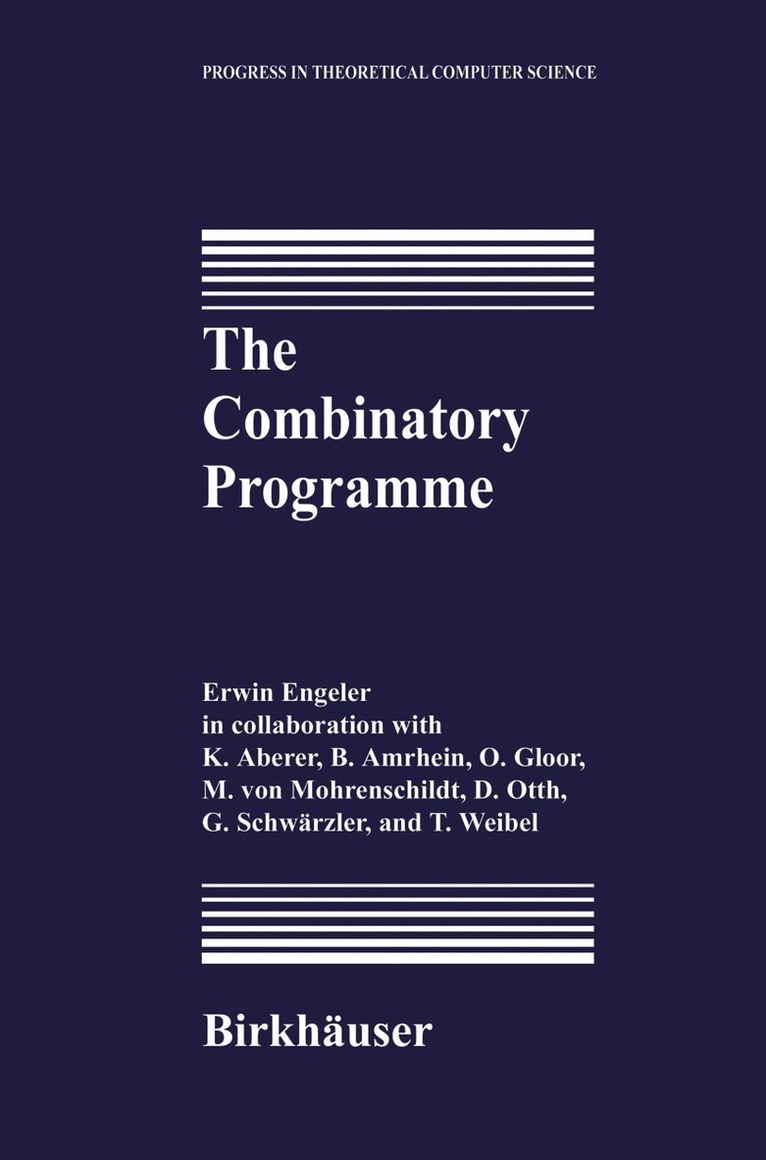
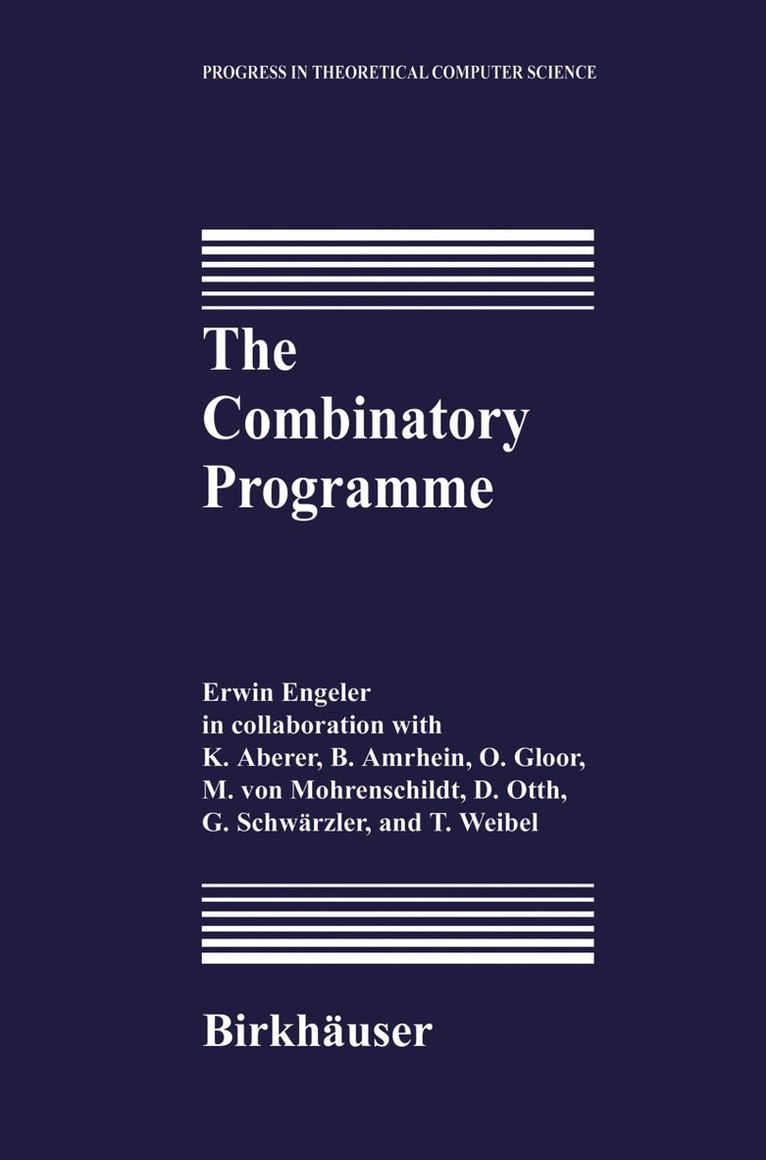
The purpose of the programme in combinatory logic is to rework the mathematical foundations of computer science on a theory of pure thought. It begins from the idea that, if logic is to be the science of correctly dealing with thought-objects, the underlying theory must be in some sense a part of, or at least a preliminary to, its structure, ie, a protologic. From this idea a combinatory algebra is constructed, using a programmatic mixture of the classical axiomatic and set-theoretic approaches. This text shows that sufficiently rich combinatory algebras can serve as a platform from which to develop the algorithmic aspects of many areas in computer science, mathematics and their applications. It should be of interest to those studying universal algebra, logic and computer algebra.
1 064 kr
Skickas inom 10-15 vardagar
Combinatory logic started as a programme in the foundation of mathematics and in an historical context at a time when such endeavours attracted the most gifted among the mathematicians. This small volume arose under quite differ ent circumstances, namely within the context of reworking the mathematical foundations of computer science. I have been very lucky in finding gifted students who agreed to work with me and chose, for their Ph. D. theses, subjects that arose from my own attempts 1 to create a coherent mathematical view of these foundations. The result of this collaborative work is presented here in the hope that it does justice to the individual contributor and that the reader has a chance of judging the work as a whole. E. Engeler ETH Zurich, April 1994 lCollected in Chapter III, An Algebraization of Algorithmics, in Algorithmic Properties of Structures, Selected Papers of Erwin Engeler, World Scientific PubJ. Co. , Singapore, 1993, pp. 183-257. I Historical and Philosophical Background Erwin Engeler In the fall of 1928 a young American turned up at the Mathematical Institute of Gottingen, a mecca of mathematicians at the time; he was a young man with a dream and his name was H. B. Curry. He felt that he had the tools in hand with which to solve the problem of foundations of mathematics mice and for all. His was an approach that came to be called "formalist" and embodied that later became known as Combinatory Logic.
451 kr
Skickas inom 10-15 vardagar
535 kr
Skickas inom 10-15 vardagar
This book appeared about ten years ago in Gennan. It started as notes for a course which I gave intermittently at the ETH over a number of years. Following repeated suggestions, this English translation was commissioned by Springer; they were most fortunate in finding translators whose mathemati cal stature, grasp of the language and unselfish dedication to the essentially thankless task of rendering the text comprehensible in a second language, both impresses and shames me. Therefore, my thanks go to Dr. Roberto Minio, now Darmstadt and Professor Charles Thomas, Cambridge. The task of preparing a La'JEX-version of the text was extremely daunting, owing to the complexity and diversity of the symbolisms inherent in the various parts of the book. Here, my warm thanks go to Barbara Aquilino of the Mathematics Department of the ETH, who spent tedious but exacting hours in front of her Olivetti. The present book is not primarily intended to teach logic and axiomat ics as such, nor is it a complete survey of what was once called "elementary mathematics from a higher standpoint". Rather, its goal is to awaken a certain critical attitude in the student and to help give this attitude some solid foun dation. Our mathematics students, having been drilled for years in high-school and college, and having studied the immense edifice of analysis, regrettably come away convinced that they understand the concepts of real numbers, Euclidean space, and algorithm.
1 428 kr
Tillfälligt slut
The work of Erwin Engeler in the logic and algebra of computer science has been influential but has become difficult to access because it has appeared in different types of publications. This collection of selected papers is therefore timely and useful. It represents an original and coherent approach to the basic interrelationships between mathematics and computer science.The volume begins with the area of enrichment of classical model theory by languages which express properties representing the outcome of hypothetical computer programs executed in a given class of mathematical structures, and is related to questions of correctness and provability of programs. This point of view allowed the generalization of classical Galois theory to the point of discussing the relation between structure and complexity of solution programs for problems posed in various mathematical theories. The algebraic approach is deepened and enlarged in the later papers by showing that the algorithmic aspects of any mathematical structure can be uniformly dealt with by expanding these structures into combinatory algebras.