Eugen Illenberger - Böcker
Visar alla böcker från författaren Eugen Illenberger. Handla med fri frakt och snabb leverans.
3 produkter
3 produkter
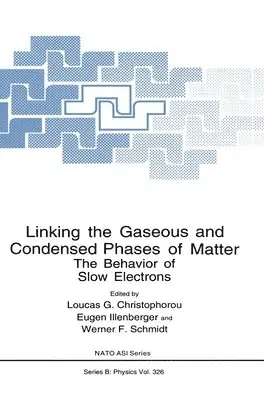
Linking the Gaseous and Condensed Phases of Matter
The Behavior of Slow Electrons
Inbunden, Engelska, 1994
852 kr
Skickas inom 10-15 vardagar
Linking the Gaseous and Condensed Phases of Matter
The Behavior of Slow Electrons
Häftad, Engelska, 2012
534 kr
Skickas inom 10-15 vardagar
The Advanced Study Institute (ASI) on "Linking the Gaseous and Condensed Phases of Matter: The Behavior of Slow Electrons" was held at Patras, Greece, September 5-18, 1993. The organizers of the Patras ASI felt that the study of the electronic properties of matter in various states of aggregation has advanced to a point where further progress required the interfacing of the phases of matter in order to find out and to understand how the microscopic and macroscopic properties of materials and processes change as we go from low pressure gas to the condensed phase. This approach is of foremost significance both from the point of view of basic research and of applications. Linking the electronic properties of the gaseous and condensed phases of matter is a fascinating new frontier of science embracing scientists not only from physics and chemistry but also from the life sciences and engineering. The Patras ASI brought together some of the world's foremost experts who work in the field of electronic properties of molecular gases, clusters, liquids, and solids. The thirty five lectures given at the meeting as well as the twenty nine poster papers presented and the formal and informal discussions that took place focused largely on the behavior of slow electrons in matter.
Gaseous Molecular Ions
An Introduction to Elementary Processes Induced by Ionization
Häftad, Engelska, 2012
536 kr
Skickas inom 10-15 vardagar
Most of the matter in our solar system, and, probably, within the whole universe, exists in the form of ionized particles. On the other hand, in our natural environ ment, gaseous matter generally consists of neutral atoms and molecules. Only under certain conditions, such as within the path oflightning or in several technical devices (e. g. gas discharges, rocket engines, etc. ) will some of the atoms and molecules be ionized. It is also believed that the chemistry of the earth's troposphere predomi nantly proceeds via reactions between neutral particles. (The complex system of atmospheric chemistry will be treated in one of the forthcoming volumes to this series. ) Why, then, are ions considered so important that hundreds oflaboratories all over the world (including some of the most prestigious) are involved in research pro grams on ions, covering many different facets, from biochemistry to physics? One may obtain as many different answers as there are research groups busy in this field. There is, however, one simple, common feature which makes it attractive to work with ions: since they carry one or more net elementary charges, they can easily be gui ded, focused or separated by appropriate electric and magnetic fields, and, last but not least, they can easily be detected. Apart from these advantages, which are welcome and appreciated by the researcher, the study of molecular ions can provide insight into very fundamental aspects of the general behavior of molecules.