Eystein Dahl – författare
Visar alla böcker från författaren Eystein Dahl. Handla med fri frakt och snabb leverans.
2 produkter
2 produkter
Del 50 - Oxford Studies in Diachronic and Historical Linguistics
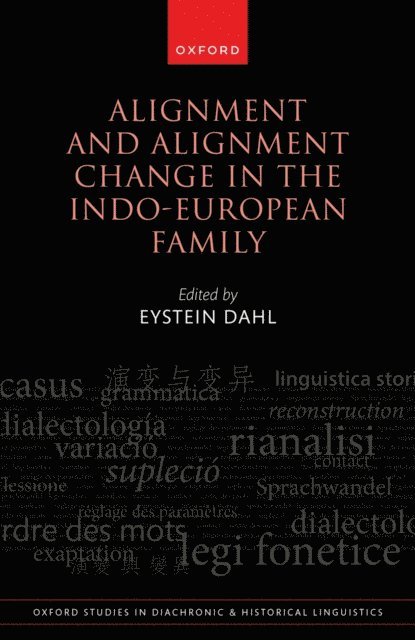
Alignment and Alignment Change in the Indo-European Family
Inbunden, Engelska, 2022
1 717 kr
Skickas inom 5-8 vardagar
This volume brings together work from leading specialists in Indo-European languages to explore the macro- and micro-dynamic factors that contribute to variation and change in alignment and argument realization. Alignment is taken to include both basic alignment patterns associated with major construction types, as well as various valency-decreasing constructions such as passives, anticausatives, and impersonals. The chapters explore synchronic and diachronic aspects of alignment morphosyntax based on data from Anatolian, Indo-Iranian, Greek, Italic, Armenian, and Slavic. All have a strong empirical focus, drawing on both qualitative and quantitative methods, and range from broad comparative studies to detailed investigations of specific constructions in individual languages. The book is one of very few studies to examine variation and change in alignment typology across languages in a single family. It contributes to a greater understanding of the roles played by analogy/extension, reanalysis, and areal factors in alignment change, and demonstrates the extent of variation found in the morphosyntax of argument realization in genetically-related languages.
1 605 kr
Skickas inom 3-6 vardagar
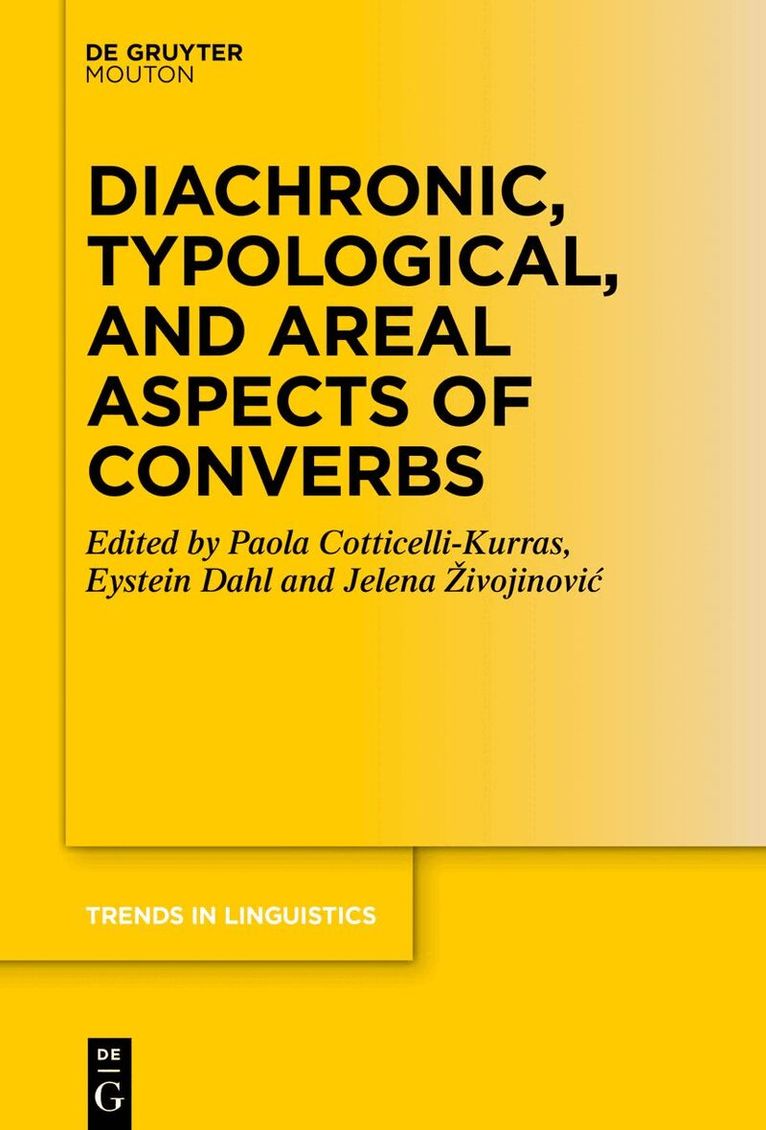
This book deals with the category of converbs, whose denomination refers to a set of structures which cross-linguistically are not comparable. Specifically, we tackle the following topics: (1) converbs and related constructions as areal features, distinguishing between a general coordinating and subordinating type of converb; (2) converbs in the context of linguistic families, particularly in the Indo-European domain, displaying different non-finite structures to express the adverbial domain; (3) converbial constructions and competing construction types, (4) the diachronic typology of converbs and their source constructions.