F. Grünwald – författare
Visar alla böcker från författaren F. Grünwald. Handla med fri frakt och snabb leverans.
7 produkter
7 produkter
Inbunden, Engelska, 2005
1 684 kr
Skickas inom 10-15 vardagar
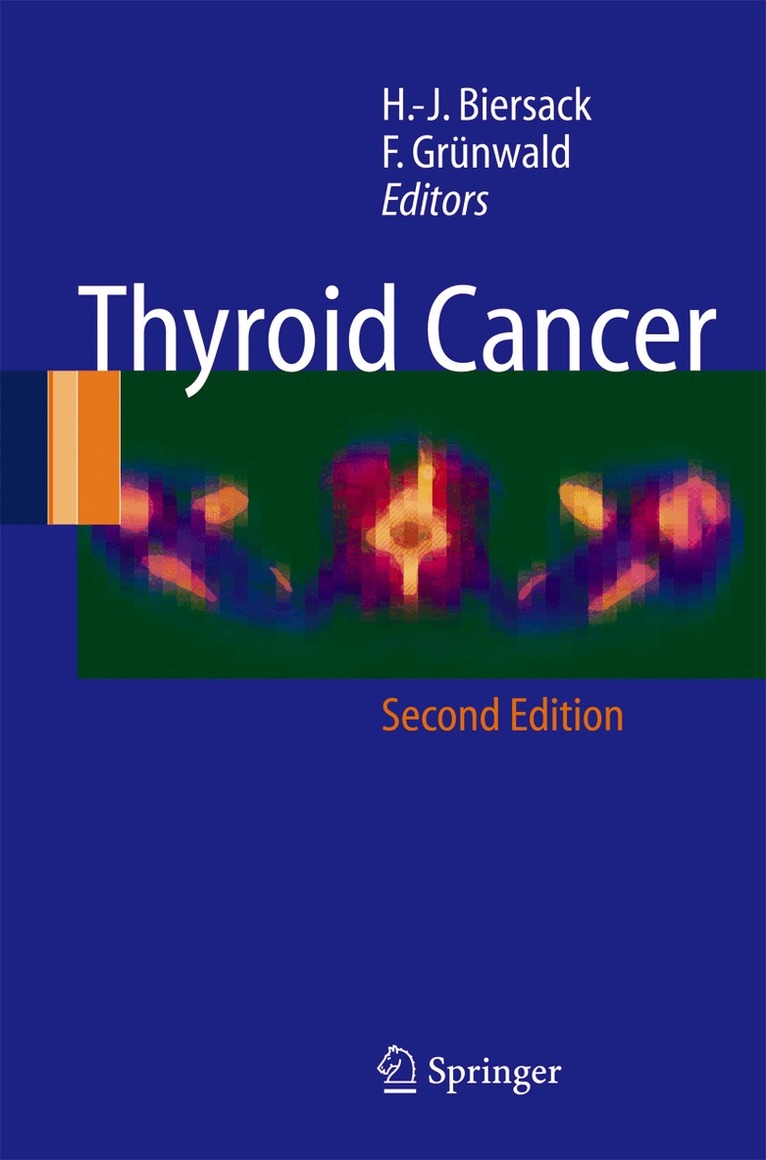
One of the main reasons for publishing this second edition of “T- roid Cancer” is the fact that the first edition has sold out. Furth- more, during the 4 years following the publication of the first edition in 2001, some progress, mainly in the basic sciences (molecular biology), has been made. The most prominent change in the clinical sciences has been the new classification of thyroid cancer, especially with relation to T1–T3 tumors. Now, tumors with a diameter of up to 2 cm are still classified T1. This new UICC classification (6th edition) follows the classification of the American Society of Pathology. These changes require a modification of the old guidelines. According to the Hedinger classification (1988) tumors with a diameter below 1 cm were classified as “papillary microcarcinoma of the thyroid”. Only in those tumors was total or nearly total thyroidectomy deemed unn- essary and I-131 therapy not a prerequisite for treatment. The majority of the chapters has been updated including references to many new publications. Two new chapters, on I-124 PET and - simetry, have been added. We strongly feel that this second edition of “Thyroid Cancer” is again a state-of-the-art overview of the diagnosis and treatment of thyroid cancer. Bonn, Frankfurt am Main H. -J. Biersack, F. Grünwald Preface to the First Edition Thyroid cancer was first described at the end of the eighteenth c- tury.
E-bok
PDF, Engelska, 20051 579 kr
Läs direkt efter köp
One of the main reasons for publishing this second edition of “T- roid Cancer” is the fact that the first edition has sold out. Furth- more, during the 4 years following the publication of the first edition in 2001, some progress, mainly in the basic sciences (molecular biology), has been made. The most prominent change in the clinical sciences has been the new classification of thyroid cancer, especially with relation to T1–T3 tumors. Now, tumors with a diameter of up to 2 cm are still classified T1. This new UICC classification (6th edition) follows the classification of the American Society of Pathology. These changes require a modification of the old guidelines. According to the Hedinger classification (1988) tumors with a diameter below 1 cm were classified as “papillary microcarcinoma of the thyroid”. Only in those tumors was total or nearly total thyroidectomy deemed unn- essary and I-131 therapy not a prerequisite for treatment. The majority of the chapters has been updated including references to many new publications. Two new chapters, on I-124 PET and - simetry, have been added. We strongly feel that this second edition of “Thyroid Cancer” is again a state-of-the-art overview of the diagnosis and treatment of thyroid cancer. Bonn, Frankfurt am Main H. -J. Biersack, F. Grünwald Preface to the First Edition Thyroid cancer was first described at the end of the eighteenth c- tury.
Häftad, Tyska, 2002
529 kr
Skickas inom 10-15 vardagar
Häftad, Engelska, 2014
1 237 kr
Skickas inom 10-15 vardagar
One of the main reasons for publishing this second edition of “T- roid Cancer” is the fact that the first edition has sold out. Furth- more, during the 4 years following the publication of the first edition in 2001, some progress, mainly in the basic sciences (molecular biology), has been made. The most prominent change in the clinical sciences has been the new classification of thyroid cancer, especially with relation to T1–T3 tumors. Now, tumors with a diameter of up to 2 cm are still classified T1. This new UICC classification (6th edition) follows the classification of the American Society of Pathology. These changes require a modification of the old guidelines. According to the Hedinger classification (1988) tumors with a diameter below 1 cm were classified as “papillary microcarcinoma of the thyroid”. Only in those tumors was total or nearly total thyroidectomy deemed unn- essary and I-131 therapy not a prerequisite for treatment. The majority of the chapters has been updated including references to many new publications. Two new chapters, on I-124 PET and - simetry, have been added. We strongly feel that this second edition of “Thyroid Cancer” is again a state-of-the-art overview of the diagnosis and treatment of thyroid cancer. Bonn, Frankfurt am Main H. -J. Biersack, F. Grünwald Preface to the First Edition Thyroid cancer was first described at the end of the eighteenth c- tury.
E-bok
PDF, Tyska, 2013446 kr
Läs direkt efter köp
E-bok
PDF, Tyska, 2013535 kr
Läs direkt efter köp
Es wird erstmals ein kurzgefaßtes Kompendium der Nuklearmedizin für Studenten und Assistenzärzte aller Disziplinen vorgestellt. In allgemeinverständlicher Form werden die wichtigsten nuklearmedizinischen Methoden in das Spektrum anderer Diagnoseverfahren eingeordnet und Indikationen für nuklearmedizinische Untersuchungen herausgearbeitet.
E-bok
PDF, Engelska, 20131 142 kr
Läs direkt efter köp
Thyroid cancer was first described at the end of the eighteenth cen tury. For one and a half centuries surgery remained the only effective therapeutic option for this cancer, until in 1946 radioiodine therapy was performed for the first time. Radioiodine therapy was brought to Germany 4 years later, in 1950. In the intervening 50 years, the use of iodine-131 has proved able to cure the cancer and its metastases. Per cutaneous radiation therapy had been added to the therapeutic ar mamentarium, but even now there is heated debate as to its potential. Suppressive 1-thyroxine supplement is a prerequisite for successful treatment, while cytotoxic drugs are mainly used for palliation. During the past 10 years, various new diagnostic and therapeutic approaches have been introduced. High-dose radioiodine therapy as well as redifferentiation therapy with retinoic acid seem beneficial. Diagnostic procedures such as magnetic resonance imaging (MRI), positron emission tomography (PET), as well as isonitriles (MIBI) 201 and thallium ( Tl), have proved useful for the follow-up of thyroid cancer. Two special issues are also discussed in this book. Iodine supple mentation in areas of iodine deficiency has led to a change in pathol ogy insofar as papillary thyroid cancer (with a better prognosis) has become more frequent than follicular carcinoma. A special chapter is dedicated to thyroid cancer in Chernobyl children.