Fabricio Fortese – författare
2 494 kr
Skickas inom 5-8 vardagar
2 200 kr
Läs direkt efter köp
The interpretation and application of the competence-competence principle are not uniform across jurisdictions. Conflicting approaches – to the extent, effects, and consequences of permitting an arbitral tribunal to decide on its own jurisdiction and the proper timing for judicial involvement – rest upon significant theoretical and policy concerns that have practical implications. Focusing on Article 8(1) of the UNCITRAL Model Law on International Commercial Arbitration, this book thoroughly examines a question of timing: whether national courts should (or could) conclusively settle jurisdictional disputes before or after the arbitrators have determined jurisdiction.
Covered in the analysis are such salient issues and aspects as the following:
prima facie versus plenary or full standard of judicial review;
obligations and powers the law affords judges in the presence of an (even putative) arbitration agreement;
cases highlighting the controversies in interpreting and applying the Model Law’s concepts, principles, and rules; and
detailed analysis of the text of the Model Law, including its drafting history.
Article 8(1) of the Model Law is analysed according to its interplay with other provisions of the same instrument and the New York Convention.
As a nuanced, deeply informed approach to interpreting national arbitration statutes that adopt the UNCITRAL Model Law, this book will help practitioners and judges approach judicial disputes over arbitral jurisdiction with full awareness of applicable rules and principles in an arbitration-friendly fashion. It provides matchless guidance through the intricacies of early determination of jurisdiction by balancing the legitimacy, efficacy, and efficiency of arbitration. For academics and policymakers, it will contribute to an ongoing paradigm shift away from state law and methodological nationalism towards transnational legal pluralism.
2 200 kr
Läs direkt efter köp
The interpretation and application of the competence-competence principle are not uniform across jurisdictions. Conflicting approaches – to the extent, effects, and consequences of permitting an arbitral tribunal to decide on its own jurisdiction and the proper timing for judicial involvement – rest upon significant theoretical and policy concerns that have practical implications. Focusing on Article 8(1) of the UNCITRAL Model Law on International Commercial Arbitration, this book thoroughly examines a question of timing: whether national courts should (or could) conclusively settle jurisdictional disputes before or after the arbitrators have determined jurisdiction.
Covered in the analysis are such salient issues and aspects as the following:
prima facie versus plenary or full standard of judicial review;
obligations and powers the law affords judges in the presence of an (even putative) arbitration agreement;
cases highlighting the controversies in interpreting and applying the Model Law’s concepts, principles, and rules; and
detailed analysis of the text of the Model Law, including its drafting history.
Article 8(1) of the Model Law is analysed according to its interplay with other provisions of the same instrument and the New York Convention.
As a nuanced, deeply informed approach to interpreting national arbitration statutes that adopt the UNCITRAL Model Law, this book will help practitioners and judges approach judicial disputes over arbitral jurisdiction with full awareness of applicable rules and principles in an arbitration-friendly fashion. It provides matchless guidance through the intricacies of early determination of jurisdiction by balancing the legitimacy, efficacy, and efficiency of arbitration. For academics and policymakers, it will contribute to an ongoing paradigm shift away from state law and methodological nationalism towards transnational legal pluralism.
1 962 kr
Läs direkt efter köp
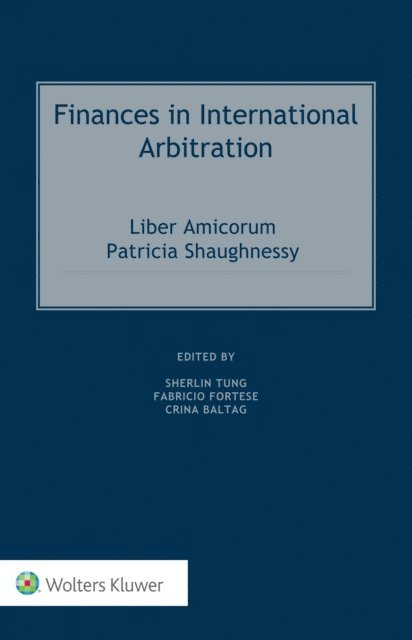
Finances in International Arbitration Liber Amicorum Patricia Shaughnessy Edited by Sherlin Tung, Fabricio Fortese & Crina Baltag
Costs of arbitration has always been a main concern in international arbitration. It is a topic most often discussed and analyzed. In spite of the recent developments in thirdparty funding regulations as well as other mechanisms made available to users of arbitration to reduce costs, the topic remains a key focus for users of arbitration.
As the founder of the world’s leading international commercial arbitration Master’s programme, Dr Patricia Shaughnessy is a huge advocate of communicating recent and important developments in international arbitration and has written and spoken extensively on such matters. Over twenty-five renowned practitioners and academics worldwide, who have been influenced by Dr Shaughnessy, explore this much-debated topic on the occasion of her 65th birthday.
The contributions in this dedication to Dr Shaughnessy’s legacy look at issues such as the following:
costs arising out of Third-Party Funding; costs of court proceedings versus arbitration proceedings; fee arrangements with legal counsel; costs of commercial versus investment arbitration; how to deal with in-house costs in international arbitration; impact of tribunal secretaries in international arbitration; cost sanctions in international arbitration; damages in international arbitration.The analysis and views offered by leading scholars and practitioners on current day issues arising out of costs of arbitration will offer readers a unique perspective on various aspects of the finances involved in arbitration. This book will provide insightful thoughts and practical guidance for academics and practitioners in the field of international arbitration.
1 893 kr
Läs direkt efter köp
Finances in International Arbitration Liber Amicorum Patricia Shaughnessy Edited by Sherlin Tung, Fabricio Fortese & Crina Baltag
Costs of arbitration has always been a main concern in international arbitration. It is a topic most often discussed and analyzed. In spite of the recent developments in thirdparty funding regulations as well as other mechanisms made available to users of arbitration to reduce costs, the topic remains a key focus for users of arbitration.
As the founder of the world’s leading international commercial arbitration Master’s programme, Dr Patricia Shaughnessy is a huge advocate of communicating recent and important developments in international arbitration and has written and spoken extensively on such matters. Over twenty-five renowned practitioners and academics worldwide, who have been influenced by Dr Shaughnessy, explore this much-debated topic on the occasion of her 65th birthday.
The contributions in this dedication to Dr Shaughnessy’s legacy look at issues such as the following:
costs arising out of Third-Party Funding; costs of court proceedings versus arbitration proceedings; fee arrangements with legal counsel; costs of commercial versus investment arbitration; how to deal with in-house costs in international arbitration; impact of tribunal secretaries in international arbitration; cost sanctions in international arbitration; damages in international arbitration.The analysis and views offered by leading scholars and practitioners on current day issues arising out of costs of arbitration will offer readers a unique perspective on various aspects of the finances involved in arbitration. This book will provide insightful thoughts and practical guidance for academics and practitioners in the field of international arbitration.
2 846 kr
Skickas inom 5-8 vardagar
2 424 kr
Läs direkt efter köp
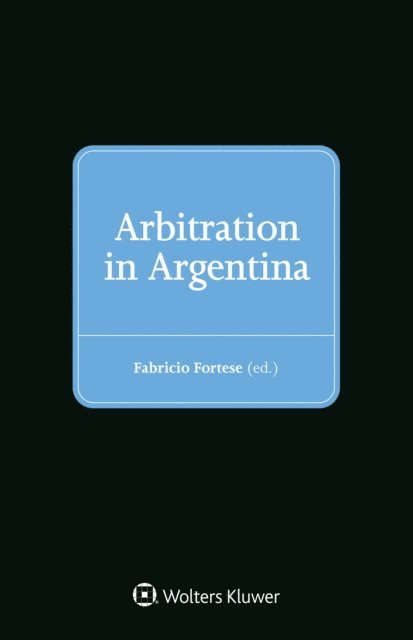
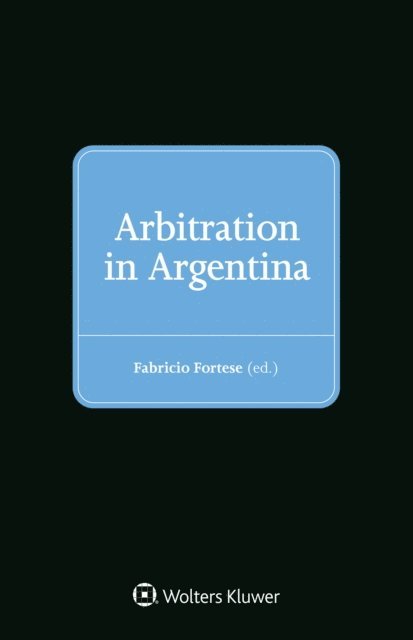
This publication is the most comprehensive international book on arbitration in Argentina. It provides a complete description and analysis of the historical and contemporary structure of arbitration law and practice in the country, which is based on the UNCITRAL Model Law. Its chapters are authored by many of the most regarded Argentine authorities, many of whom are responsible for drafting Argentina’s current arbitration regulation.
Throughout its thirty-one chapters, the book covers an ample number of topics in commercial and investment arbitration, and an exhaustive analysis of arbitration in different specific fields (energy, sports, consumers, among others). Some of the topics addressed in this book include the following:
regulatory framework of arbitration in Argentina; arbitration agreements; arbitral proceedings and the applicable law; issues of arbitrability; interim measures; costs and financing of arbitrations; validity, recognition and enforcement of awards; arbitration and the MERCOSUR.This publication also includes some particular studies, for example those related to the tensions between investment arbitration and human rights, as well as the relationship between the country and the ICC, and the PCA. Although mainly focused in Argentina, the discussions contained in several contributions exceed such geographical boundaries.
Given that the law and practice of arbitration in Argentina has seen remarkable changes in recent decades, this book is an essential tool for arbitrators, judges, in-house counsels, global law firms, large- and medium-sized companies doing transnational business, interested academics, and international arbitration centres. Because this publication draws from the teachings and experience of leading academics and practitioners, arbitration specialists will find in it all the guidance needed to identify and assess the different theoretical and practical legal avenues available when working on arbitrations with a seat in Argentina or with an Argentine element.
2 339 kr
Läs direkt efter köp
This publication is the most comprehensive international book on arbitration in Argentina. It provides a complete description and analysis of the historical and contemporary structure of arbitration law and practice in the country, which is based on the UNCITRAL Model Law. Its chapters are authored by many of the most regarded Argentine authorities, many of whom are responsible for drafting Argentina’s current arbitration regulation.
Throughout its thirty-one chapters, the book covers an ample number of topics in commercial and investment arbitration, and an exhaustive analysis of arbitration in different specific fields (energy, sports, consumers, among others). Some of the topics addressed in this book include the following:
regulatory framework of arbitration in Argentina; arbitration agreements; arbitral proceedings and the applicable law; issues of arbitrability; interim measures; costs and financing of arbitrations; validity, recognition and enforcement of awards; arbitration and the MERCOSUR.This publication also includes some particular studies, for example those related to the tensions between investment arbitration and human rights, as well as the relationship between the country and the ICC, and the PCA. Although mainly focused in Argentina, the discussions contained in several contributions exceed such geographical boundaries.
Given that the law and practice of arbitration in Argentina has seen remarkable changes in recent decades, this book is an essential tool for arbitrators, judges, in-house counsels, global law firms, large- and medium-sized companies doing transnational business, interested academics, and international arbitration centres. Because this publication draws from the teachings and experience of leading academics and practitioners, arbitration specialists will find in it all the guidance needed to identify and assess the different theoretical and practical legal avenues available when working on arbitrations with a seat in Argentina or with an Argentine element.