Federico Ferrara - Böcker
Visar alla böcker från författaren Federico Ferrara. Handla med fri frakt och snabb leverans.
4 produkter
4 produkter
360 kr
Skickas inom 7-10 vardagar
While the literature on “new institutionalism” explains the stability of institutional arrangements within countries and the divergence of paths of institutional development between countries, Federico Ferrara takes a “historical institutionalist” approach to theorize dynamic processes of institutional reproduction, institutional decay, and institutional change in explaining the development of political institutions. Ferrara synthesizes “power-based” or “power-distributional” explanations and “ideas-based” “legitimation explanations.” He specifies the psychological “microfoundations” of processes of institutional development, drawing heavily from the findings of experimental psychology to ensure that the explanation is grounded in clear and realistic assumptions regarding human motivation, cognition, and behavior. Aside from being of interest to scholars and graduate students in political science and other social-scientific disciplines whose research concentrates on the genesis of political institutions, their evolution over time, and their impact on the stability of political order and the quality of governance, the book will be required reading in graduate courses and seminars in comparative politics where the study of institutions and their development ranks among the subfield’s most important subjects.
795 kr
Skickas inom 7-10 vardagar
While the literature on “new institutionalism” explains the stability of institutional arrangements within countries and the divergence of paths of institutional development between countries, Federico Ferrara takes a “historical institutionalist” approach to theorize dynamic processes of institutional reproduction, institutional decay, and institutional change in explaining the development of political institutions. Ferrara synthesizes “power-based” or “power-distributional” explanations and “ideas-based” “legitimation explanations.” He specifies the psychological “microfoundations” of processes of institutional development, drawing heavily from the findings of experimental psychology to ensure that the explanation is grounded in clear and realistic assumptions regarding human motivation, cognition, and behavior. Aside from being of interest to scholars and graduate students in political science and other social-scientific disciplines whose research concentrates on the genesis of political institutions, their evolution over time, and their impact on the stability of political order and the quality of governance, the book will be required reading in graduate courses and seminars in comparative politics where the study of institutions and their development ranks among the subfield’s most important subjects.
1 192 kr
Skickas inom 7-10 vardagar
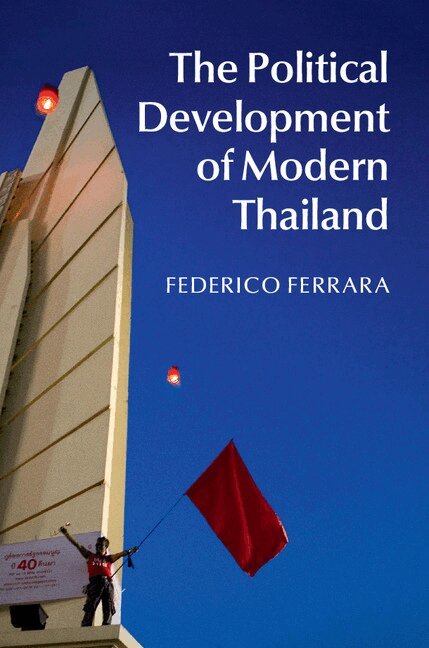
Based on extensive, empirical research, The Political Development of Modern Thailand analyses the country's political history from the late nineteenth century to the present day. Long known for political instability, Thailand was thrust into a deep state of crisis by a royalist military coup staged in 2006. Since then, conservative royalists have overthrown more elected governments after violent street protests, while equally disruptive demonstrations staged by supporters of electoral democracy were crushed by military force. Federico Ferrara traces the roots of the crisis to unresolved struggles regarding the content of Thailand's national identity, dating back to the abolition of absolute monarchy in 1932. He explains the conflict's re-intensification with reference to a growing chasm between the hierarchical worldview of Thailand's hegemonic 'royal nationalism' and the aspirations that millions of ordinary people have come to harbour as a result of modernisation.
428 kr
Skickas inom 7-10 vardagar
Based on extensive, empirical research, The Political Development of Modern Thailand analyses the country's political history from the late nineteenth century to the present day. Long known for political instability, Thailand was thrust into a deep state of crisis by a royalist military coup staged in 2006. Since then, conservative royalists have overthrown more elected governments after violent street protests, while equally disruptive demonstrations staged by supporters of electoral democracy were crushed by military force. Federico Ferrara traces the roots of the crisis to unresolved struggles regarding the content of Thailand's national identity, dating back to the abolition of absolute monarchy in 1932. He explains the conflict's re-intensification with reference to a growing chasm between the hierarchical worldview of Thailand's hegemonic 'royal nationalism' and the aspirations that millions of ordinary people have come to harbour as a result of modernisation.