Forrest Maltzman - Böcker
Visar alla böcker från författaren Forrest Maltzman. Handla med fri frakt och snabb leverans.
5 produkter
5 produkter
349 kr
Skickas inom 7-10 vardagar
Since Woodrow Wilson, political scientists have recognized the importance of congressional committees in the policy-making process. Congressional committees often determine what legislation will reach the floor of the House or Senate and what form that legislation will take. In spite of the broad consensus on the importance of congressional committees, there is little agreement on what explains committee action. Committees are alternately viewed as agents of the chamber, the party caucuses, or constituencies outside the institution. Each theory suggests a different distribution of power in the policy-making process.Forrest Maltzman argues that none of these models fully captures the role performed by congressional committees and that committee members attempt to balance the interests of the chamber, the party caucus, and outside constituencies. Over time, and with the changing importance of a committee's agenda to these groups, the responsiveness of members of committees will vary. Maltzman argues that the responsiveness of the committee to these groups is driven by changes in procedure, the strength of the party caucus, and the salience of a committee's agenda. Maltzman tests his theory against historical data.This book will appeal to social scientists interested in the study of Congress and legislative bodies, as well as those interested in studying the impact of institutional structure on the policy-making process."This specialized study, of value to congressional scholars and partisan activists, enriches an understanding of the increasingly predictable patterns of committee variety." --ChoiceForrest Maltzman is Assistant Professor of Political Science, George Washington University.
951 kr
Skickas inom 7-10 vardagar
Material is gleaned from internal memos circulated among justices on the Supreme Court to systematically account for the building of majority opinions. The authors argue that at the heart of this process are policy-seeking justices who are constrained by the choices made by the other justices. By strategically using threats, signals, and persuasion, justices attempt to influence the behavior of their colleagues on the bench. Evidence derived from the recently released papers of justices Brennan, Douglas, Marshall, and Powell is used to test the authors' theory of opinion writing. The portrait of the Supreme Court that emerges stands in sharp contrast to the conventional portrait where justices act solely on the basis of the law or their personal policy preferences. This book provides a fascinating glimpse of how the Court crafts the law.
273 kr
Skickas inom 7-10 vardagar
Material is gleaned from internal memos circulated among justices on the Supreme Court to systematically account for the building of majority opinions. The authors argue that at the heart of this process are policy-seeking justices who are constrained by the choices made by the other justices. By strategically using threats, signals, and persuasion, justices attempt to influence the behavior of their colleagues on the bench. Evidence derived from the recently released papers of justices Brennan, Douglas, Marshall, and Powell is used to test the authors' theory of opinion writing. The portrait of the Supreme Court that emerges stands in sharp contrast to the conventional portrait where justices act solely on the basis of the law or their personal policy preferences. This book provides a fascinating glimpse of how the Court crafts the law.
293 kr
Skickas inom 7-10 vardagar
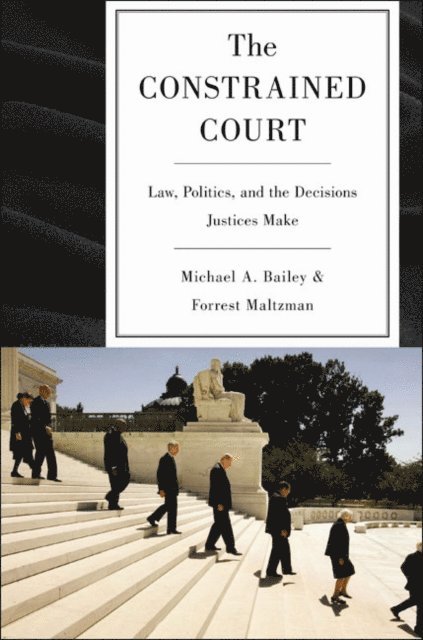
How do Supreme Court justices decide their cases? Do they follow their policy preferences? Or are they constrained by the law and by other political actors? The Constrained Court combines new theoretical insights and extensive data analysis to show that law and politics together shape the behavior of justices on the Supreme Court. Michael Bailey and Forrest Maltzman show how two types of constraints have influenced the decision making of the modern Court. First, Bailey and Maltzman document that important legal doctrines, such as respect for precedents, have influenced every justice since 1950. The authors find considerable variation in how these doctrines affect each justice, variation due in part to the differing experiences justices have brought to the bench. Second, Bailey and Maltzman show that justices are constrained by political factors. Justices are not isolated from what happens in the legislative and executive branches, and instead respond in predictable ways to changes in the preferences of Congress and the president. The Constrained Court shatters the myth that justices are unconstrained actors who pursue their personal policy preferences at all costs.By showing how law and politics interact in the construction of American law, this book sheds new light on the unique role that the Supreme Court plays in the constitutional order.
277 kr
Skickas inom 10-15 vardagar
For better or worse, federal judges in the United States today are asked to resolve some of the nation's most important and contentious public policy issues. Although some hold onto the notion that federal judges are simply neutral arbiters of complex legal questions, the justices who serve on the Supreme Court and the judges who sit on the lower federal bench are in fact crafters of public law. In recent years, for example, the Supreme Court has bolstered the rights of immigrants, endorsed the constitutionality of school vouchers, struck down Washington D.C.'s blanket ban on handgun ownership, and most famously, determined the outcome of the 2000 presidential election. The judiciary now is an active partner in the making of public policy.Judicial selection has been contentious at numerous junctures in American history, but seldom has it seemed more acrimonious and dysfunctional than in recent years. Fewer than half of recent appellate court nominees have been confirmed, and at times over the past few years, over ten percent of the federal bench has sat vacant. Many nominations linger in the Senate for months, even years. All the while, the judiciary's caseload grows. Advice and Dissent explores the state of the nation's federal judicial selection systema process beset by deepening partisan polarization, obstructionism, and deterioration of the practice of advice and consent.Focusing on the selection of judges for the U.S. Courts of Appeals and the U.S. District Courts, the true workhorses of the federal bench, Sarah A. Binder and Forrest Maltzman reconstruct the history and contemporary practice of advice and consent. They identify the political and institutional causes of conflict over judicial selection over the past sixty years, as well as the consequences of such battles over court appointments. Advice and Dissent offers proposals for reforming the institutions of judicial selection, advocating pragmatic reforms that seek to harness the incentives of presidents and senators together. How well lawmakers confront the breakdown in advice and consent will have lasting consequences for the institutional capacity of the U.S. Senate and for the performance of the federal bench.