Francesca R. Jensenius – författare
Visar alla böcker från författaren Francesca R. Jensenius. Handla med fri frakt och snabb leverans.
6 produkter
6 produkter
Inbunden, Engelska, 2017
1 509 kr
Skickas inom 5-8 vardagar
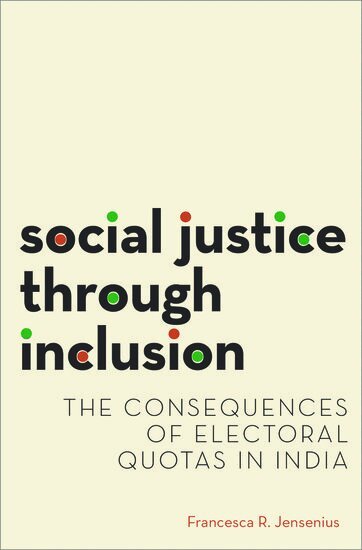
Across the world, governments design and implement policies with the explicit goal of promoting social justice. But can such institutions change entrenched social norms? And what effects should we expect from differently designed policies? Francesca R. Jensenius' Social Justice through Inclusion is an empirically rich study of one of the most extensive electoral quota systems in the world: the reserved seats for the Scheduled Castes (SCs, the former "untouchables") in India's legislative assemblies. Combining evidence from quantitative datasets from the period 1969-2012, archival work, and in-depth interviews with politicians, civil servants, and voters across India, the book explores the long-term effects of electoral quotas for the political elite and the general population. It shows that the quota system has played an important role in reducing caste-based discrimination, particularly at the elite level. Interestingly, this is not because the system has led to more group representation - SC politicians working specifically for SC interests - but because it has made possible the creation and empowerment of a new SC elite who have gradually become integrated into mainstream politics. This is a study of India, but the findings and discussions have broader implications. Policies such as quotas are usually supported with arguments about various assumed positive long-term consequences. The nuanced discussions in this book shed light on how electoral quotas for SCs have shaped the incentives for politicians, parties, and voters, and indicate the trade-offs inherent in how such policies of group inclusion are designed.
Häftad, Engelska, 2017
396 kr
Skickas inom 5-8 vardagar
Across the world, governments design and implement policies with the explicit goal of promoting social justice. But can such institutions change entrenched social norms? And what effects should we expect from differently designed policies? Francesca R. Jensenius' Social Justice through Inclusion is an empirically rich study of one of the most extensive electoral quota systems in the world: the reserved seats for the Scheduled Castes (SCs, the former "untouchables") in India's legislative assemblies. Combining evidence from quantitative datasets from the period 1969-2012, archival work, and in-depth interviews with politicians, civil servants, and voters across India, the book explores the long-term effects of electoral quotas for the political elite and the general population. It shows that the quota system has played an important role in reducing caste-based discrimination, particularly at the elite level. Interestingly, this is not because the system has led to more group representation - SC politicians working specifically for SC interests - but because it has made possible the creation and empowerment of a new SC elite who have gradually become integrated into mainstream politics. This is a study of India, but the findings and discussions have broader implications. Policies such as quotas are usually supported with arguments about various assumed positive long-term consequences. The nuanced discussions in this book shed light on how electoral quotas for SCs have shaped the incentives for politicians, parties, and voters, and indicate the trade-offs inherent in how such policies of group inclusion are designed.
E-bok
PDF, Engelska, 2017351 kr
Läs direkt efter köp
Across the world, governments design and implement policies with the explicit goal of promoting social justice. But can such institutions change entrenched social norms? And what effects should we expect from differently designed policies? Francesca R. Jensenius'' Social Justice through Inclusion is an empirically rich study of one of the most extensive electoral quota systems in the world: the reserved seats for the Scheduled Castes (SCs, the former "untouchables") in India''s legislative assemblies. Combining evidence from quantitative datasets from the period 1969-2012, archival work, and in-depth interviews with politicians, civil servants, and voters across India, the book explores the long-term effects of electoral quotas for the political elite and the general population. It shows that the quota system has played an important role in reducing caste-based discrimination, particularly at the elite level. Interestingly, this is not because the system has led to more group representation - SC politicians working specifically for SC interests - but because it has made possible the creation and empowerment of a new SC elite who have gradually become integrated into mainstream politics. This is a study of India, but the findings and discussions have broader implications. Policies such as quotas are usually supported with arguments about various assumed positive long-term consequences. The nuanced discussions in this book shed light on how electoral quotas for SCs have shaped the incentives for politicians, parties, and voters, and indicate the trade-offs inherent in how such policies of group inclusion are designed.
355 kr
Läs direkt efter köp
Across the world, governments design and implement policies with the explicit goal of promoting social justice. But can such institutions change entrenched social norms? And what effects should we expect from differently designed policies? Francesca R. Jensenius'' Social Justice through Inclusion is an empirically rich study of one of the most extensive electoral quota systems in the world: the reserved seats for the Scheduled Castes (SCs, the former "untouchables") in India''s legislative assemblies. Combining evidence from quantitative datasets from the period 1969-2012, archival work, and in-depth interviews with politicians, civil servants, and voters across India, the book explores the long-term effects of electoral quotas for the political elite and the general population. It shows that the quota system has played an important role in reducing caste-based discrimination, particularly at the elite level. Interestingly, this is not because the system has led to more group representation - SC politicians working specifically for SC interests - but because it has made possible the creation and empowerment of a new SC elite who have gradually become integrated into mainstream politics. This is a study of India, but the findings and discussions have broader implications. Policies such as quotas are usually supported with arguments about various assumed positive long-term consequences. The nuanced discussions in this book shed light on how electoral quotas for SCs have shaped the incentives for politicians, parties, and voters, and indicate the trade-offs inherent in how such policies of group inclusion are designed.
Inbunden, Engelska, 2027
888 kr
Kommande
While ethnic voting is usually linked with stable voting patterns, Indian elections are notoriously fragmented and difficult to predict. The Reciprocity Trap argues that the instability of Indian elections can largely be attributed to the weakness and mobilizational strategy of political parties, which leads to the under-mobilization of the poor. Using an impressive array of data, ranging from geo-coded polling station data to elite interviews, Pradeep Chhibber and Francesca Jensenius show how the poor are more likely to shift their allegiance between elections, to "waste" their vote on unviable contenders, and less likely to participate in all forms of political activities. This groundbreaking work reintegrates class and economic status into the study of South Asian politics, which has long been dominated by discussions of identity politics, showing that while identity groups may provide a stable source of support for parties, the volatile choices of the under-mobilized poor ultimately determine who wins elections. This title is also available as Open Access on Cambridge Core.
Häftad, Engelska, 2027
300 kr
Kommande
While ethnic voting is usually linked with stable voting patterns, Indian elections are notoriously fragmented and difficult to predict. The Reciprocity Trap argues that the instability of Indian elections can largely be attributed to the weakness and mobilizational strategy of political parties, which leads to the under-mobilization of the poor. Using an impressive array of data, ranging from geo-coded polling station data to elite interviews, Pradeep Chhibber and Francesca Jensenius show how the poor are more likely to shift their allegiance between elections, to "waste" their vote on unviable contenders, and less likely to participate in all forms of political activities. This groundbreaking work reintegrates class and economic status into the study of South Asian politics, which has long been dominated by discussions of identity politics, showing that while identity groups may provide a stable source of support for parties, the volatile choices of the under-mobilized poor ultimately determine who wins elections. This title is also available as Open Access on Cambridge Core.