Franco De Angelis - Böcker
Visar alla böcker från författaren Franco De Angelis. Handla med fri frakt och snabb leverans.
7 produkter
7 produkter
719 kr
Skickas
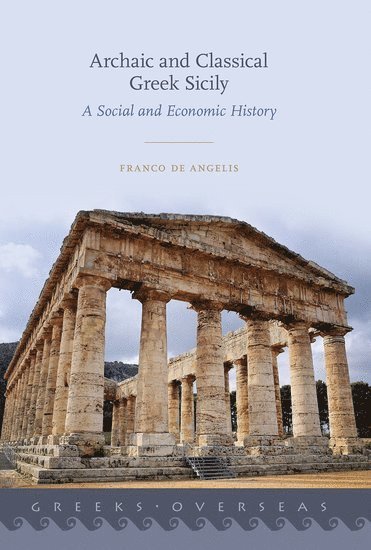
Ancient Greek migrants in Sicily produced societies and economies that both paralleled and differed from their homeland. Explanations for these similarities and differences have been hotly debated. On the one hand, some scholars have viewed the ancient Greeks as one in a long line of migrants who were shaped by Sicily and its inhabitants. On the other hand, other scholars have argued that the Greeks acted as the main source of innovation and achievement in the culture of ancient Sicily, a culture that was still removed from that of mainland Greece. Neither of these positions is completely satisfactory. What is lacking in this debate is a basic framework for understanding ancient Sicily's social and economic history. Archaic and Classical Greek Sicily represents the first ever systematic and comprehensive attempt to synthesize the historical and archaeological evidence, and to deploy it to test the various historical models proposed over the past two centuries. It adopts an interdisciplinary approach that combines classical and prehistoric studies, texts and material culture, and a variety of methods and theories to put the history of Greek Sicily on a completely new footing. While Sicily and Greece had conjoined histories from the start, their relationship was not one of periphery and center or of colony and state in any sense, but of an interdependent and mutually enriching diaspora. At the same time, local conditions and peoples, including Phoenician migrants, also shaped the evolution of Sicilian Greek societies and economies. This book reveals and explains the similarities and differences between developments in Greek Sicily and the mainland, and brings greater clarity to the parts played by locals and immigrants in ancient Sicily's impressive achievements.
1 505 kr
Skickas inom 5-8 vardagar
Ancient Greek migrants in Sicily produced societies and economies that both paralleled and differed from their homeland. Since the nineteenth century explanations for these similarities and differences have been heavily debated, with attention focusing in particular on the roles played on this frontier by locals and immigrants in Greek Sicily's remarkable cultural efflorescence. Polarized positions have resulted. On one side, scholars have viewed the ancient Greeks as one of a long line of incomers whom Sicily and its inhabitants shape. On the other side, the ancient Greeks have been viewed in a hierarchical manner with the Sicilian Greeks acting as the source of innovation and achievement in shaping their Sicily, while at the same being lesser to homeland Greece, the center of their world. Neither of these two extremes is completely satisfactory. What is lacking in this debate is a basic work on social and economic history that gathers the historical and archaeological evidence and deploys it to test the various historical models proposed over the past two hundred years. This book represents the first ever such systematic and comprehensive endeavor. It adopts a broadly based interdisciplinary approach that combines classical and prehistoric studies, texts, and material culture, and a variety of methods and theories to put the history of Greek Sicily on a completely new footing. While Sicily and Greece had conjoined histories right from the start, their relationship was not one of center and periphery or "colonial" in any sense, but of an interdependent and mutually enriching diaspora. At the same time, local conditions and peoples, including Phoenician migrants, also shaped the evolution of Sicilian Greek societies and economies. This book reveals and explains the similarities and differences with developments in Greece and brings greater clarity to the parts played by locals and immigrants in ancient Sicily's impressive achievements.
146 kr
Skickas inom 5-8 vardagar
142 kr
Skickas
This collection of eight essays on the archaeology of Greek colonisation, dedicated to Sir John Boardman on the occasion of his retirement, has now been reprinted in paperback. Greek colonisation continues to be a much debated topic among ancient historians and archaeologists of the Mediterranean region. These classic essays focus on archaeological research, but they consider themes relevant to archaeologists and historians alike, including: the motivation for colonisation, identity, and social integration; technology and trade; collaboration, competition and conflict. First published in 1994, the new edition includes a new preface and corrections. Contributors: A M Snodgrass, M R Popham, D Ridgway, J N Coldstream, B B Shefton, F De Angelis, G R Tsetskhladze, and J Boardman.
2 221 kr
Skickas inom 7-10 vardagar
A COMPANION TO GREEKS ACROSS THE ANCIENT WORLD An innovative, up-to-date treatment of ancient Greek mobility and migration from 1000 BCE to 30 BCE A Companion to Greeks Across the Ancient World explores the mobility and migration of Greeks who left their homelands in the ten centuries between the Early Iron Age and the Hellenistic period. While most academic literature centers on the Greeks of the Aegean basin area, this unique volume provides a systematic examination of the history of the other half of the ancient Greek world. Contributions from leading scholars and historians discuss where migrants settled, their new communities, and their connections and interactions with both Aegean Greeks and non-Greeks. Divided into three parts, the book first covers ancient and modern approaches and the study of the ancient Greeks outside their homelands, including various intellectual, national, and linguistic traditions. Regional case studies form the core of the text, taking a microhistory approach to examine Greeks in the Near Eastern Empires, Greek-Celtic interactions in Central Europe, Greek-established states in Central Asia, and many others throughout Europe, Africa, and Asia. The closing section of the text discusses wider themes such as the relations between the Greek homeland and the edges of Greek civilization. Reflecting contemporary research and fresh perspectives on ancient Greek culture contact, this volume: Discusses the development and intersection of mobility, migration, and diaspora studiesExamines the various forms of ancient Greek mobility and their outcomesHighlights contributions to cultural development in the Greek and non-Greek worldExamines wider themes and the various forms of ancient Greek mobility and their outcomesIncludes an overview of ancient terminology and concepts, modern translations, numerous maps, and full referencesA Companion to Greeks Across the Ancient World is a valuable resource for students, instructors, and researchers of Classical antiquity, as well as non-specialists with interest in ancient Greek mobilities, migrations, and diasporas.
598 kr
Skickas inom 7-10 vardagar
A COMPANION TO GREEKS ACROSS THE ANCIENT WORLD An innovative, up-to-date treatment of ancient Greek mobility and migration from 1000 BCE to 30 BCE A Companion to Greeks Across the Ancient World explores the mobility and migration of Greeks who left their homelands in the ten centuries between the Early Iron Age and the Hellenistic period. While most academic literature centers on the Greeks of the Aegean basin area, this unique volume provides a systematic examination of the history of the other half of the ancient Greek world. Contributions from leading scholars and historians discuss where migrants settled, their new communities, and their connections and interactions with both Aegean Greeks and non-Greeks. Divided into three parts, the book first covers ancient and modern approaches and the study of the ancient Greeks outside their homelands, including various intellectual, national, and linguistic traditions. Regional case studies form the core of the text, taking a microhistory approach to examine Greeks in the Near Eastern Empires, Greek-Celtic interactions in Central Europe, Greek-established states in Central Asia, and many others throughout Europe, Africa, and Asia. The closing section of the text discusses wider themes such as the relations between the Greek homeland and the edges of Greek civilization. Reflecting contemporary research and fresh perspectives on ancient Greek culture contact, this volume: Discusses the development and intersection of mobility, migration, and diaspora studiesExamines the various forms of ancient Greek mobility and their outcomesHighlights contributions to cultural development in the Greek and non-Greek worldExamines wider themes and the various forms of ancient Greek mobility and their outcomesIncludes an overview of ancient terminology and concepts, modern translations, numerous maps, and full referencesA Companion to Greeks Across the Ancient World is a valuable resource for students, instructors, and researchers of Classical antiquity, as well as non-specialists with interest in ancient Greek mobilities, migrations, and diasporas.
146 kr
Skickas inom 5-8 vardagar