Franz Schurmann - Böcker
Visar alla böcker från författaren Franz Schurmann. Handla med fri frakt och snabb leverans.
4 produkter
4 produkter
Del 3 - Center for Chinese Studies, UC Berkeley
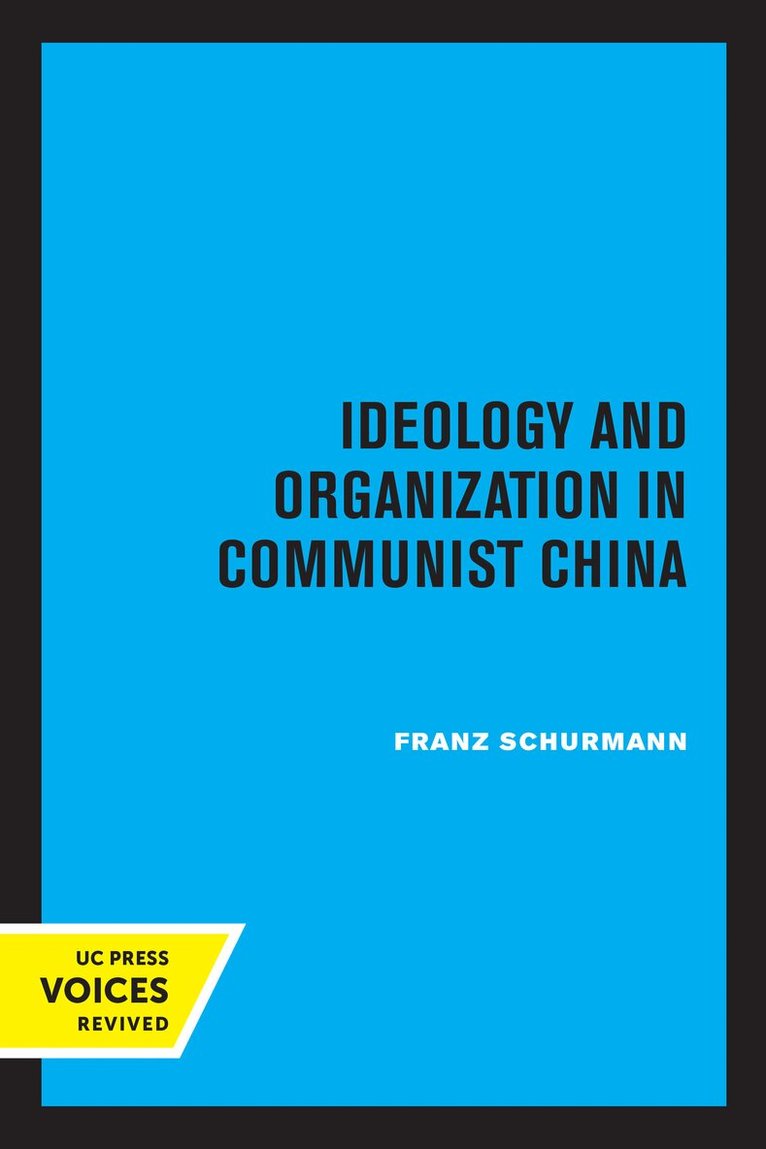
Ideology and Organization in Communist China
Häftad, Engelska, 2022
1 212 kr
Skickas inom 3-6 vardagar
In 1949 a powerful political-military movement, led by the Chinese Communist party, gained control of war-ravaged China, inheriting a disorganized administration and a society eroded by decades of revolution. Within a short time China was so radically transformed politically, economically, and socially that it appeared to have cut all links with the past. The instruments of that transformation were ideology and organization. Today, seventeen years later, the ideology and the organizational network, despite changes, remain as powerful as they were in 1949. They still hold that vast country together politically and determine its economic and social development. This book, after a discussion of ideology in its first part, attempts to answer the question how Chinese Communist organization functions and why it is so successful. The second part analyzes the organization of Party and government, emphasizing methods of command and administration. The third part looks at industrial organization: the problems of management and control, especially the continuing struggle between the professionals and the politicians. The fourth part investigates the Chinese Communist methods of organizing their cities and villages, tracing the history of village organization from traditional times through the Yenan period, the land reform of the late 1940's, and the collectivization of the mid-1950's to communization in 1958. Although organization has been constantly changing in China, basic patterns ar apparent. The book analyzes the most characteristic pattern in all aspects of organization, the conflict between two incompatible elements or, in the Chinese Communist terms, "contradictions." The basic contradiction is that between professional ("expert") and political ("red") elements. This contradiction dominates the two distinctive periods in the short history of Communist China, the First Five-Year Plan (1953 - 1957) and the so-called Great Leap Forward (1958 - 1960). The book describes how the Chinese Communists attempted during the former period to emulate the Soviet organizational experience, with stress on techniques and technology; and during the latter period to use their own organizational methods to achieve economic progress. The presentation of the contrast between these two models of organization sheds light on the significant differences between the Soviet Union and Communist China. This title is part of UC Press's Voices Revived program, which commemorates University of California Press's mission to seek out and cultivate the brightest minds and give them voice, reach, and impact. Drawing on a backlist dating to 1893, Voices Revived makes high-quality, peer-reviewed scholarship accessible once again using print-on-demand technology. This title was originally published in 1966.
684 kr
Skickas inom 3-6 vardagar
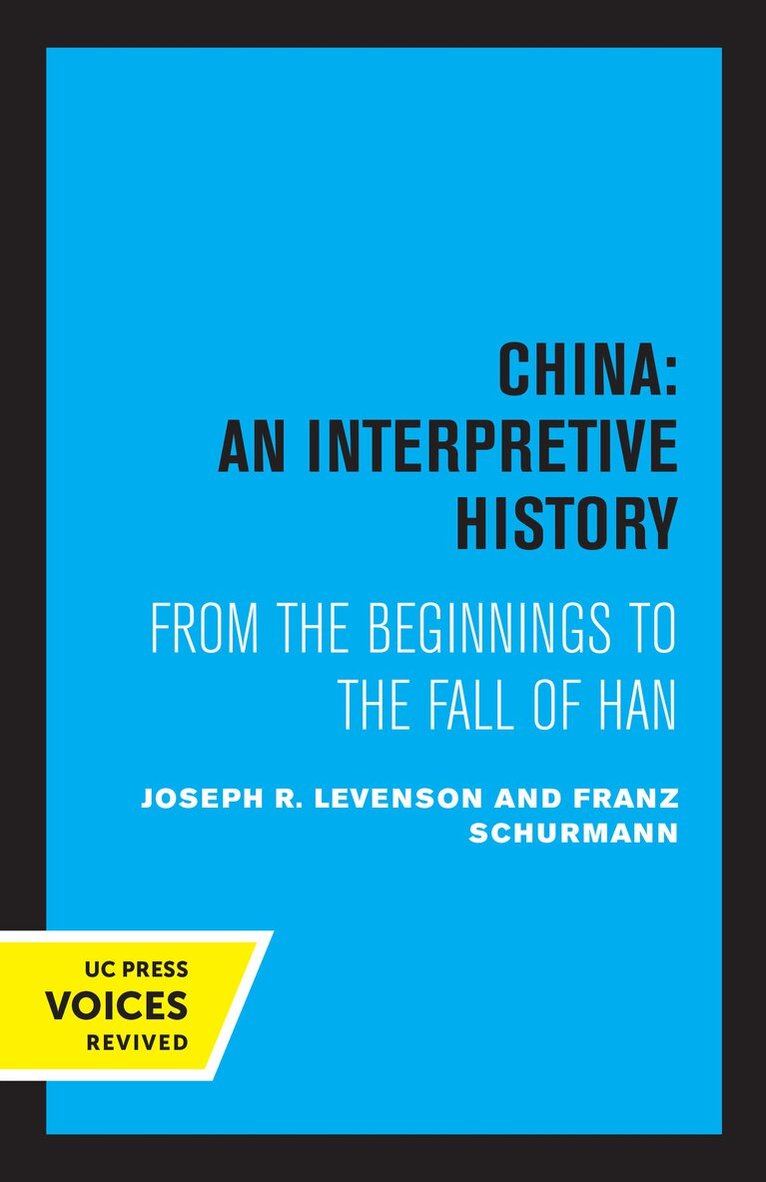
China: An Interpretive History offers a compelling exploration of the origins of Chinese civilization, delving into the fascinating intersection of historical fact and cultural narrative. Beginning with the discovery of "Peking Man," this book examines the deep geological and evolutionary roots that predate Chinese history and raises profound questions about the nature of historical continuity. By tracing the line from prehistoric human remains to the emergence of a distinctly Chinese cultural identity, it illustrates how history, as a retrospective framework, imposes meaning on ancient artifacts and events, bridging the abstract with the culturally specific.The book's thought-provoking narrative does not merely recount events but interrogates the very concept of history itself, distinguishing biological evolution from cultural heritage. It invites readers to consider how "Peking Man," an evolutionary figure, becomes a historical one only through the lens of later cultural achievements and societal developments. This dynamic interplay between geography, anthropology, and the shaping of historical consciousness makes this work an essential resource for understanding how civilizations root themselves in the past while projecting their unique identities into the present.This title is part of UC Press's Voices Revived program, which commemorates University of California Press’s mission to seek out and cultivate the brightest minds and give them voice, reach, and impact. Drawing on a backlist dating to 1893, Voices Revived makes high-quality, peer-reviewed scholarship accessible once again using print-on-demand technology. This title was originally published in 1969.
Del 3 - Center for Chinese Studies, UC Berkeley
Ideology and Organization in Communist China
Inbunden, Engelska, 2022
1 814 kr
Skickas inom 3-6 vardagar
In 1949 a powerful political-military movement, led by the Chinese Communist party, gained control of war-ravaged China, inheriting a disorganized administration and a society eroded by decades of revolution. Within a short time China was so radically transformed politically, economically, and socially that it appeared to have cut all links with the past. The instruments of that transformation were ideology and organization. Today, seventeen years later, the ideology and the organizational network, despite changes, remain as powerful as they were in 1949. They still hold that vast country together politically and determine its economic and social development. This book, after a discussion of ideology in its first part, attempts to answer the question how Chinese Communist organization functions and why it is so successful. The second part analyzes the organization of Party and government, emphasizing methods of command and administration. The third part looks at industrial organization: the problems of management and control, especially the continuing struggle between the professionals and the politicians. The fourth part investigates the Chinese Communist methods of organizing their cities and villages, tracing the history of village organization from traditional times through the Yenan period, the land reform of the late 1940's, and the collectivization of the mid-1950's to communization in 1958. Although organization has been constantly changing in China, basic patterns ar apparent. The book analyzes the most characteristic pattern in all aspects of organization, the conflict between two incompatible elements or, in the Chinese Communist terms, "contradictions." The basic contradiction is that between professional ("expert") and political ("red") elements. This contradiction dominates the two distinctive periods in the short history of Communist China, the First Five-Year Plan (1953 - 1957) and the so-called Great Leap Forward (1958 - 1960). The book describes how the Chinese Communists attempted during the former period to emulate the Soviet organizational experience, with stress on techniques and technology; and during the latter period to use their own organizational methods to achieve economic progress. The presentation of the contrast between these two models of organization sheds light on the significant differences between the Soviet Union and Communist China. This title is part of UC Press's Voices Revived program, which commemorates University of California Press's mission to seek out and cultivate the brightest minds and give them voice, reach, and impact. Drawing on a backlist dating to 1893, Voices Revived makes high-quality, peer-reviewed scholarship accessible once again using print-on-demand technology. This title was originally published in 1966.
1 513 kr
Skickas inom 3-6 vardagar
China: An Interpretive History offers a compelling exploration of the origins of Chinese civilization, delving into the fascinating intersection of historical fact and cultural narrative. Beginning with the discovery of "Peking Man," this book examines the deep geological and evolutionary roots that predate Chinese history and raises profound questions about the nature of historical continuity. By tracing the line from prehistoric human remains to the emergence of a distinctly Chinese cultural identity, it illustrates how history, as a retrospective framework, imposes meaning on ancient artifacts and events, bridging the abstract with the culturally specific.The book's thought-provoking narrative does not merely recount events but interrogates the very concept of history itself, distinguishing biological evolution from cultural heritage. It invites readers to consider how "Peking Man," an evolutionary figure, becomes a historical one only through the lens of later cultural achievements and societal developments. This dynamic interplay between geography, anthropology, and the shaping of historical consciousness makes this work an essential resource for understanding how civilizations root themselves in the past while projecting their unique identities into the present.This title is part of UC Press's Voices Revived program, which commemorates University of California Press’s mission to seek out and cultivate the brightest minds and give them voice, reach, and impact. Drawing on a backlist dating to 1893, Voices Revived makes high-quality, peer-reviewed scholarship accessible once again using print-on-demand technology. This title was originally published in 1969.