Frederic Bostedt – författare
Visar alla böcker från författaren Frederic Bostedt. Handla med fri frakt och snabb leverans.
5 produkter
5 produkter
E-bok
PDF, Engelska, 2007186 kr
Läs direkt efter köp
Seminar paper from the year 2003 in the subject Law - Comparative Legal Systems, Comparative Law, grade: A, Victoria University of Wellington (Victoria Law School), course: International Law, language: English, abstract: The fight against terrorism has two distinct objectives. First, it implies resolving 'political' disputes, political in its broadest sense, comprising different areas such as the division between the rich and the poor or the denouement of religious tensions. Or, to state it even broader: the first objective is to deal with the roots and the causes of terrorism. Secondly, the fight against terrorism means maintaining order at home, so as not to allow terrorists to reach their objective of destroying the core values in our society. Moreover, it allows the government to gain time while the international community works on the first objective. The main prospect in maintaining law and order at home is to put terrorists to trial. Thus criminal law plays an important role in the fight against terrorism. This paper focuses exclusively on the second objective and its purpose is to survey and compare the legislation related to criminal law and terrorism in the UK, Canada, Australia, New Zealand, and Germany. The following chapters are divided into the countries experience with terrorism and an overview on their criminal law relevant in the fight against terrorism. A comparison of the terrorist legislations in these countries will lead to an evaluation of the different approaches and an answer to the question if terrorism should be defined at all in criminal law.
E-bok
PDF, Engelska, 2007354 kr
Läs direkt efter köp
Master's Thesis from the year 2003 in the subject Law - European and International Law, Intellectual Properties, grade: A, Victoria University of Wellington (Victoria Law School), course: International Law, language: English, abstract: The United Nations Human Rights Committee, established under the International Covenant of Civil and Political Rights, has the power to examine individual complaints on alleged human rights violations. It is noted, however, that the Committee lacks important powers to be as effective as the regional human rights courts in Europe and the Americas. The paper assesses the effectiveness of the Committee by means of a comparative analysis. The comparison takes place within four criteria that are essential in an assessment of a court's effectiveness: the visibility of the court in the public domain, the adoption of interim measures to hinder the aggravation of the violation, the fact-finding capacity of the court, and the enforcement of the final decisions and the follow-ups thereto. The paper argues that despite the statutory deficiencies of the Covenant and the Optional Protocol, the Committee can be as effective as the regional courts even without an amendment to these instruments. This would be possible if the Committee successfully argues for a binding nature of its interim measures; further, it can overcome the lack of its independent fact-finding capacity through a - thoroughly argued - reversal of burden of proof. If it could also augment its own visibility and the publicity of its decisions, the Committee will finally enhance states' compliance with its final, non-legally binding 'views'. The Committee may welll be able to become as effective as the regional courts of human rights, and could in fact evolve into an effective court of human rights on a global level.
Häftad, Engelska, 2007
771 kr
Skickas inom 3-6 vardagar
Häftad, Tyska, 2008
337 kr
Skickas inom 3-6 vardagar
Inbunden, Engelska, 2015
2 925 kr
Skickas inom 5-8 vardagar
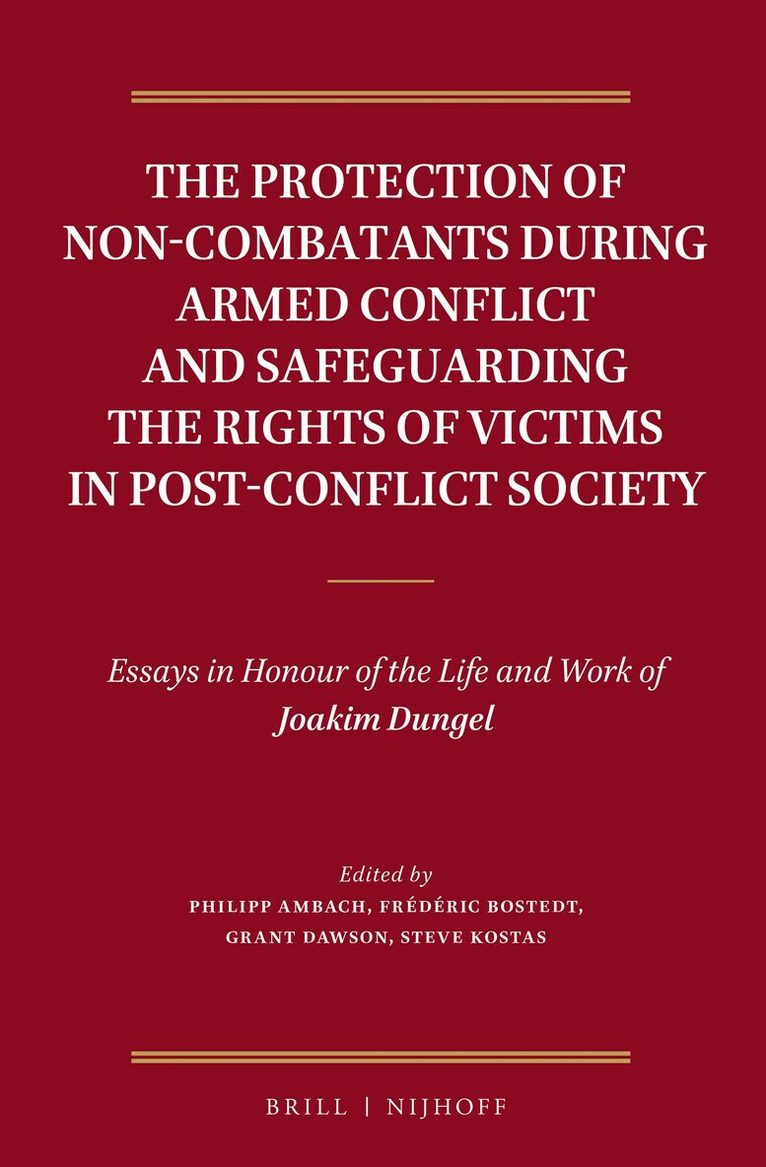
This collection of essays—written by friends and colleagues of Joakim Dungel—focuses on the protection of the innocent during and after war. It is a tribute to Joakim’s life and work. Joakim made a significant contribution to international justice and the rule of law, through his service to the United Nations International Criminal Tribunals for the former Yugoslavia and Rwanda, the Special Court for Sierra Leone, the Temporary International Presence in Hebron, and the United Nations Assistance Mission in Afghanistan. He was also a prolific author and published scholarly works on a wide range of issues, including command responsibility, national security interests, the right to humanitarian assistance during internal armed conflicts, and crimes against humanity. This book continues Joakim’s work with in-depth analyses of a variety of issues arising under modern conflict, such as the application of international humanitarian law and international human rights law to aerial drone attacks, targeted sanctions, and reparations to victims. Joakim understood these complex and interlinked issues and dedicated his professional life to engaging with them. Through his work and his scholarship, he demonstrated the crucial importance of adopting victim-centred approaches to dealing with the consequences of armed conflict and to its prevention. This was also why he chose to work for the United Nations as a human rights officer in Afghanistan. This book attempts to honour and affirm Joakim’s choice.