Frederic Charles Schaffer - Böcker
Visar alla böcker från författaren Frederic Charles Schaffer. Handla med fri frakt och snabb leverans.
5 produkter
5 produkter
2 088 kr
Skickas inom 10-15 vardagar
Concepts have always been foundational to the social science enterprise. This book is a guide to working with them. Against the positivist project of concept "reconstruction"—the formulation of a technical, purportedly neutral vocabulary for measuring, comparing, and generalizing—Schaffer adopts an interpretivist approach that he calls "elucidation." Elucidation includes both a reflexive examination of social science technical language and an investigation into the language of daily life. It is intended to produce a clear view of both types of language, the relationship between them, and the practices of life and power that they evoke and sustain. After an initial chapter explaining what elucidation is and how it differs from reconstruction, the book lays out practical elucidative strategies—grounding, locating, and exposing—that help situate concepts in particular language games, times and tongues, and structures of power. It also explores the uses to which elucidation can be put and the moral dilemmas that attend such uses. By illustrating his arguments with lively analyses of such concepts as "person," "family," and "democracy," Schaffer shows rather than tells, making the book both highly readable and an essential guide for social science research.
563 kr
Skickas inom 10-15 vardagar
Concepts have always been foundational to the social science enterprise. This book is a guide to working with them. Against the positivist project of concept "reconstruction"—the formulation of a technical, purportedly neutral vocabulary for measuring, comparing, and generalizing—Schaffer adopts an interpretivist approach that he calls "elucidation." Elucidation includes both a reflexive examination of social science technical language and an investigation into the language of daily life. It is intended to produce a clear view of both types of language, the relationship between them, and the practices of life and power that they evoke and sustain. After an initial chapter explaining what elucidation is and how it differs from reconstruction, the book lays out practical elucidative strategies—grounding, locating, and exposing—that help situate concepts in particular language games, times and tongues, and structures of power. It also explores the uses to which elucidation can be put and the moral dilemmas that attend such uses. By illustrating his arguments with lively analyses of such concepts as "person," "family," and "democracy," Schaffer shows rather than tells, making the book both highly readable and an essential guide for social science research.
674 kr
Skickas inom 10-15 vardagar
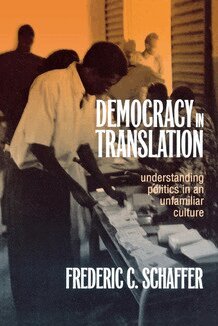
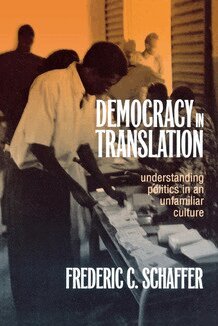
Frederic C. Schaffer challenges the assumption often made by American scholars that democracy has been achieved in foreign countries when criteria such as free elections are met. Elections, he argues, often have cultural underpinnings that are invisible to outsiders. To examine grassroots understandings of democratic institutions and political concepts, Schaffer conducted fieldwork in Senegal, a mostly Islamic and agrarian country with a long history of electoral politics. Schaffer discovered that ideas of "demokaraasi" held by Wolof-speakers often reflect concerns about collective security. Many Senegalese see voting as less a matter of choosing leaders than of reinforcing community ties that may be called upon in times of crisis.By looking carefully at language, Schaffer demonstrates that institutional arrangements do not necessarily carry the same meaning in different cultural contexts. Democracy in Translation asks how social scientists should investigate the functioning of democratic institutions in cultures dissimilar from their own, and raises larger issues about the nature of democracy, the universality of democratic ideals, and the practice of cross-cultural research.
514 kr
Skickas inom 10-15 vardagar
American voters are increasingly aware that the mechanics of elections matter. The conduct of elections—how eligible voters make it onto the voter rolls, how voters cast their ballots, and how those votes are counted—determines the degree to which the people's preferences are expressed freely, weighed equally, and recorded accurately. It is not surprising, then, that attempts to "clean up" elections are widely applauded as being unambiguously good for democracy.In The Hidden Costs of Clean Election Reform, Frederic Charles Schaffer reveals how tinkering with the electoral process can easily damage democratic ideals. Drawing on both recent and historical evidence from the United States and countries around the world, including the Philippines (where Schaffer has served as an election observer), Venezuela, South Africa, and Taiwan, The Hidden Costs of Clean Election Reform investigates why citizens sometimes find themselves abruptly disenfranchised. Schaffer examines numerous incidents in which election reforms have, whether intentionally or accidentally, harmed the quality and experience of democracy.These cases include the introduction of secret balloting in 1890s Arkansas, which deliberately stripped black citizens of the power to vote; efforts to insulate voters from outside influences in nineteenth-century France; the purge of supposed felons from the voter rolls of Florida ahead of the 2000 presidential election; and current debates over the reliability and security of touch-screen voting machines. Lawmakers, election officials, partisan operatives, and civic educators, Schaffer finds, can all contribute to the harm caused by improperly or cynically constructed election reforms. By understanding how even good-faith efforts to improve corrupt or flawed electoral practices may impede the democratic process, The Hidden Costs of Clean Election Reform suggests new ways to help prevent future breaches of democracy.
274 kr
Skickas inom 10-15 vardagar
Frederic C. Schaffer challenges the assumption often made by American scholars that democracy has been achieved in foreign countries when criteria such as free elections are met. Elections, he argues, often have cultural underpinnings that are invisible to outsiders. To examine grassroots understandings of democratic institutions and political concepts, Schaffer conducted fieldwork in Senegal, a mostly Islamic and agrarian country with a long history of electoral politics. Schaffer discovered that ideas of "demokaraasi" held by Wolof-speakers often reflect concerns about collective security. Many Senegalese see voting as less a matter of choosing leaders than of reinforcing community ties that may be called upon in times of crisis.By looking carefully at language, Schaffer demonstrates that institutional arrangements do not necessarily carry the same meaning in different cultural contexts. Democracy in Translation asks how social scientists should investigate the functioning of democratic institutions in cultures dissimilar from their own, and raises larger issues about the nature of democracy, the universality of democratic ideals, and the practice of cross-cultural research.