Frederick B. Bird - Böcker
Visar alla böcker från författaren Frederick B. Bird. Handla med fri frakt och snabb leverans.
3 produkter
3 produkter
Ritual and Ethnic Identity
A Comparative Study of the Social Meaning of Liturgical Ritual in Synagogues
Inbunden, Engelska, 1995
1 053 kr
Skickas inom 11-20 vardagar
In this innovative and comprehensive collection of essays Jack Lightstone and Frederick Bird document and interpret ritual practice among contemporary Canadian Jews. They particularly focus on the character and meaning of the public performance of the Sabbath liturgy in six urban Canadian synagogues, ranging from Orthodox to Reform, and from large congregations to a small house synagogue-yeshiva (rabbinic academy). Their examination of synagogue ritual is complemented with accounts of the ritual life of contemporary Canadian Jews outside the synagogue - amongst their families, within their homes and beyond. In contrast with other studies of Jewish observance, Lightstone and Bird document not simply which rituals are practised and how often; rather they stress the meaning, including the social meaning, of these rituals and treat them as complex symbolic systems. Their multidisciplinary approach together with their openness to include a wide variety of phenomena in their study (for example, the organization of the physical setting of the Sabbath, dress codes and patterns of greeting and handshaking) place this work at the very forefront of current research. Ritual and Ethnic Identity will be of great value to historians and sociologists of religion, anthropologists and all those concerned with religion, ritual and Canadian Jewish and ethnic studies.
1 039 kr
Skickas inom 10-15 vardagar
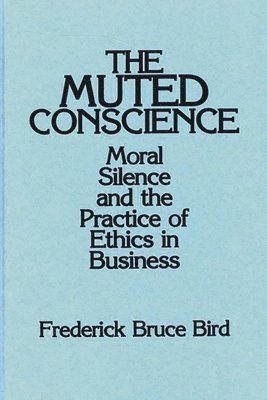
It's not that most businesspeople lack moral convictions. Rather, they tend not to voice them and are inattentive when others do. Dr. Bird sees this behavior as moral silence, deafness, and blindness, and, following this analogy to the senses, he argues that the practice of ethics is a form of communication. Thus, instead of focusing on specific moral issues, Dr. Bird examines the things that stifle communication about moral issues—factors that have a costly impact on business. His book presents a new view of ethics, in which ethics can be construed as a practical social activity, not a utopian concept to be contemplated in the abstract. With numerous examples and case studies from business life and a logical, sensible analysis of what causes moral silence, deafness, and blindness, Dr. Bird's book will be challenging reading not only for professionals and academics in various fields of business, but also for their colleagues in philosophy, religion, and the social sciences.The author begins by discussing the nature of moral silence in contemporary business and asks what kind of problem it is. He examines what it means to voice or not voice moral convictions and what it means to be inattentive or deaf to moral issues. He continues the analogy into moral blindness—the problem of not perceiving moral issues clearly. From there he explores the consequences of moral silence, deafness, and blindness and traces their causes to a variety of cultural, individual, and organizational factors, all of them interconnected. The book concludes with a way in which businesspeople and others can understand ethics as a social activity in which everyone can and must participate. Dr. Bird sees the practice of ethics as a form of conversation, a way in which people establish and maintain agreements among themselves, and in doing so help each other overcome their sensory incapacitations. Dr. Bird provides ways in which this can be done, from the use of workshops on interpersonal skills to seminars on conflict resolution—tools and aids that are already prevalent in organizations but that have not, until now, been seen as facilitators of moral awareness and action.
612 kr
Skickas inom 10-15 vardagar
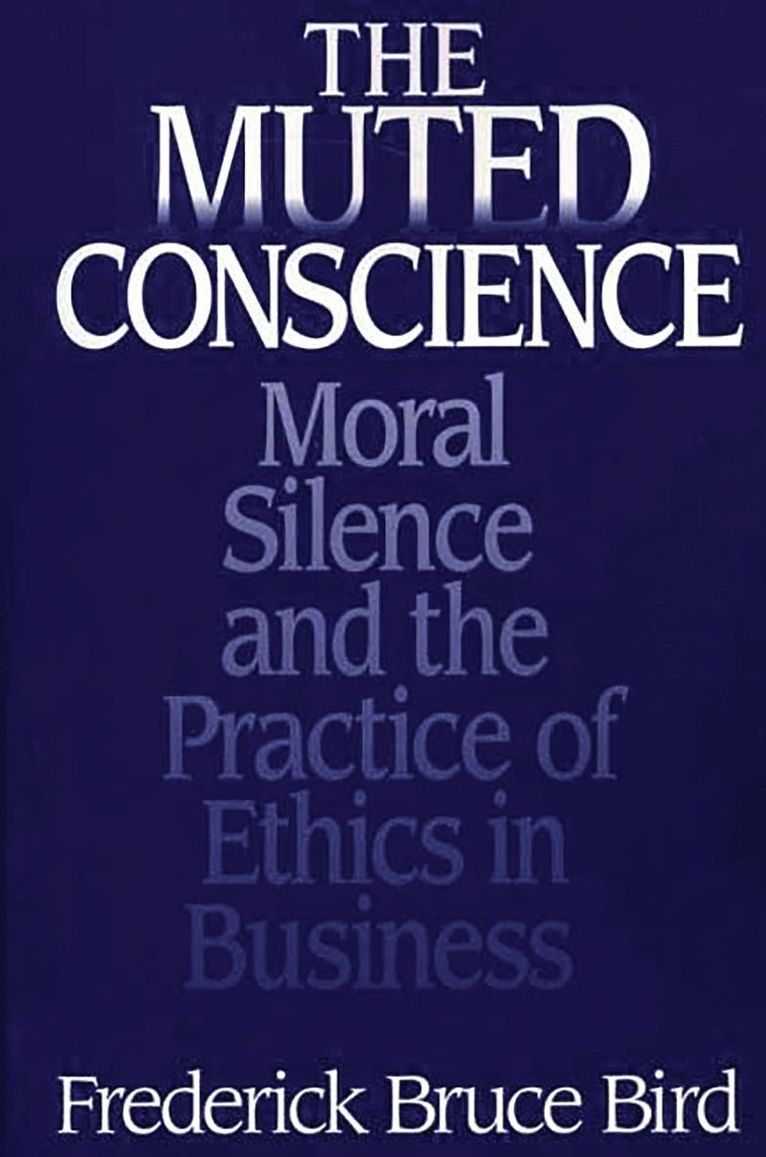
t's not that most businesspeople lack moral convictions. Rather, they tend not to voice them and are inattentive when others ^Udo. Bird sees this behavior as moral silence, deafness, and blindness, and, following this analogy to the senses, he argues that the practice of ethics is a form of communication. Thus, instead of focusing on specific moral issues, Bird examines the things that stifle communication about moral issues—factors that have a costly impact on business. His book presents a new view of ethics, in which ethics can be construed as a practical social activity, not a utopian concept to be contemplated in the abstract. With numerous examples and case studies from business life and a logical, sensible analysis of what causes moral silence, deafness, and blindness, Bird's book will be challenging reading not only for professionals and academics in various fields of business, but also for their colleagues in philosophy, religion, and the social sciences.The author begins by discussing the nature of moral silence in contemporary business and asks what kind of problem it is. He examines what it means to voice or not voice moral convictions and what it means to be inattentive or deaf to moral issues. He continues the analogy into moral blindness—the problem of not perceiving moral issues clearly. From there he explores the consequences of moral silence, deafness, and blindness and traces their causes to a variety of cultural, individual, and organizational factors, all of them interconnected. The book concludes with a way in which businesspeople and others can understand ethics as a social activity in which everyone can and must participate. Bird sees the practice of ethics as a form of conversation, a way in which people establish and maintain agreements among themselves, and in doing so help each other overcome their sensory incapacitations. Bird provides ways in which this can be done, from the use of workshops on interpersonal skills to seminars on conflict resolution—tools and aids that are already prevalent in organizations but that have not, until now, been seen as facilitators of moral awareness and action.