Fritz Barth - Böcker
Visar alla böcker från författaren Fritz Barth. Handla med fri frakt och snabb leverans.
6 produkter
6 produkter
339 kr
Skickas inom 5-8 vardagar
177 kr
Skickas inom 5-8 vardagar
420 kr
Skickas inom 3-6 vardagar
Dominikus Zimmermann's pilgrimage church of Our Lady and parish church of St Peter and Paul in Steinhausen, built between 1728 and 1733, is undoubtedly one of the most remarkable creations not only of Upper Swabian Baroque architecture. Architectural history has devoted considerable space to it, and yet there are important aspects that have remained unnoticed and unexamined.The first question that arises is that of the ovals on which the building is based, whereby two different versions need to be examined: the design drawing that the architect presented to his abbot client, and the completed building, which could be analyzed in detail for the first time thanks to a recently created precise measurement. In both cases, the result shows ambitious oval constructions that deviate from the usual practice, as well as two fundamentally different geometric approaches, the respective reasons for which are open to speculation.The second complex deals with peculiarities of perception. Here, one cannot help but accord the Steinhausen church a prominent position. Zimmermann designs the path into and through the church interior as a sequence of stations, each characterized by different expectations of what is to come—by illusory images of space that the viewer creates in his imagination based on what he can perceive from his respective vantage point. These images dissolve as one walks through the church, they change, expectations are in a state of constant metamorphosis, until finally the image of the last station coincides with reality.A concluding chapter is devoted to the question of whether, and if so, to what extent Zimmermann's Steinhausen spatial artwork can be said to have a dialectical constitution of architecture, and which dialectically related moments prove to be constitutive of a unity.
833 kr
Skickas inom 11-20 vardagar
Text in German. The Villa Lante in Bagnaia near Viterbo is outstanding among 16th-century Italian gardens. It is not particularly large, but it is the undisputed highlight of this epoch, the heyday of Italian horticulture, not just because it is outstandingly well maintained, but also because of its unique formal qualities and its extremely complex iconographic programme. The present monograph attempts to establish what triggers the intense sense of beauty with which visitors to the gardens are confronted. It is immediately clear that it is essential to analyse the form of the garden -- here the extremely precise treatment of central perspective as a device is of considerable interest -- but close attention has also to be paid to the significance of the individual elements and the connections between them. This examination brings an elaborate accumulation of various sign systems to light, which seem to have the astonishing characteristic of not being entirely reconcilable, indeed they appear to build in contradictions as a basic constant. From this develops a panorama of the late 16th century, presenting the tangled pathways of perception of the gardens in all their complex relations, from the various late Renaissance garden types, via philosophy, the response to antiquity, perception of nature, perspective, harmony, literature, theatre and religion, and on to models of time and the forms it takes. Against this background the garden of the Villa Lante, which belonged to the scholarly cardinal and inquisitor Francesco Gambara, proves to be a difficult -- and perhaps not entirely successful -- balancing act between Renaissance traditions and the thrust of the Counter-Reformation, but showing at the same time, as a kind of 'apotheosis of the artwork', a surprising affinity with the present day.
521 kr
Skickas inom 11-20 vardagar
Text in English & German. Francesco di Giorgio Martini's fortress complexes, created at the end of the Quattrocento, continue to look experimental and highly speculative half a millennium later by their semiotic character. They represent an extreme of European architectural history, occupying a position where architecture and sculpture cannot be sharply distinguished any longer. The alien-looking creations represented in this book have their origins in a particular historic situation: the emergence of firearms in the 14th century and their spread in the 15th century had shifted the balance of warfare in favour of the attacking side, against which the defensive structure had not yet found a remedy. Enter Francesco di Giorgio Martini (1439 to 1502) at this point, a native of Siena and one of the Quattrocento's highly versatile artists. He worked mainly in Federico da Montefeltro's Urbino, and left behind a body of work that included painting -- the three famous prospects of ideal cities in Berlin, Baltimore and Urbino are attributed to him -- sculpture -- primarily his imposing reliefs -- and architecture -- here he was definitely the outstanding figure between Alberti and Bramante. His achievements as an engineer are equally impressive, and his elaborate designs for machines strongly influenced those of Leonardo da Vinci. He was a true Renaissance uomo universale, though, despite of his voluminous and influential theoretical work, less in the sense of a humanist homme de lettres than as an all-round artist. Francesco's sacred and secular structures are classicist and austere in nature, yet his fortress structures look as if, moving beyond all functional concerns, he is exploiting the newness of the task, the lack of any tried and tested technical solutions and the removal of all typological boundaries to give his architectonic fantasies free rein, resulting in an apotheosis of the new, the unfamiliar and the alien. This book is an attempt to understand the strangely grandiose semiotic character of these structures. In doing so, it poses the question of what strategies can be used when seeking a shape for buildings for which there is no precedent.
354 kr
Skickas inom 11-20 vardagar
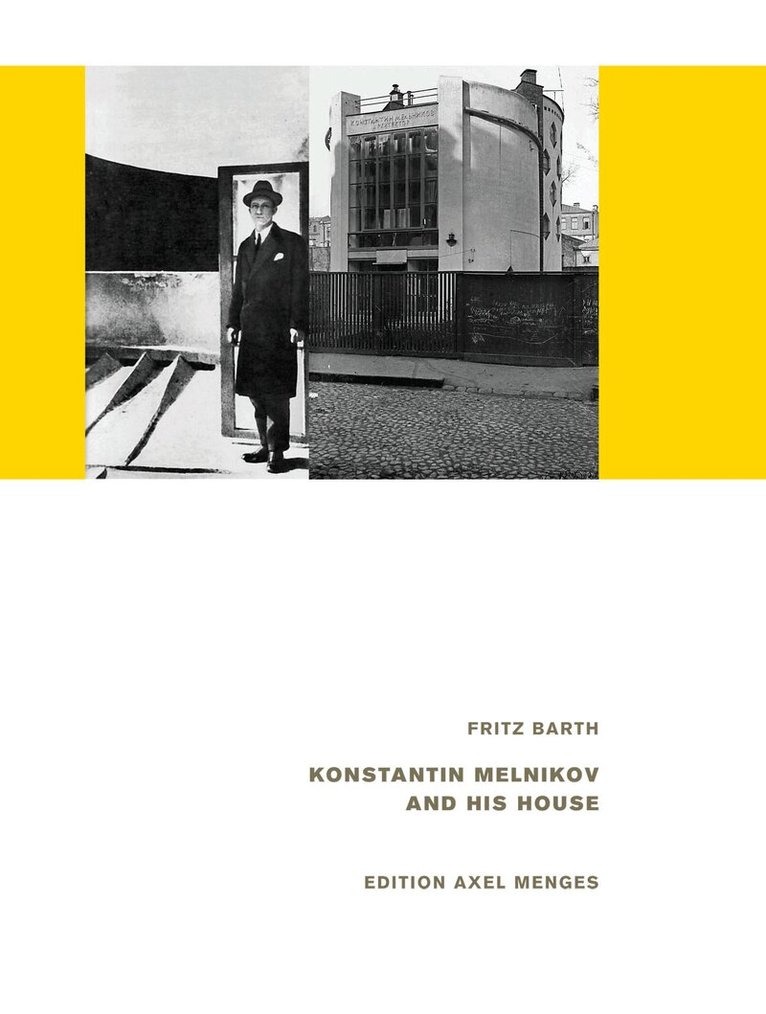
Konstantin Melnikov (18901974) is unquestionably one of the outstanding architects of the 20th century in spite of the fact that he fell silent early, leaving behind only limited work that was insufficiently publicized, and restricted almost exclusively to Moscow, the city of his birth in which he spent nearly his entire life and which did not appreciate him. He was raised in humble circumstances, but enjoyed an excellent education. Beginning in the mid-1920s, after the turmoil that followed the war, revolution and civil war, his career soared at almost meteoric speed as he took the lead in the young Soviet architecture movement with completely autonomous, highly artistic buildings that were free from dogmatism of any kind. Even more rapid than his rise to fame was his downfall: Treated with general hostility, he was unable to defend himself against the accusation of formalism when Stalin put an end to architectural ventures and experiments around the mid-1930s. He was expelled from the architects' association and was banned from practicing as an architect for the remaining four decades of his life. In the late 1920s, at the peak of his career, he had the opportunity to build a house for himself and his family in Moscow, in which he was then able to live until the end of his life. This house, a memorable symbiosis of almost peasant-like simplicity and extreme radicalness, is one of the most impressive, surprising and probably most enigmatic works produced by 20th-century architecture. Its simplicity is only outward; in reality this is a highly complex work which links together the elements of architecture explicitly and inextricably, which takes a clear and completely autonomous stand and which, in a way that little else has done, raises the question as to the nature of genuinely architectonic thinking. In essayistic form the book attempts to follow the paths laid out in the architect's work from the perspective of an architect.