G. Antonides - Böcker
Visar alla böcker från författaren G. Antonides. Handla med fri frakt och snabb leverans.
3 produkter
3 produkter
1 625 kr
Skickas inom 10-15 vardagar
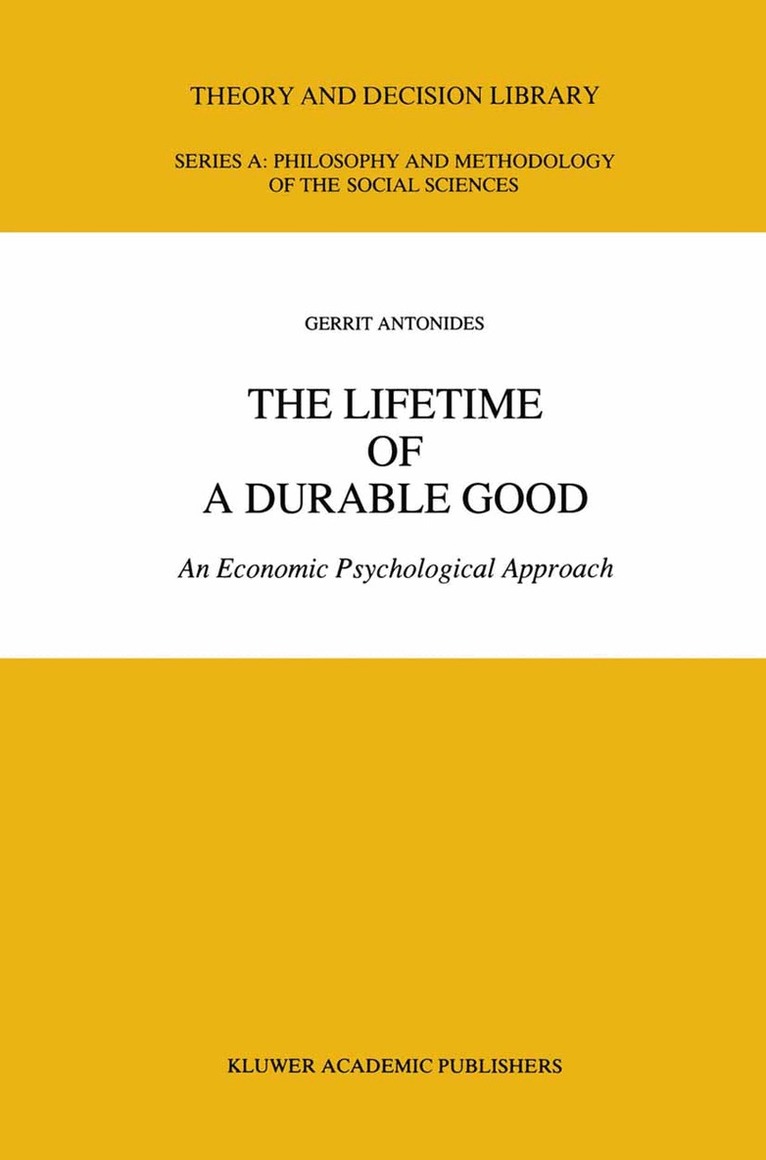
As a psychologist by education, my interest is in how people solve problems. At the Economic Institute of Leyden Universi ty, I learned that economists study human behavior too, although their studies are limited to economic affairs. At the Institute of Scientific Research on Consumer Affairs became (SWOKA), I aware of the needs of consumer organizations and the government for consumer research to base their policy on. At Erasmus University Rotterdam, I got the opportunity to integrate my interests and knowledge into this book. The first part of the book attempts to integrate psychological theories of attitude, perception, motivation and decision into economics. Both disciplines are concerned with human behavior, and the economic paradigm of demand, subj ect to restrictions, is combined with the psychological tradition of direct measurements of perceptions and motivations. This results in a micro-model of economic choice that can be tested by means of information obtained directly from consumers. The empirical study deals with the problem of scrapping a durable consumption good. By means of a consumer survey, the micro-model of choice is applied to the decision to scrap a durable good, or to repair the good in case of a defect. This individual decision obviously is connected with the large scale problem of waste, and with the manufacturer's problem of producing durable goods with a certain quality and durabili ty.
1 625 kr
Skickas inom 10-15 vardagar
As a psychologist by education, my interest is in how people solve problems. At the Economic Institute of Leyden Universi ty, I learned that economists study human behavior too, although their studies are limited to economic affairs. At the Institute of Scientific Research on Consumer Affairs became (SWOKA), I aware of the needs of consumer organizations and the government for consumer research to base their policy on. At Erasmus University Rotterdam, I got the opportunity to integrate my interests and knowledge into this book. The first part of the book attempts to integrate psychological theories of attitude, perception, motivation and decision into economics. Both disciplines are concerned with human behavior, and the economic paradigm of demand, subj ect to restrictions, is combined with the psychological tradition of direct measurements of perceptions and motivations. This results in a micro-model of economic choice that can be tested by means of information obtained directly from consumers. The empirical study deals with the problem of scrapping a durable consumption good. By means of a consumer survey, the micro-model of choice is applied to the decision to scrap a durable good, or to repair the good in case of a defect. This individual decision obviously is connected with the large scale problem of waste, and with the manufacturer's problem of producing durable goods with a certain quality and durabili ty.
1 096 kr
Skickas inom 10-15 vardagar
A number of books on economic psychology have appeared in the past few years. The most recent publications are by MacFadyen and Mac Fadyen (1986), Furnham and Lewis (1986), Lea et al. (1987) and Van Raaij et al. (1988). Why produce yet another book for this discipline? This question can be answered in various ways. In a sense, this book is the answer in itself. Its presentation of re search and theories is innovative in this field, at least to my knowledge. It attempts to structure the many theories emerging in the interdisci plinary science of economic psychology and to explain the background of the research. The second answer is pragmatic. In our introductory course of eco nomic psychology for economics students at Erasmus University Rot terdam we used several of the above mentioned books. Our experience with this material is that, when preparing our lectures, we had to ex plain many additional theories and experiments to our students. fur thermore, diagrams, figures and examples had to be culled from other sources or made by ourselves. It is not my intention to run down these publications since I think they provide an excellent treatment of a num ber of topics by specialists in economic psychology. The plan for the present book, however, emerged from our need to present an integrated introductory course for our students.