G. Rozenberg – författare
Visar alla böcker från författaren G. Rozenberg. Handla med fri frakt och snabb leverans.
22 produkter
Graph-Grammars and Their Application to Computer Science and Biology
International Workshop, Bad Honnef, October 30 - November 3, 1978
Häftad, 1979
567 kr
Lägg i varukorg
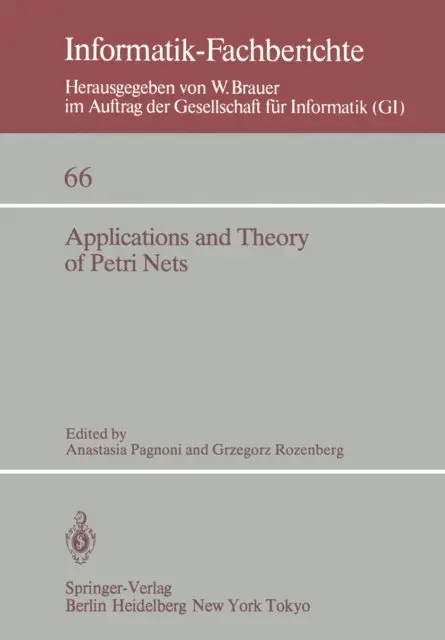
Applications and Theory of Petri Nets
Selected Papers from the 3rd European Workshop on Applications and Theory of Petri Nets Varenna, Italy, September 27–30, 1982 (under auspices of AFCET, AICA, GI, and EATCS)
Häftad, 1983
1126 kr
Lägg i varukorg
This volume presents a selection of papers presented at the 3rd European Workshop on Appl ications and Theory of Petri Nets that took place in Villa Monastero, Varenna (Italy) in the period September 27 - September 30, 1982. The I ist of topics included: nets and related models, mathematical …
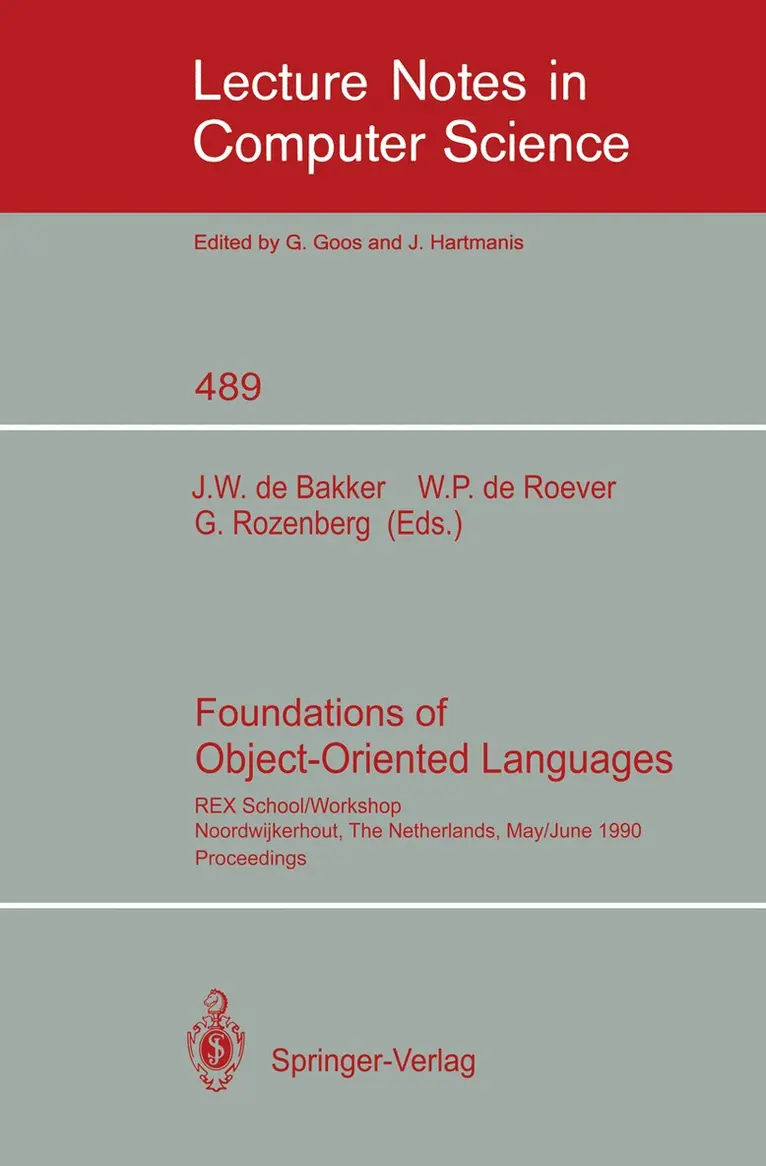
Foundations of Object-Oriented Languages
REX School/Workshop, Noordwijkerhout, The Netherlands, May 28 - June 1, 1990
Av J.W. de Bakker, W.P. de Roever m. fl.
Häftad, 1991
567 kr
Lägg i varukorg
Over the last few years, object-oriented programming has been recognized as the best way currently available of structuring software systems. It emphasizes grouping together data and the operations performed on them, encapsulating the whole behind a clean interface, and organizing the resulting …
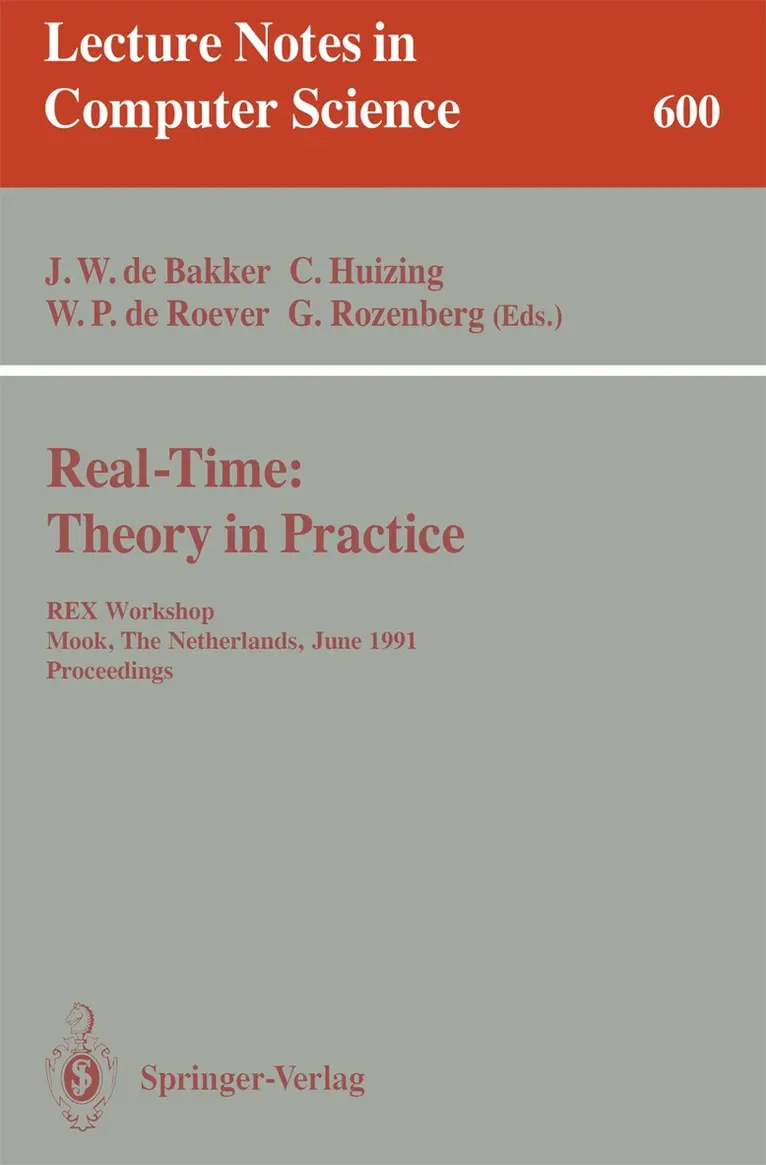
Real-Time: Theory in Practice
REX Workshop, Mook, The Netherlands, June 3-7, 1991. Proceedings
Av J.W.de Bakker, C. Huizing m. fl.
Häftad, 1992
1126 kr
Lägg i varukorg
In the past decade, the formal theory of specification,verfication and development of real-time programs has grownfrom work of a few specialized groups to a real "bandwagon".Many eminent research groups have shifted their interests inthis direction. Consequently, research in real-time is …
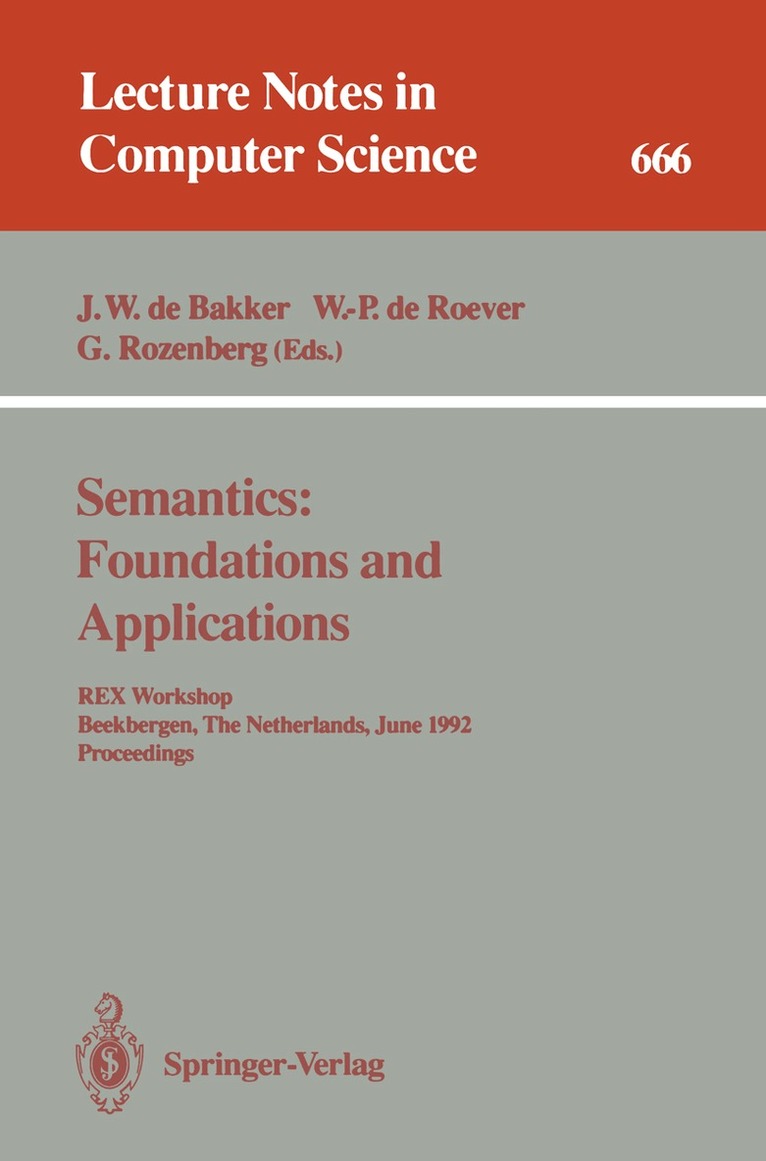
Semantics: Foundations and Applications
REX Workshop, Beekbergen, The Netherlands, June 1-4, 1992. Proceedings
Av J.W.de Bakker, W.-P.de Roever m. fl.
Häftad, 1993
1126 kr
Lägg i varukorg
Researchers working on the semantics of programminglanguages came together in The Netherlands in June 1992 fora workshop on Semantics - Foundations and Applications. Thisvolume is based on the meeting and contains materialprepared by the lecturers after the meeting took place. Thevolume includes …
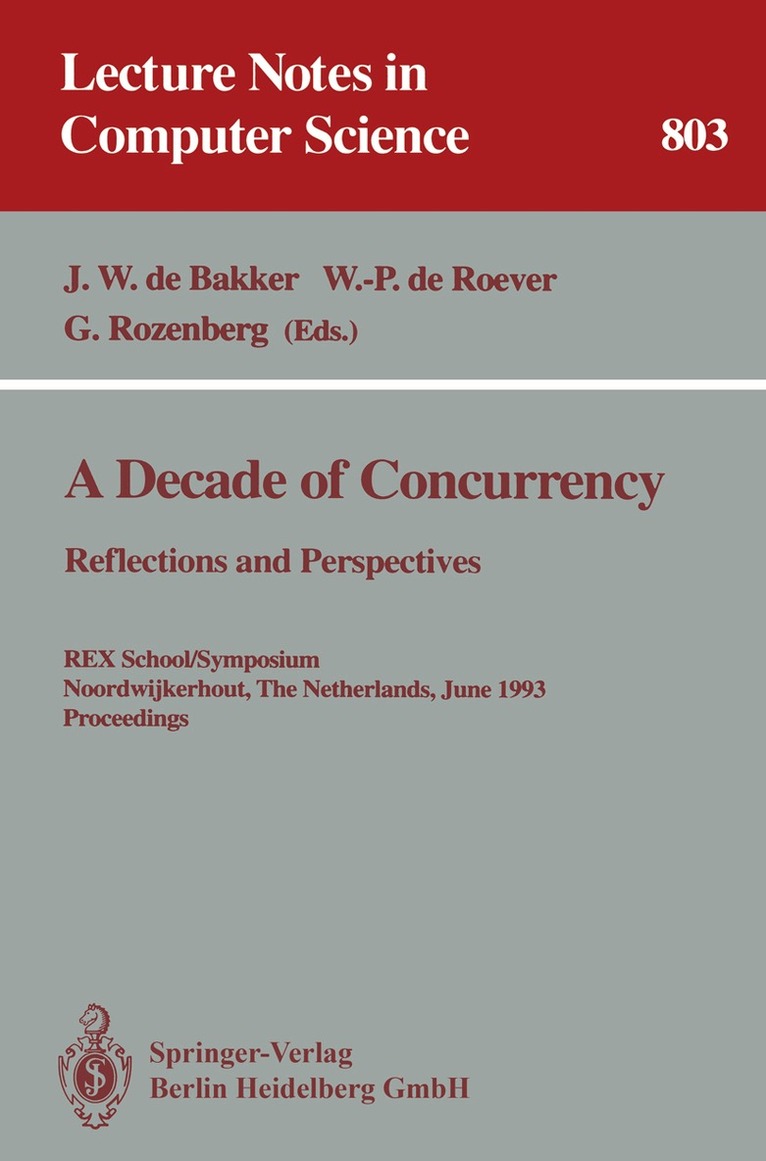
Decade of Concurrency: Reflections and Perspectives
Reflections and Perspectives. REX School/Symposium Noordwijkerhout, The Netherlands, June 1 - 4, 1993. Proceedings
Av J.W.de Bakker, W.-P.de Roever m. fl.
Häftad, 1994
1126 kr
Lägg i varukorg
The REX School/Symposium "A Decade of Concurrency - Reflections and Perspectives" was the final event of a ten-year period of cooperation between three Dutch research groups working on the foundations of concurrency. Ever since its inception in 1983, the goal of the project has been to contribute …
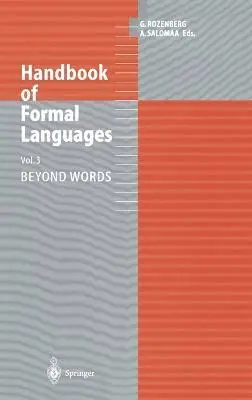
Beyond Words
Av G. Rozenberg, Grzegorz Rozenberg m. fl.
Inbunden, 1996
902 kr
Lägg i varukorg
This third volume of the Handbook of Formal Languages discusses language theory beyond linear or string models: trees, graphs, grids, pictures, computer graphics. Many chapters offer an authoritative self-contained exposition of an entire area. Special emphasis is on interconnections with logic.
Applications and Theory of Petri Nets
Selected Papers from the 3rd European Workshop on Applications and Theory of Petri Nets Varenna, Italy, September 27–30, 1982 (under auspices of AFCET, AICA, GI, and EATCS)
E-bok, 2012
1470 kr
Lägg i varukorg
This volume presents a selection of papers presented at the 3rd European Workshop on Appl ications and Theory of Petri Nets that took place in Villa Monastero, Varenna (Italy) in the period September 27 - September 30, 1982. The I ist of topics included: nets and related models, mathematical …
Book of L
E-bok, 2012
1502 kr
Lägg i varukorg
This book is dedicated to Aristid Lindenmayer on the occasion of his 60th birthday on November 17, 1985. Contributions range from mathematics and theoretical computer science to biology. Aristid Lindenmayer introduced language-theoretic models for developmental biology in 1968. Since then the …
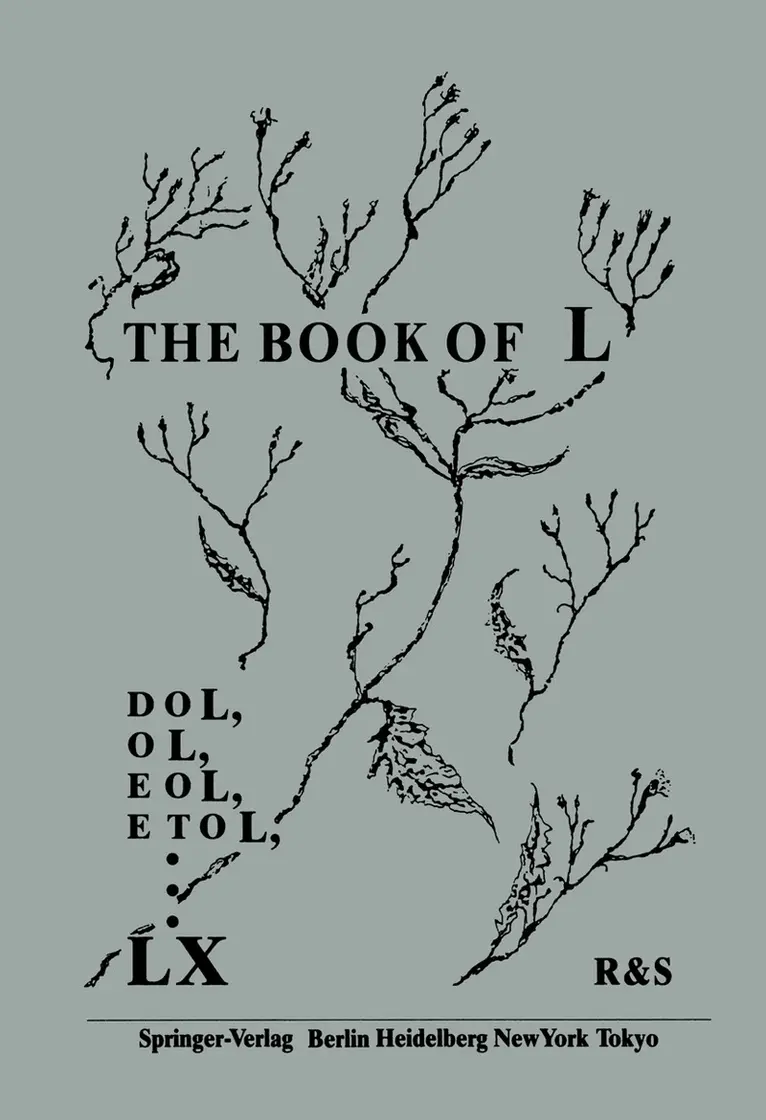
Book of L
Häftad, 2012
1126 kr
Lägg i varukorg
This book is dedicated to Aristid Lindenmayer on the occasion of his 60th birthday on November 17, 1985. Contributions range from mathematics and theoretical computer science to biology. Aristid Lindenmayer introduced language-theoretic models for developmental biology in 1968. Since then the …
BOOK OF TRACES, THE
Av Diekert V, V Diekert m. fl.
Inbunden, 1995
2893 kr
Lägg i varukorg
The theory of traces employs techniques and tackles problems from quite diverse areas which include formal language theory, combinatorics, graph theory, algebra, logic, and the theory of concurrent systems. In all these areas the theory of traces has led to interesting problems and significant …
HANDBOOK OF GRAPH GRAMMARS AND COMPUTING BY GRAPH TRANSFORMATION - VOLUME 2: APPLICATIONS, LANGUAGES AND TOOLS
Inbunden, 1999
4309 kr
Lägg i varukorg
Graph grammars originated in the late 60s, motivated by considerations about pattern recognition and compiler construction. Since then, the list of areas which have interacted with the development of graph grammars has grown quite impressively. Besides the aforementioned areas, it includes software …
CURRENT TRENDS IN THEORETICAL COMPUTER SCIENCE: ESSAYS AND TUTORIALS
Av ROZENBERG G, G Rozenberg m. fl.
Inbunden, 1993
2741 kr
Tillfälligt slut
The book is a very up-to-date collection of articles in theoretical computer science, written by leading authorities in the field. The topics range from algorithms and complexity to algebraic specifications, and from formal languages and language-theoretic modeling to computational geometry. The …
DEVELOPMENTS IN LANGUAGE THEORY: AT THE CROSSROADS OF MATHEMATICS, COMPUTER SCI AND BIOLOGY
Av ROZENBER ROZENBERG A SALOMAA, G Rozenberg m. fl.
Inbunden, 1994
2915 kr
Tillfälligt slut
This proceedings volume provides a modern synopsis of recent studies concerning certain areas of language theory very close to applications. The topics covered range from image generation and developmental models to combinatorics of words and formal power series, as well as from fractals to …
DEVELOPMENTS IN LANGUAGE THEORY II, AT THE CROSSROADS OF MATHEMATICS, COMPUTER SCIENCE AND BIOLOGY
Av ROZENBER DASSOW ROZENBERG A SALOMAA, J Dassow m. fl.
Inbunden, 1996
3002 kr
Tillfälligt slut
The contributions of the proceedings cover almost all parts of the theory of formal languages from pure theoretical investigations to applications to programming languages. Main topics are combinatorial properties of words, sequences of words and sets of words, grammar systems and grammars with …
HANDBOOK OF GRAPH GRAMMARS AND COMPUTING BY GRAPH TRANSFORMATION - VOLUME 3: CONCURRENCY, PARALLELISM, AND DISTRIBUTION
Inbunden, 1999
2643 kr
Tillfälligt slut
Graph grammars originated in the late 60s, motivated by considerations about pattern recognition and compiler construction. Since then, the list of areas which have interacted with the development of graph grammars has grown quite impressively. Besides the aforementioned areas, it includes software …
THEORY OF 2-STRUCTURES, THE: A FRAMEWORK FOR DECOMPOSITION AND TRANSFORMATION OF GRAPHS
Av A Ehrenfeucht, T Harju m. fl.
Inbunden, 1999
1121 kr
Tillfälligt slut
The theory of 2-structures provides a convenient framework for decomposition and transformation of mathematical systems where one or several different binary relationships hold between the objects of the system. In particular, it forms a useful framework for decomposition and transformation of …
DEVELOPMENTS IN LANGUAGE THEORY: FOUNDATIONS, APPLICATIONS, AND PERSPECTIVES - PROCEEDINGS OF THE 4TH INTERNATIONAL CONFERENCE
Av ROZENBERG G, G Rozenberg m. fl.
Inbunden, 2000
2664 kr
Tillfälligt slut
The theory of formal languages is one of the oldest branches of theoretical computer science. Its original aim (in the fifties and sixties) was to clarify the laws and algorithms that underlie the definition and compilation of programming languages. Since then, formal language theory has changed …
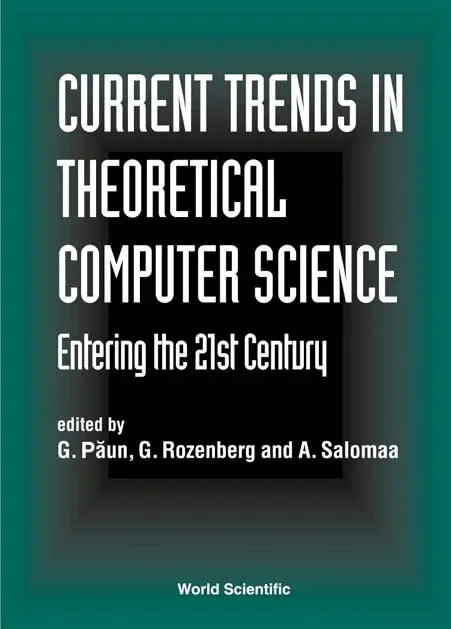
CURRENT TRENDS IN THEORETICAL COMPUTER SCIENCE - ENTERING THE 21ST CENTURY
Av ROZENBERG G, G Paun m. fl.
Inbunden, 2001
5130 kr
Tillfälligt slut
The scientific developments at the end of the past millennium were dominated by the huge increase and diversity of disciplines with the common label “computer science”. The theoretical foundations of such disciplines have become known as theoretical computer science. This book highlights some key …
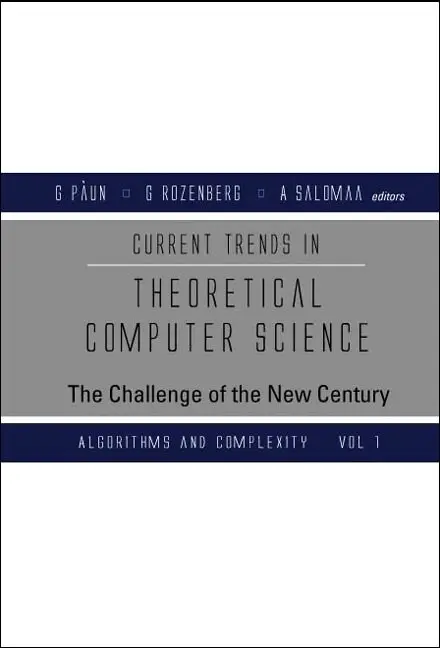
CURRENT TRENDS IN THEORETICAL COMPUTER SCIENCE: THE CHALLENGE OF THE NEW CENTURY (IN 2 VOLUMES)
Inbunden, 2004
5915 kr
Tillfälligt slut
This book is based on columns and tutorials published in the Bulletin of the European Association for Theoretical Computer Science (EATCS) during the period 2000–2003. It presents many of the most active current research lines in theoretical computer science. The material appears in two volumes, …