Gabriel Kuper – författare
Visar alla böcker från författaren Gabriel Kuper. Handla med fri frakt och snabb leverans.
4 produkter
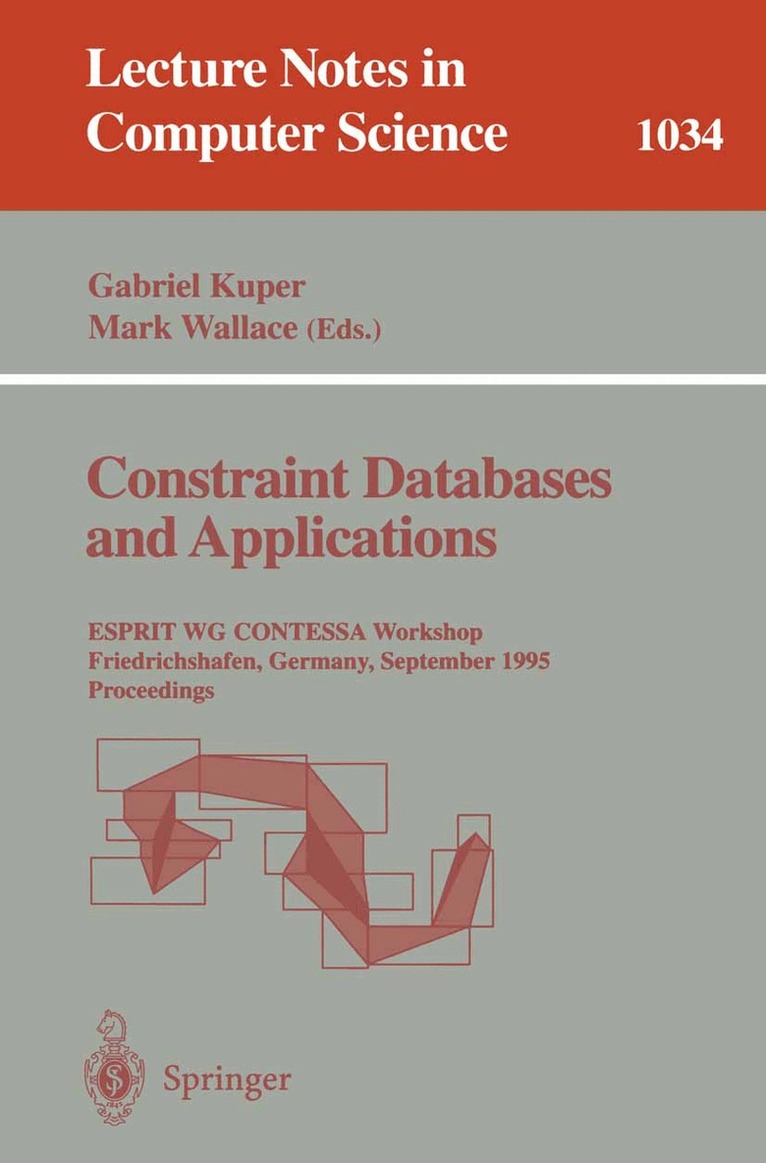
Constraint Databases and Applications
ESPRIT WG CONTESSA Workshop, Friedrichshafen, Germany, September, 8 - 9, 1995. Proceedings
Av Gabriel Kuper, Mark Wallace
Häftad, 1996
551 kr
Lägg i varukorg
This book constitutes the refereed proceedings of the ESPRIT Working Group CONTESSA Workshop on Constraint Databases and Applications, held in Friedrichshafen, Germany in September 1995.The 10 full revised papers selected for inclusion in this volume are written by and for practitioners, …
Constraint Databases
Av Gabriel Kuper, Leonid Libkin m. fl.
Inbunden, 2000
1688 kr
Lägg i varukorg
This book is the first comprehensive survey of the field of constraint databases. Constraint databases are a fairly new and active area of database research. The key idea is that constraints, such as linear or polynomial equations, are used to represent large, or even infinite, sets in a compact …
Constraint Databases
Av Gabriel Kuper, Leonid Libkin m. fl.
Häftad, 2010
1688 kr
Lägg i varukorg
This book is the first comprehensive survey of the field of constraint databases. Constraint databases are a fairly new and active area of database research. The key idea is that constraints, such as linear or polynomial equations, are used to represent large, or even infinite, sets in a compact …
Constraint Databases
Av Jan Paredaens, Leonid Libkin m. fl.
E-bok, 2013
2174 kr
Lägg i varukorg
This book is the first comprehensive survey of the field of constraint databases. Constraint databases are a fairly new and active area of database research. The key idea is that constraints, such as linear or polynomial equations, are used to represent large, or even infinite, sets in a compact …