Gail Kligman - Böcker
Visar alla böcker från författaren Gail Kligman. Handla med fri frakt och snabb leverans.
6 produkter
6 produkter
639 kr
Skickas inom 3-6 vardagar
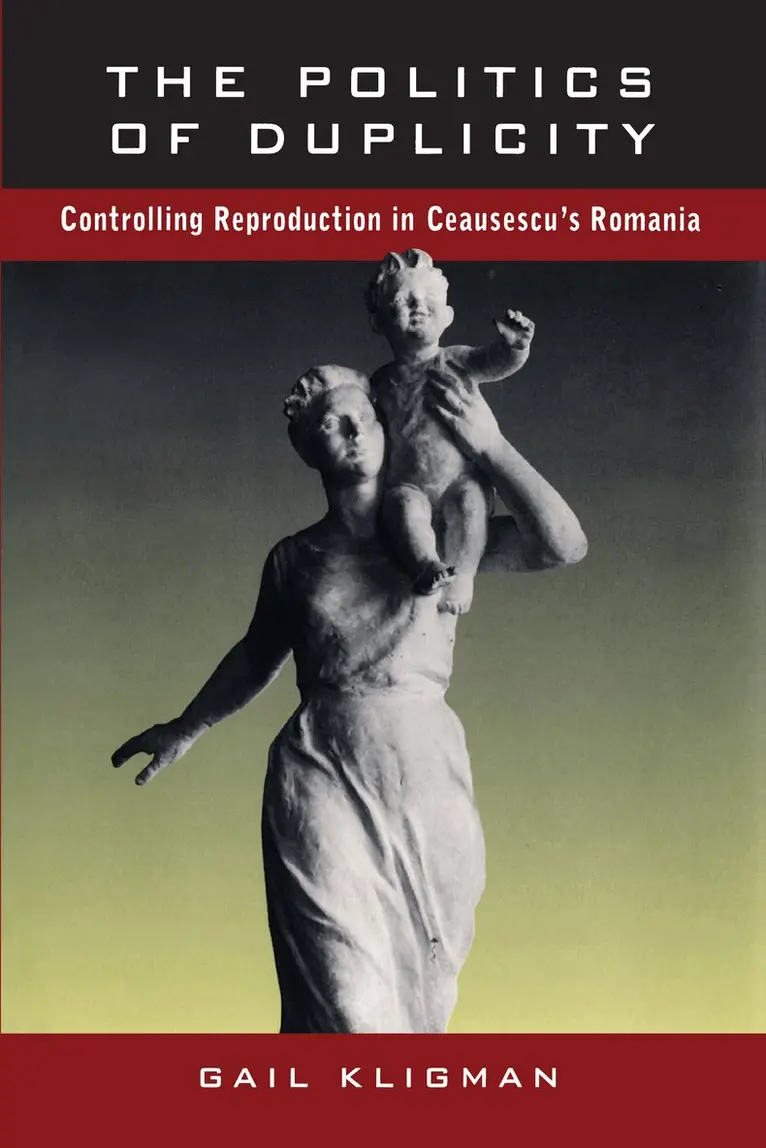
The political hypocrisy and personal horrors of one of the most repressive anti-abortion regimes in history came to the world's attention soon after the fall of Romanian dictator Nicolae Ceausescu. Photographs of orphans with vacant eyes, sad faces, and wasted bodies circled the globe, as did alarming maternal mortality statistics and heart-breaking details of a devastating infant AIDS epidemic. Gail Kligman's chilling ethnography - of the state and of the politics of reproduction - is the first in-depth examination of this extreme case of political intervention into the most intimate aspects of everyday life. Ceausescu's reproductive policies, among which the banning of abortion was central, affected the physical and emotional well-being not only of individual men, women, children, and families but also of society as a whole. Sexuality, intimacy, and fertility control were fraught with fear, which permeated daily life and took a heavy moral toll as lying and dissimulation transformed both individuals and the state. This powerful study is based on moving interviews with women and physicians as well as on documentary and archival material.In addition to discussing the social implications and human costs of restrictive reproductive legislation, Kligman explores the means by which reproductive issues become embedded in national and international agendas. She concludes with a review of the lessons the rest of the world can learn from Romania's tragic experience.
Del 4 - Studies on the History of Society and Culture
Wedding of the Dead
Ritual, Poetics, and Popular Culture in Transylvania
Häftad, Engelska, 2021
811 kr
Skickas inom 3-6 vardagar
The Wedding of the Dead: Ritual, Poetics, and Popular Culture in Transylvania by Gail Kligman explores how life-cycle rituals—weddings, funerals, and the symbolic “death-weddings” of the young unmarried dead—both express and reshape community life in Maramureș, an isolated region of northern Transylvania. Moving far beyond the gothic myth of Dracula, Kligman situates ritual within the historical and political upheavals of twentieth-century Romania, from Habsburg rule to socialist centralization. Drawing on seventeen months of fieldwork, she reconstructs how villagers use ritual action and ritual poetry to interpret life, death, gender, and social identity, while also negotiating their subordination to state power. Through laments, shouted couplets, and ritualized exchanges, these communities make sense of upheaval, loss, and desire, turning the fragility of everyday existence into shared, enduring meaning.The book traces in detail how these rites mediate the tensions between continuity and change, religion and ideology, local autonomy and national appropriation. Weddings reaffirm kinship and exchange, funerals stage relations between the living and the dead, and the nupta mortului—the “wedding of the dead”—renders untimely death intelligible by ritualizing it as marriage. Kligman shows how oral poetics in these rituals constitute a collective language of both conformity and critique, offering villagers a veiled arena to voice social tensions even under censorship. At the same time, she illuminates how state folklorization of ritual traditions turned peasant life into symbolic capital for Romanian nationalism. Richly interdisciplinary, The Wedding of the Dead brings anthropology, history, and literary analysis together to reveal ritual as a powerful medium through which communities continually renegotiate identity, gender, and mortality. It is an essential study for readers interested in Eastern Europe, folklore, religion, and the politics of culture.This title is part of UC Press's Voices Revived program, which commemorates University of California Press’s mission to seek out and cultivate the brightest minds and give them voice, reach, and impact. Drawing on a backlist dating to 1893, Voices Revived makes high-quality, peer-reviewed scholarship accessible once again using print-on-demand technology. This title was originally published in 1988.
Del 4 - Studies on the History of Society and Culture
Wedding of the Dead
Ritual, Poetics, and Popular Culture in Transylvania
Inbunden, Engelska, 2021
1 469 kr
Skickas inom 3-6 vardagar
The Wedding of the Dead: Ritual, Poetics, and Popular Culture in Transylvania by Gail Kligman explores how life-cycle rituals—weddings, funerals, and the symbolic “death-weddings” of the young unmarried dead—both express and reshape community life in Maramureș, an isolated region of northern Transylvania. Moving far beyond the gothic myth of Dracula, Kligman situates ritual within the historical and political upheavals of twentieth-century Romania, from Habsburg rule to socialist centralization. Drawing on seventeen months of fieldwork, she reconstructs how villagers use ritual action and ritual poetry to interpret life, death, gender, and social identity, while also negotiating their subordination to state power. Through laments, shouted couplets, and ritualized exchanges, these communities make sense of upheaval, loss, and desire, turning the fragility of everyday existence into shared, enduring meaning.The book traces in detail how these rites mediate the tensions between continuity and change, religion and ideology, local autonomy and national appropriation. Weddings reaffirm kinship and exchange, funerals stage relations between the living and the dead, and the nupta mortului—the “wedding of the dead”—renders untimely death intelligible by ritualizing it as marriage. Kligman shows how oral poetics in these rituals constitute a collective language of both conformity and critique, offering villagers a veiled arena to voice social tensions even under censorship. At the same time, she illuminates how state folklorization of ritual traditions turned peasant life into symbolic capital for Romanian nationalism. Richly interdisciplinary, The Wedding of the Dead brings anthropology, history, and literary analysis together to reveal ritual as a powerful medium through which communities continually renegotiate identity, gender, and mortality. It is an essential study for readers interested in Eastern Europe, folklore, religion, and the politics of culture.This title is part of UC Press's Voices Revived program, which commemorates University of California Press’s mission to seek out and cultivate the brightest minds and give them voice, reach, and impact. Drawing on a backlist dating to 1893, Voices Revived makes high-quality, peer-reviewed scholarship accessible once again using print-on-demand technology. This title was originally published in 1988.
541 kr
Skickas inom 7-10 vardagar
The striking fact that abortion was among the first issues raised, after 1989, by almost all of the newly formed governments of East Central Europe points to the significance of gender and reproduction in the postsocialist transformations. The fourteen studies in this volume result from a comparative, collaborative research project on the complex relationship between ideas and practices of gender, and political economic change. The book presents detailed evidence about women's and men's new circumstances in eight of the former communist countries, exploring the intersection of politics and the life cycle, the differential effects of economic restructuring, and women's public and political participation. Individual contributions on the former German Democratic Republic, Poland, the Czech Republic, Slovakia, Hungary, Serbia, Romania, and Bulgaria provide rich empirical data and interpretive insights on postsocialist transformation analyzed from a gendered perspective. Drawing on multiple methods and disciplines, these original papers advance scholarship in several fields, including anthropology, sociology, women's studies, law, comparative political science, and regional studies.The analyses make clear that practices of gender, and ideas about the differences between men and women, have been crucial in shaping the broad social changes that have followed the collapse of communism. In addition to the editors, the contributors are Eleonora Zieliaska, Eva Maleck-Lewy, Myra Marx Ferree, Sharon Wolchik, Irene Dolling, Daphne Hahn, Sylka Scholz, Mira Marody, Anna Giza-Poleszczuk, Katalin Kovacs, Monika Varadi, Julia Szalai, Adriana Baban, MaIgorzata Fuszara, Laura Grunberg, Zorica Mrsevia, Krassimira Daskalova, Joanna Goven, and Jasmina Lukia.
376 kr
Skickas inom 7-10 vardagar
With the collapse of communism, a new world seemed to open for the peoples of East Central Europe. The possibilities this world presented, and the costs it exacted, have been experienced differently by men and women. Susan Gal and Gail Kligman explore these differences through a probing analysis of the role of gender in reshaping politics and social relations since 1989. The authors raise two crucial questions: How are gender relations and ideas about gender shaping political and economic change in the region? And what forms of gender inequality are emerging as a result? The book provides a rich understanding of gender relations and their significance in social and institutional transformations. Gal and Kligman offer a systematic comparison of East Central European gender relations with those of western welfare states, and with the presocialist, bourgeois past. Throughout this essay, the authors attend to historical comparisons as well as cross regional interactions and contrasts.Their work contributes importantly to the study of postsocialism, and to the broader feminist literature that critically examines how states and political-economic processes are gendered, and how states and markets regulate gender relations.
439 kr
Skickas inom 7-10 vardagar
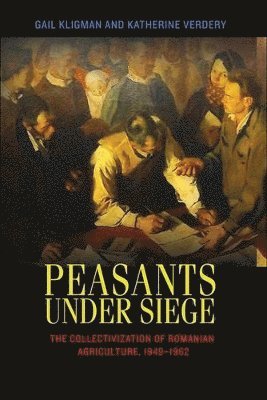
In 1949, Romania's fledgling communist regime unleashed a radical and brutal campaign to collectivize agriculture in this largely agrarian country, following the Soviet model. Peasants under Siege provides the first comprehensive look at the far-reaching social engineering process that ensued. Gail Kligman and Katherine Verdery examine how collectivization assaulted the very foundations of rural life, transforming village communities that were organized around kinship and status hierarchies into segments of large bureaucratic organizations, forged by the language of "class warfare" yet saturated with vindictive personal struggles. Collectivization not only overturned property relations, the authors argue, but was crucial in creating the Party-state that emerged, its mechanisms of rule, and the "new persons" that were its subjects. The book explores how ill-prepared cadres, themselves unconvinced of collectivization's promises, implemented technologies and pedagogies imported from the Soviet Union through actions that contributed to the excessive use of force, which Party leaders were often unable to control.In addition, the authors show how local responses to the Party's initiatives compelled the regime to modify its plans and negotiate outcomes. Drawing on archival documents, oral histories, and ethnographic data, Peasants under Siege sheds new light on collectivization in the Soviet era and on the complex tensions underlying and constraining political authority.