Gary Steiner - Böcker
Visar alla böcker från författaren Gary Steiner. Handla med fri frakt och snabb leverans.
6 produkter
6 produkter
519 kr
Skickas inom 7-10 vardagar
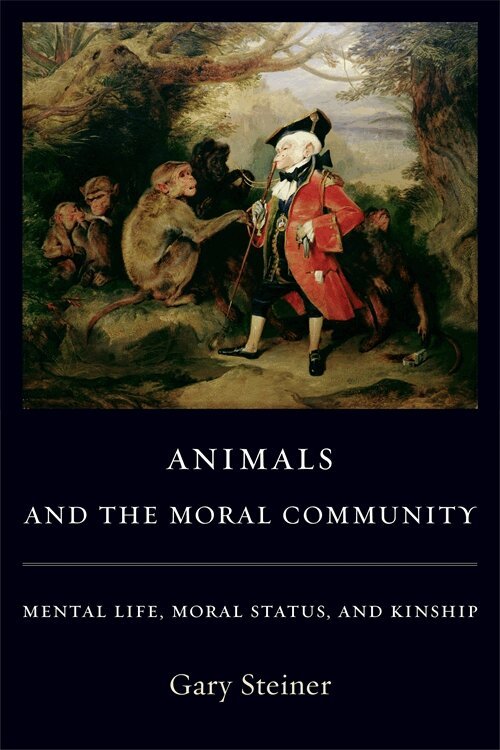
Gary Steiner argues that ethologists and philosophers in the analytic and continental traditions have largely failed to advance an adequate explanation of animal behavior. Critically engaging the positions of Marc Hauser, Daniel Dennett, Donald Davidson, John Searle, Martin Heidegger, and Hans-Georg Gadamer, among others, Steiner shows how the Western philosophical tradition has forced animals into human experiential categories in order to make sense of their cognitive abilities and moral status and how desperately we need a new approach to animal rights. Steiner rejects the traditional assumption that a lack of formal rationality confers an inferior moral status on animals vis-a-vis human beings. Instead, he offers an associationist view of animal cognition in which animals grasp and adapt to their environments without employing concepts or intentionality. Steiner challenges the standard assumption of liberal individualism according to which humans have no obligations of justice toward animals. Instead, he advocates a "cosmic holism" that attributes a moral status to animals equivalent to that of people.Arguing for a relationship of justice between humans and nature, Steiner emphasizes our kinship with animals and the fundamental moral obligations entailed by this kinship.
1 189 kr
Skickas inom 7-10 vardagar
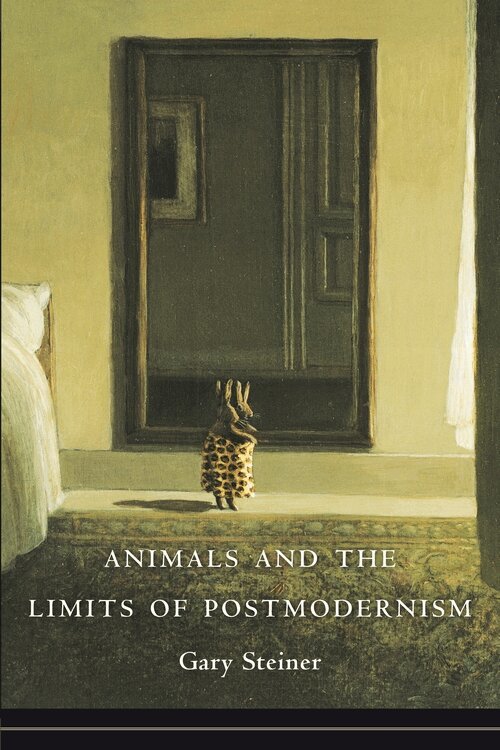
In Animals and the Limits of Postmodernism, Gary Steiner illuminates postmodernism's inability to produce viable ethical and political principles. Ethics requires notions of self, agency, and value that are not available to postmodernists. Thus, much of what is published under the rubric of postmodernist theory lacks a proper basis for a systematic engagement with ethics. Steiner demonstrates this through a provocative critique of postmodernist approaches to the moral status of animals, set against the background of a broader indictment of postmodernism's failure to establish clear principles for action. He revisits the ideas of Derrida, Foucault, Nietzsche, and Heidegger, together with recent work by their American interpreters, and shows that the basic terms of postmodern thought are incompatible with definitive claims about the moral status of animals-as well as humans. Steiner also identifies the failures of liberal humanist thought in regards to this same moral dilemma, and he encourages a rethinking of humanist ideas in a way that avoids the anthropocentric limitations of traditional humanist thought.Drawing on the achievements of the Stoics and Kant, he builds on his earlier ideas of cosmic holism and non-anthropocentric cosmopolitanism to arrive at a more concrete foundation for animal rights.
291 kr
Skickas inom 7-10 vardagar
In Animals and the Limits of Postmodernism, Gary Steiner illuminates postmodernism's inability to produce viable ethical and political principles. Ethics requires notions of self, agency, and value that are not available to postmodernists. Thus, much of what is published under the rubric of postmodernist theory lacks a proper basis for a systematic engagement with ethics. Steiner demonstrates this through a provocative critique of postmodernist approaches to the moral status of animals, set against the background of a broader indictment of postmodernism's failure to establish clear principles for action. He revisits the ideas of Derrida, Foucault, Nietzsche, and Heidegger, together with recent work by their American interpreters, and shows that the basic terms of postmodern thought are incompatible with definitive claims about the moral status of animals-as well as humans. Steiner also identifies the failures of liberal humanist thought in regards to this same moral dilemma, and he encourages a rethinking of humanist ideas in a way that avoids the anthropocentric limitations of traditional humanist thought.Drawing on the achievements of the Stoics and Kant, he builds on his earlier ideas of cosmic holism and non-anthropocentric cosmopolitanism to arrive at a more concrete foundation for animal rights.
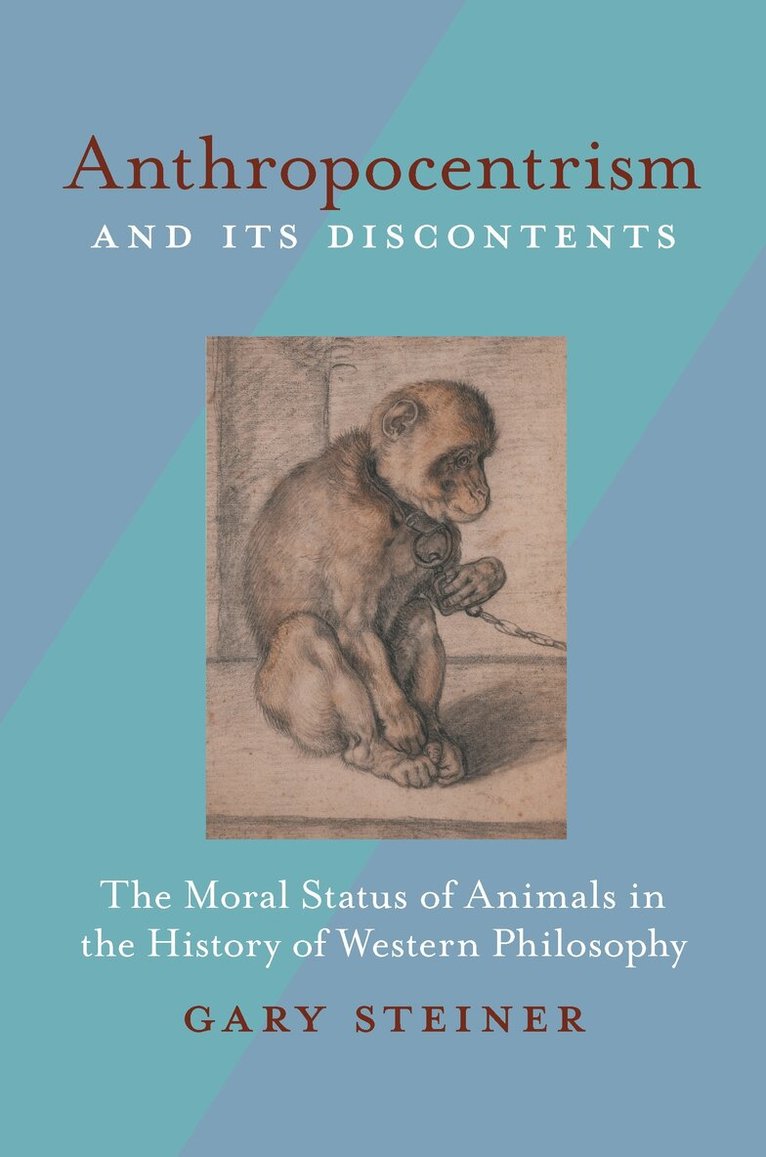
Anthropocentrism and Its Discontents
The Moral Status of Animals in the History of Western Philosophy
Häftad, Engelska, 2010
699 kr
Skickas inom 7-10 vardagar
Anthropocentrism and Its Discontents is the first-ever comprehensive examination of views of animals in the history of Western philosophy, from Homeric Greece to the twentieth century.In recent decades, increased interest in this area has been accompanied by scholars' willingness to conceive of animal experience in terms of human mental capacities: consciousness, self-awareness, intention, deliberation, and in some instances, at least limited moral agency. This conception has been facilitated by a shift from behavioral to cognitive ethology (the science of animal behavior), and by attempts to affirm the essential similarities between the psychophysical makeup of human beings and animals. Gary Steiner sketches the terms of the current debates about animals and relates these to their historical antecedents, focusing on both the dominant anthropocentric voices and those recurring voices that instead assert a fundamental kinship relation between human beings and animals. He concludes with a discussion of the problem of balancing the need to recognize a human indebtedness to animals and the natural world with the need to preserve a sense of the uniqueness and dignity of the human individual.
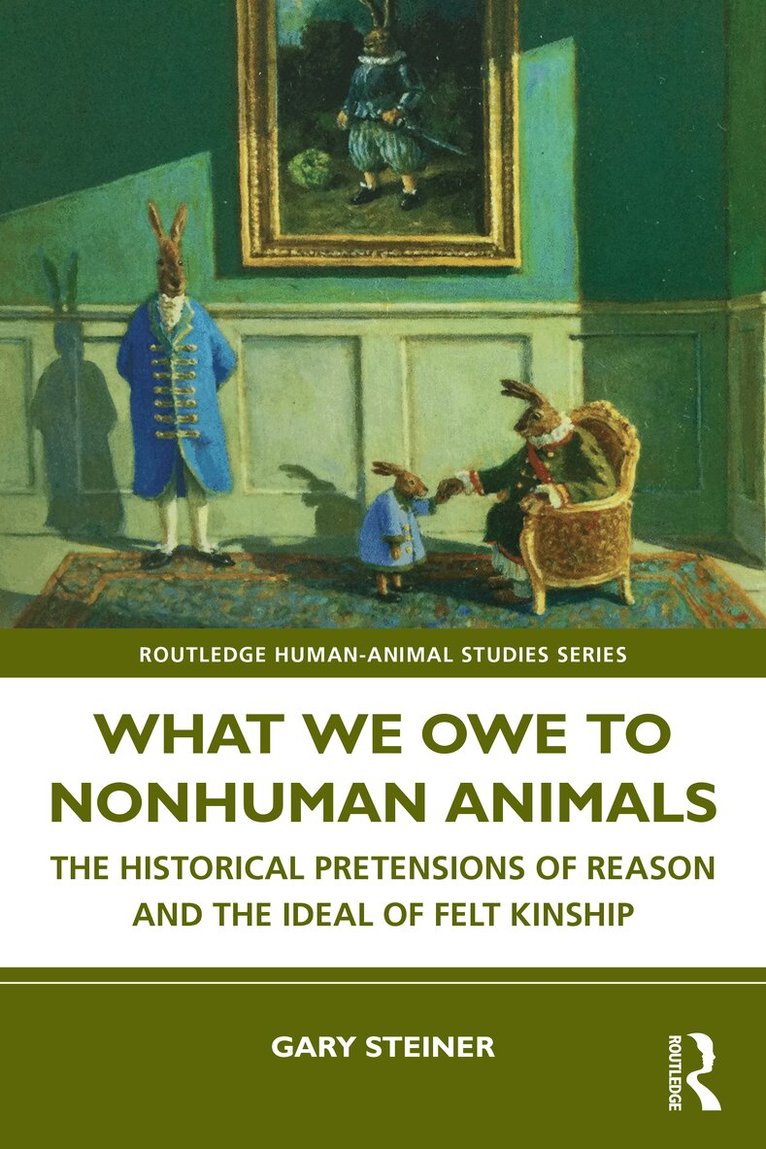
What We Owe to Nonhuman Animals
The Historical Pretensions of Reason and the Ideal of Felt Kinship
Inbunden, Engelska, 2023
2 104 kr
Skickas inom 10-15 vardagar
This book strongly challenges the Western philosophical tradition’s assertion that humans are superior to nonhuman animals. It makes a case for the full and direct moral status of nonhuman animals. The book provides the basis for a radical critique of the entire trajectory of animal studies over the past fifteen years. The key idea explored is that of ‘felt kinship’—a sense of shared fate with and obligations to all sentient life. It will help to inspire some deep rethinking on the part of leading exponents of animal studies. The book’s strong outlook is expressed through an appeal for radical humility on the side of humans rather than a constant reference to the ‘human-animal divide’. Historical figures examined in depth include Aristotle, Seneca, and Kant; contemporary figures examined include Christine Korsgaard and Martha Nussbaum. This book presents an account according to which the tradition has not proceeded on the basis of impartial motivations at all, but instead has made a set of pointedly self-serving assumptions about the proper criteria for assessing moral worth. Readers of this book will gain exposure to a wide variety of thinkers in the Western philosophical tradition, historical as well as contemporary. This book is suitable for professionals working in nonhuman animal studies, students, advanced undergraduates, and practitioners working in the fields of philosophy, environmental studies, law, literature, anthropology, and related fields.
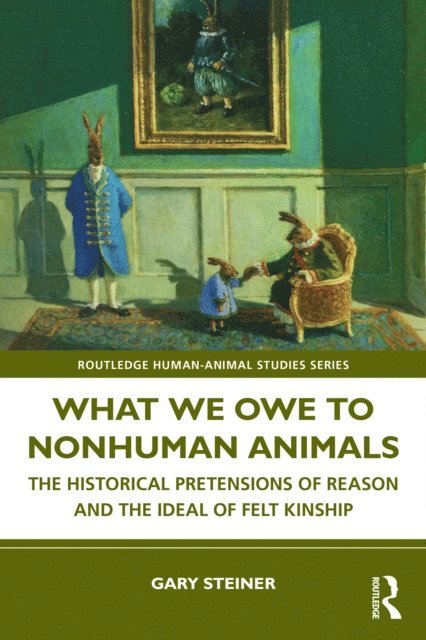
What We Owe to Nonhuman Animals
The Historical Pretensions of Reason and the Ideal of Felt Kinship
Häftad, Engelska, 2023
575 kr
Skickas inom 10-15 vardagar
This book strongly challenges the Western philosophical tradition’s assertion that humans are superior to nonhuman animals. It makes a case for the full and direct moral status of nonhuman animals. The book provides the basis for a radical critique of the entire trajectory of animal studies over the past fifteen years. The key idea explored is that of ‘felt kinship’—a sense of shared fate with and obligations to all sentient life. It will help to inspire some deep rethinking on the part of leading exponents of animal studies. The book’s strong outlook is expressed through an appeal for radical humility on the side of humans rather than a constant reference to the ‘human-animal divide’. Historical figures examined in depth include Aristotle, Seneca, and Kant; contemporary figures examined include Christine Korsgaard and Martha Nussbaum. This book presents an account according to which the tradition has not proceeded on the basis of impartial motivations at all, but instead has made a set of pointedly self-serving assumptions about the proper criteria for assessing moral worth. Readers of this book will gain exposure to a wide variety of thinkers in the Western philosophical tradition, historical as well as contemporary. This book is suitable for professionals working in nonhuman animal studies, students, advanced undergraduates, and practitioners working in the fields of philosophy, environmental studies, law, literature, anthropology, and related fields.