Gemma Williams – författare
Visar alla böcker från författaren Gemma Williams. Handla med fri frakt och snabb leverans.
3 produkter
3 produkter
203 kr
Skickas inom 7-10 vardagar
Understanding Others in a Neurodiverse World
A Radical Perspective on Communication and Shared Meaning
Häftad, Engelska, 2024
507 kr
Skickas inom 3-6 vardagar
Autistic people often experience difficulties with social communication. This can impact all areas of life and can contribute to poorer mental health outcomes, reduced opportunities for fulfilling social interactions and barriers to health and social care, education and employment. This book offers a new way of understanding why cross-neurotype mis attunements in communication may happen by taking the double empathy problem - the reframing of social communication difficulties as a two-way problem, not simply the result of an autistic 'deficit' - and a little-known cognitive linguistics theory, 'relevance theory', as a starting point.Weaving together threads from critical autism studies, a social-justice perspective, cognitive science, linguistics and sociology, this book leads the reader towards a new, radical perspective of how we can understand these breakdowns in understanding.
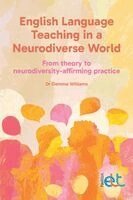
English Language Teaching in a Neurodiverse World
From theory to neurodiversity-affirming practice
Häftad, Engelska, 2026
390 kr
Skickas inom 5-8 vardagar
As teachers, our intrinsic motivation is to supportour students in their learning. Because every student’s learning journey isunique, ELT professionals tend already to be experts at adapting materials,grading our language and planning out individualised learning targets. But evenfor the most experienced English language teacher, understanding how toanticipate and meet the needs of neurodivergent learners can feel a stretch toofar, even if you are already informally incorporating a number of inclusive practices.In this book, Dr Gemma Williams provides aresearch-informed and neurodiversity-affirming perspective, that respects andvalues neurodivergence as simply a different way of processing the world,rather than a collection of pathologised ‘deficits’. From this, she provides clearpathways from theory to practical adjustments and real-world classroomapplications.Section One starts at the beginning, to explore whatneurodiversity really means. Section Two brings the focus to the classroom toexplore meaningful inclusion. Section Three thinks about our neurodivergentlearners as unique individuals with different needs. Finally, Section Fourmoves towards the practicalities of teaching for neurodiversity; not justteaching neurodivergent students but also helping them ready themselves for navigatinga neurodiverse world.By reading this book, our hope is that you finish itnot only equipped with a greater understanding of the generalities of aneurodiverse world, but also the encouragement and confidence to supportneurodivergent learners. Supporting neurodivergent students doesn’t meanreinventing your practice: just thinking about it in (potentially) new ways.Many of you will already be doing lots of things that support yourneurodivergent learners. All that’s needed is a little additional underlyingtheory and some structure…