Gena Hahn - Böcker
Visar alla böcker från författaren Gena Hahn. Handla med fri frakt och snabb leverans.
3 produkter
3 produkter
Del 497 - Nato Science Series C:
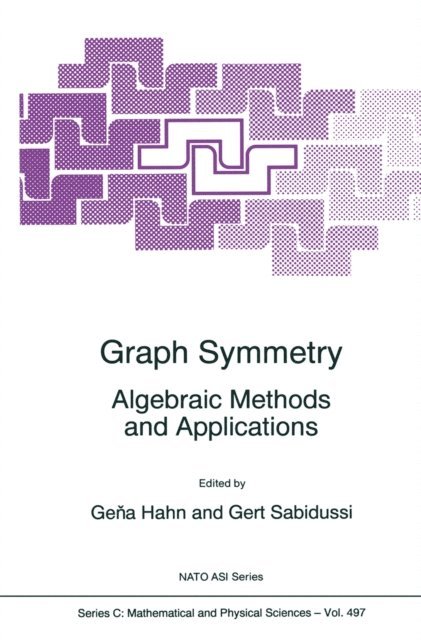
Graph Symmetry
Algebraic Methods and Applications
Inbunden, Engelska, 1997
2 101 kr
Skickas inom 10-15 vardagar
The last decade has seen parallel developments in computer science and combinatorics, both dealing with networks having strong symmetry properties. Both developments are centred on Cayley graphs: in the design of large interconnection networks, Cayley graphs arise as one of the most frequently used models; on the mathematical side, they play a central role as the prototypes of vertex-transitive graphs. The surveys published here provide an account of these developments, with emphasis on the interplay of methods from group theory and graph theory that characterizes the subject. Topics covered include: combinatorial properties of various hierarchical families of Cayley graphs (fault tolerance, diameter, routing, forwarding indices, etc.); Laplace eigenvalues of graphs and their relations to forwarding problems, isoperimetric properties, partition problems, and random walks on graphs; vertex-transitive graphs of small orders and of orders having few prime factors; distance transitive graphs; isomorphism problems for Cayley graphs of cyclic groups; infinite vertex-transitive graphs (the random graph and generalizations, actions of the automorphisms on ray ends, relations to the growth rate of the graph).
2 101 kr
Skickas inom 10-15 vardagar
The last decade has seen parallel developments in computer science and combinatorics, both dealing with networks having strong symmetry properties. Both developments are centred on Cayley graphs: in the design of large interconnection networks, Cayley graphs arise as one of the most frequently used models; on the mathematical side, they play a central role as the prototypes of vertex-transitive graphs. The surveys published here provide an account of these developments, with a strong emphasis on the fruitful interplay of methods from group theory and graph theory that characterises the subject. Topics covered include: combinatorial properties of various hierarchical families of Cayley graphs (fault tolerance, diameter, routing, forwarding indices, etc.); Laplace eigenvalues of graphs and their relations to forwarding problems, isoperimetric properties, partition problems, and random walks on graphs; vertex-transitive graphs of small orders and of orders having few prime factors; distance transitive graphs; isomorphism problems for Cayley graphs of cyclic groups; infinite vertex-transitive graphs (the random graph and generalisations, actions of the automorphisms on ray ends, relations to the growth rate of the graph).
536 kr
Skickas inom 10-15 vardagar
What is the "archetypal" image that comes to mind when one thinks of an infinite graph? What with a finite graph - when it is thought of as opposed to an infinite one? What structural elements are typical for either - by their presence or absence - yet provide a common ground for both? In planning the workshop on "Cycles and Rays" it had been intended from the outset to bring infinite graphs to the fore as much as possible. There never had been a graph theoretical meeting in which infinite graphs were more than "also rans", let alone one in which they were a central theme. In part, this is a matter of fashion, inasmuch as they are perceived as not readily lending themselves to applications, in part it is a matter of psychology stemming from the insecurity that many graph theorists feel in the face of set theory - on which infinite graph theory relies to a considerable extent. The result is that by and large, infinite graph theorists know what is happening in finite graphs but not conversely. Lack of knowledge about infinite graph theory can also be found in authoritative l sources. For example, a recent edition (1987) of a major mathematical encyclopaedia proposes to ". . . restrict [itself] to finite graphs, since only they give a typical theory". If anything, the reverse is true, and needless to say, the graph theoretical world knows better. One may wonder, however, by how much.