Gert Sabidussi – författare
Visar alla böcker från författaren Gert Sabidussi. Handla med fri frakt och snabb leverans.
10 produkter
Algebras and Orders
Av Ivo G. Rosenberg, Gert Sabidussi
Inbunden, 1993
5452 kr
Lägg i varukorg
In the summer of 1991 the Department of Mathematics and Statistics of the Universite de Montreal was fortunate to host the NATO Advanced Study Institute "Algebras and Orders" as its 30th Seminaire de mathematiques superieures (SMS), a summer school with a long tradition and well-established …
Complex Potential Theory
Proceedings of the NATO Advanced Study Institute and Seminaire de Mathematiques Superieures, Montreal, Canada, July 26-August 6, 1993
Av Paul M. Gauthier, Gert Sabidussi
Inbunden, 1994
878 kr
Lägg i varukorg
This conference allowed specialists in several complex variables to meet with specialists in potential theory to demonstrate the interface and interconnections between their two fields. The following topics were discussed: 1. Real and complex potential theory - capacity and approximation, basic …
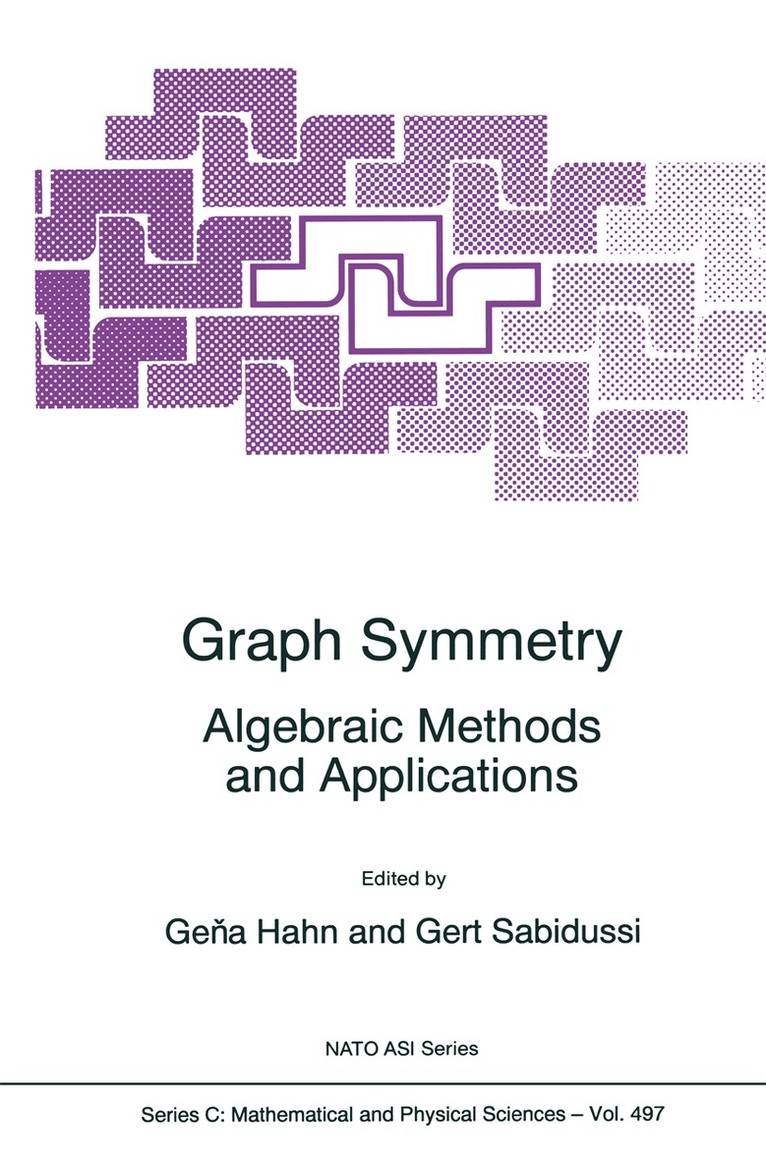
Graph Symmetry
Algebraic Methods and Applications
Inbunden, 1997
2185 kr
Lägg i varukorg
The last decade has seen two parallel developments, one in computer science, the other in mathematics, both dealing with the same kind of combinatorial structures: networks with strong symmetry properties or, in graph-theoretical language, vertex-transitive graphs, in particular their prototypical …
Modern Methods in Scientific Computing and Applications
Proceedings of the NATO Advanced Study Institute and Seminaire De Math Eacute Matiques Superieures on Modern Methods in Scientific Computing and Applications, Montreal, Quebec, Canada, 9-20 July 2001
Av Anne Bourlioux, Anne Bourlioux m. fl.
Inbunden, 2002
1205 kr
Lägg i varukorg
The influence of scientific computing has become very wide over the last few decades: almost every area of science and engineering is greatly influenced by simulations - image processing, thin films, mathematical finance, electrical engineering, moving interfaces and combustion, to name but a few. …
Algebras and Orders
Av Ivo G. Rosenberg, Gert Sabidussi
Häftad, 2010
5452 kr
Lägg i varukorg
The book consists of the lectures presented at the NATO ASI on 'Algebras and Orders' held in 1991 at the Universite de Montreal. The lectures cover a broad spectrum of topics in universal algebra, Boolean algebras, lattices and orders, and their links with graphs, relations, topology and …
Graph Symmetry
Algebraic Methods and Applications
Häftad, 2010
2185 kr
Lägg i varukorg
The last decade has seen two parallel developments, one in computer science, the other in mathematics, both dealing with the same kind of combinatorial structures: networks with strong symmetry properties or, in graph-theoretical language, vertex-transitive graphs, in particular their prototypical …
Cycles and Rays
Av R.E. Woodrow, Gert Sabidussi m. fl.
E-bok, 2012
734 kr
Lägg i varukorg
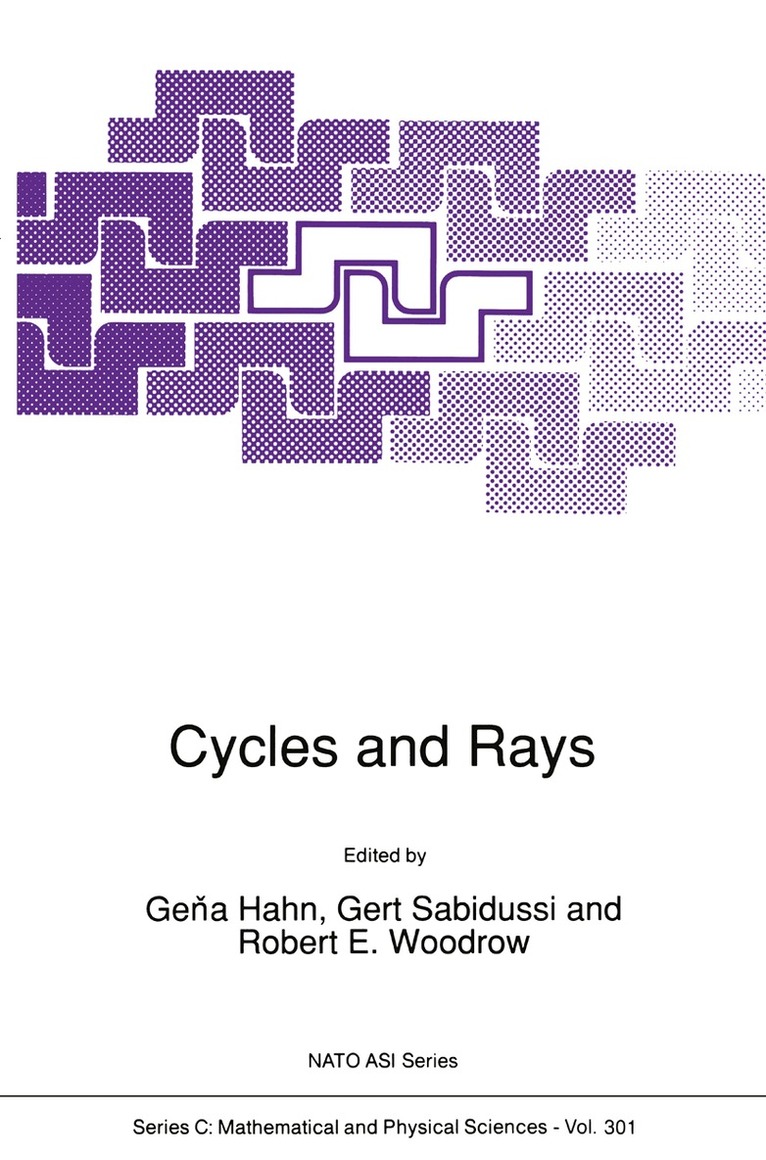
What is the "archetypal" image that comes to mind when one thinks of an infinite graph? What with a finite graph - when it is thought of as opposed to an infinite one? What structural elements are typical for either - by their presence or absence - yet provide a common ground for both? In planning …
Cycles and Rays
Av Gena Hahn, Gert Sabidussi m. fl.
Häftad, 2011
550 kr
Lägg i varukorg
What is the "archetypal" image that comes to mind when one thinks of an infinite graph? What with a finite graph - when it is thought of as opposed to an infinite one? What structural elements are typical for either - by their presence or absence - yet provide a common ground for both? In planning …
Graph Symmetry
Algebraic Methods and Applications
E-bok, 2013
2925 kr
Lägg i varukorg
The last decade has seen two parallel developments, one in computer science, the other in mathematics, both dealing with the same kind of combinatorial structures: networks with strong symmetry properties or, in graph-theoretical language, vertex-transitive graphs, in particular their prototypical …
Algebras and Orders
Av Gert Sabidussi, Ivo G. Rosenberg
E-bok, 2013
7325 kr
Lägg i varukorg
In the summer of 1991 the Department of Mathematics and Statistics of the Universite de Montreal was fortunate to host the NATO Advanced Study Institute "Algebras and Orders" as its 30th Seminaire de mathematiques superieures (SMS), a summer school with a long tradition and well-established …