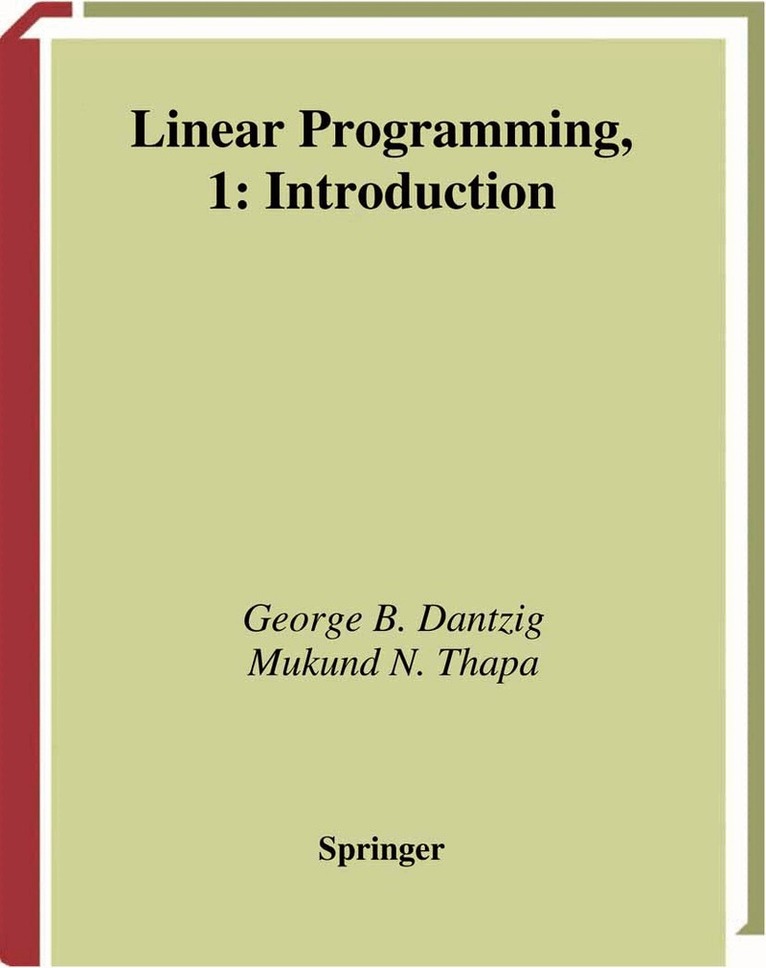
George B. Dantzig - Böcker
Visar alla böcker från författaren George B. Dantzig. Handla med fri frakt och snabb leverans.
5 produkter
5 produkter
1 690 kr
Skickas inom 10-15 vardagar
This book provides a comprehensive introduction to linear programming which encompasses all the major topics students will encounter in courses on the subject. The authors aim to teach both the underlying mathematical foundations and how these ideas are implemented in practice. The book illustrates all the concepts with both worked examples and plenty of exercises. In addition, Windows software is provided with the book so that students can try out numerical methods using the examples and exercises and hone their skills in interpreting the results. As a result, this will make an ideal textbook for all those coming to the subject for the first time.Authors'note: A problem recently found with the software is due to a bug in Formula One, the third party commercial software package that was used for the development of the interface. It occurs when the date currency, etc. format is set to a non-United States version. Please try setting your computer date/currency option to the United States. The new version of Formula One, when ready, will be posted on WWW.
1 387 kr
Skickas inom 10-15 vardagar
Linear programming represents one of the major applications of mathematics to business, industry, and economics. It provides a methodology for optimizing an output given that is a linear function of a number of inputs. George Dantzig is widely regarded as the founder of the subject with his invention of the simplex algorithm in the 1940's. This second volume is intended to add to the theory of the items discussed in the first volume. It also includes additional advanced topics such as variants of the simplex method; interior point methods (early and current methods), GUB, decomposition, integer programming, and game theory. Graduate students in the fields of operations research, industrial engineering and applied mathematics will find this volume of particular interest.
1 216 kr
Skickas inom 7-10 vardagar
In real-world problems related to finance, business, and management, mathematicians and economists frequently encounter optimization problems. In this classic book, George Dantzig looks at a wealth of examples and develops linear programming methods for their solutions. He begins by introducing the basic theory of linear inequalities and describes the powerful simplex method used to solve them. Treatments of the price concept, the transportation problem, and matrix methods are also given, and key mathematical concepts such as the properties of convex sets and linear vector spaces are covered. George Dantzig is properly acclaimed as the "father of linear programming." Linear programming is a mathematical technique used to optimize a situation. It can be used to minimize traffic congestion or to maximize the scheduling of airline flights. He formulated its basic theoretical model and discovered its underlying computational algorithm, the "simplex method," in a pathbreaking memorandum published by the United States Air Force in early 1948.Linear Programming and Extensions provides an extraordinary account of the subsequent development of his subject, including research in mathematical theory, computation, economic analysis, and applications to industrial problems. Dantzig first achieved success as a statistics graduate student at the University of California, Berkeley. One day he arrived for a class after it had begun, and assumed the two problems on the board were assigned for homework. When he handed in the solutions, he apologized to his professor, Jerzy Neyman, for their being late but explained that he had found the problems harder than usual. About six weeks later, Neyman excitedly told Dantzig, "I've just written an introduction to one of your papers. Read it so I can send it out right away for publication." Dantzig had no idea what he was talking about. He later learned that the "homework" problems had in fact been two famous unsolved problems in statistics.
963 kr
Skickas inom 10-15 vardagar
Linear programming represents one of the major applications of mathematics to business, industry, and economics. It provides a methodology for optimizing an output given that is a linear function of a number of inputs. George Dantzig is widely regarded as the founder of the subject with his invention of the simplex algorithm in the 1940's. This second volume is intended to add to the theory of the items discussed in the first volume. It also includes additional advanced topics such as variants of the simplex method; interior point methods (early and current methods), GUB, decomposition, integer programming, and game theory. Graduate students in the fields of operations research, industrial engineering and applied mathematics will find this volume of particular interest.
1 387 kr
Skickas inom 10-15 vardagar
By George B. Dantzig LINEAR PROGRAMMING The Story About How It Began: Some legends, a little about its historical sign- cance, and comments about where its many mathematical programming extensions may be headed. Industrial production, the ?ow of resources in the economy, the exertion of military e?ort in a war, the management of ?nances—all require the coordination of interrelated activities. What these complex undertakings share in common is the task of constructing a statement of actions to be performed, their timing and quantity(calledaprogramorschedule), that, ifimplemented, wouldmovethesystem from a given initial status as much as possible towards some de?ned goal. While di?erences may exist in the goals to be achieved, the particular processes, and the magnitudes of e?ort involved, when modeled in mathematical terms these seemingly disparate systems often have a remarkably similar mathematical str- ture. The computational task is then to devise for these systems an algorithm for choosing the best schedule of actions from among the possible alternatives. The observation, in particular, that a number of economic, industrial, ?nancial, and military systems can be modeled (or reasonably approximated) by mathem- ical systems of linear inequalities and equations has given rise to the development of the linear programming ?eld.