George Comstock – författare
Visar alla böcker från författaren George Comstock. Handla med fri frakt och snabb leverans.
5 produkter
5 produkter
E-bok
PDF, Engelska, 2005742 kr
Läs direkt efter köp
Research indicates that people discount their own opinions and experiences in favor of those of "experts" as espoused in the media. The framing of news coverage thus has a profound impact on public opinion, and political decision making as a response to public outcry. However, the choice of how to frame the news is typically made to solicit viewership and high ratings rather than to convey accurate and meaningful information. The Psychology of Media and Politics discusses why people discount their own opinions, how the media shapes the news, when this drives political decision making, and what the effect is on the future of society.Issues addressed include:- How powerful are the media in shaping political beliefs/judgment?- How has this power changed in recent years?- How does media influence voting behavior?- To what extent do media opinions affect political decision making?- Demonstrates the ways in which the media both constrain and facilitate democratic participation- Provides insight into why individuals have varying levels of attention to and interest in politics- Discusses such issues as political advertising, polls, debates, and journalists'' pursuit of scandal- Describes why only some Americans turn out to vote in prominent elections- Offers a model of personal- versus social-level influences that extends beyond politics into other important topic areas- Brings together research and theories from the fields of Communication, Psychology, and Political Science- Reviews hundreds of key sources, both historical and contemporary
E-bok
PDF, Engelska, 2010727 kr
Läs direkt efter köp
Media and the American Child summarizes the research on all forms of media on children, looking at how much time they spend with media everyday, television programming and its impact on children, how advertising has changed to appeal directly to children and the effects on children and the consumer behavior of parents, the relationship between media use and scholastic achievement, the influence of violence in media on anti-social behavior, and the role of media in influencing attitudes on body image, sex and work roles, fashion, & lifestyle.The average American child, aged 2-17, watches 25 hours of TV per week, plays 1 hr per day of video or computer games, and spends an additional 36 min per day on the internet. 19% of children watch more than 35 hrs per week of TV. This in the face of research that shows TV watching beyond 10 hours per week decreases scholastic performance.In 1991, George Comstock published Television and the American Child, which immediately became THE standard reference for the research community of the effects of television on children. Since then, interest in the topic has mushroomed, as the availability and access of media to children has become more widespread and occurs earlier in their lifetimes. No longer restricted to television, media impacts children through the internet, computer and video games, as well as television and the movies. There are videos designed for infants, claiming to improve cognitive development, television programs aimed for younger and younger children-even pre-literates, computer programs aimed for toddlers, and increasingly graphic, interactive violent computer games.- Presents the most recent research on the media use of young people- Investigates the content of children''s media and addresses areas of great concern including violence, sexual behavior, and commercialization- Discusses policy making in the area of children and the media- Focuses on experiences unique to children and adolescents
E-bok
PDF, Engelska, 19991 023 kr
Läs direkt efter köp
Television: What''s On, Who''s Watching, and What It Means presents a comprehensive examination of the role of television in one''s life. The emphasis is on data collected over the past two decades pointing to an increasing and in some instances a surprising influence of the medium. Television is not only watched but its messages are attended to and well understood. There is no shame in spending hours in front of the set, in fact, people over-estimate the time they spend viewing. Television advertising no longer persuades--it sells by creating a burst of emotional liking for the commercial. The emphases of television news determine not only what voters think about but also the presidential candidate they expect to support on election day. Children and teenagers who watch a great deal of television perform poorly on standardized achievement tests, and among the reasons are the usurpation of time spent learning to read and the discouragement of book reading. Television violence frightens some children and excites others, but its foremost effect is to increase aggressive behavior that sometimes spills over into seriously harmful antisocial behavior.- Incorporates social psychology, political science, sociology, child development, and the growing field of communications- Presents tables and graphs clarifying theories and linking sets of data- Paints concise portraits of the role of television in entertainment, politics, and child-rearing- Contains background for dozens of lectures and articles- Contains a comprehensive bibliography of more than 1000 citations, many recent
E-bok
PDF, Engelska, 2013735 kr
Läs direkt efter köp
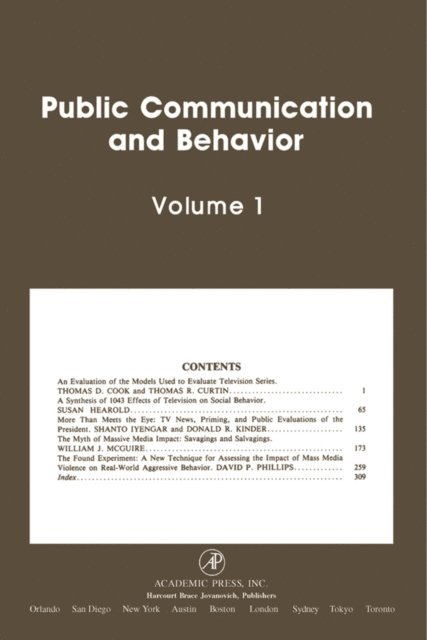
Public Communication and Behavior, Volume I is devoted to the study of communicatory behavior that has a public or social character. The book discusses an evaluation of the models used to evaluate television series; a synthesis of 1043 effects of television on social behavior; and TV news, priming, and public evaluations of the president. The text also describes the myth of massive media impact: savagings and salvaging, and a technique for assessing the impact of mass media violence on real-world aggressive behavior. Psychologists, sociologists, educators, journalists, and people involved in the study of child development will find the book invaluable.
E-bok
PDF, Engelska, 2013756 kr
Läs direkt efter köp
Public Communication and Behavior, Volume 2, is devoted to the study of communicatory behavior that has a public or social character. More concretely, it encompasses research and theory designated as ""within a range of disciplines and fields—advertising, child development, education, journalism, political science, sociology, and wherever else such scholarly activity occurs including, of course, social psychology"". The book opens with a chapter on television exposure as a potential cause of aggression. This is followed by separate chapters on barriers to information flow and the manner in which news audiences make use of TV news; various television forms and their impact on children; and the characterization and formalization of some elements of the evolving paradigm of communications research. The final chapter discusses the research findings concerning the public impact of the 1983 television movie about the aftermath of nuclear war, The Day After.