George I. N. Rozvany – författare
Visar alla böcker från författaren George I. N. Rozvany. Handla med fri frakt och snabb leverans.
12 produkter
Topology Optimization of Structures and Composite Continua
Av George I. N. Rozvany, N. Olhoff
Inbunden, 2001
1643 kr
Lägg i varukorg
Topology optimization of structures and composite materials is a new and rapidly expanding field of mechanics which is now coming to play a major role in most branches of engineering, such as aerospace, mechanical, structural, civil and materials. There are also significant implications for energy …
Topology Optimization of Structures and Composite Continua
Av George I. N. Rozvany, N. Olhoff
Häftad, 2001
1643 kr
Lägg i varukorg
Topology optimization of structures and composite materials is a new and rapidly expanding field of mechanics which now plays an ever-increasing role in most branches of technology, such as aerospace, mechanical, structural, civil and ma terials engineering, with important implications for energy …
Topology Optimization in Structural and Continuum Mechanics
Av George I. N. Rozvany, Tomasz Lewinski
Inbunden, 2013
2407 kr
Lägg i varukorg
The book covers new developments in structural topology optimization. Basic features and limitations of Michell’s truss theory, its extension to a broader class of support conditions, generalizations of truss topology optimization, and Michell continua are reviewed. For elastic bodies, the layout …
Topology Optimization in Structural and Continuum Mechanics
Av Tomasz Lewinski, George I. N. Rozvany
E-bok, 2013
3251 kr
Lägg i varukorg
The book covers new developments in structural topology optimization. Basic features and limitations of Michell’s truss theory, its extension to a broader class of support conditions, generalizations of truss topology optimization, and Michell continua are reviewed. For elastic bodies, the layout …
Topology Optimization in Structural and Continuum Mechanics
Av George I. N. Rozvany, Tomasz Lewinski
Häftad, 2015
2407 kr
Lägg i varukorg
The book covers new developments in structural topology optimization. Basic features and limitations of Michell’s truss theory, its extension to a broader class of support conditions, generalizations of truss topology optimization, and Michell continua are reviewed. For elastic bodies, the layout …
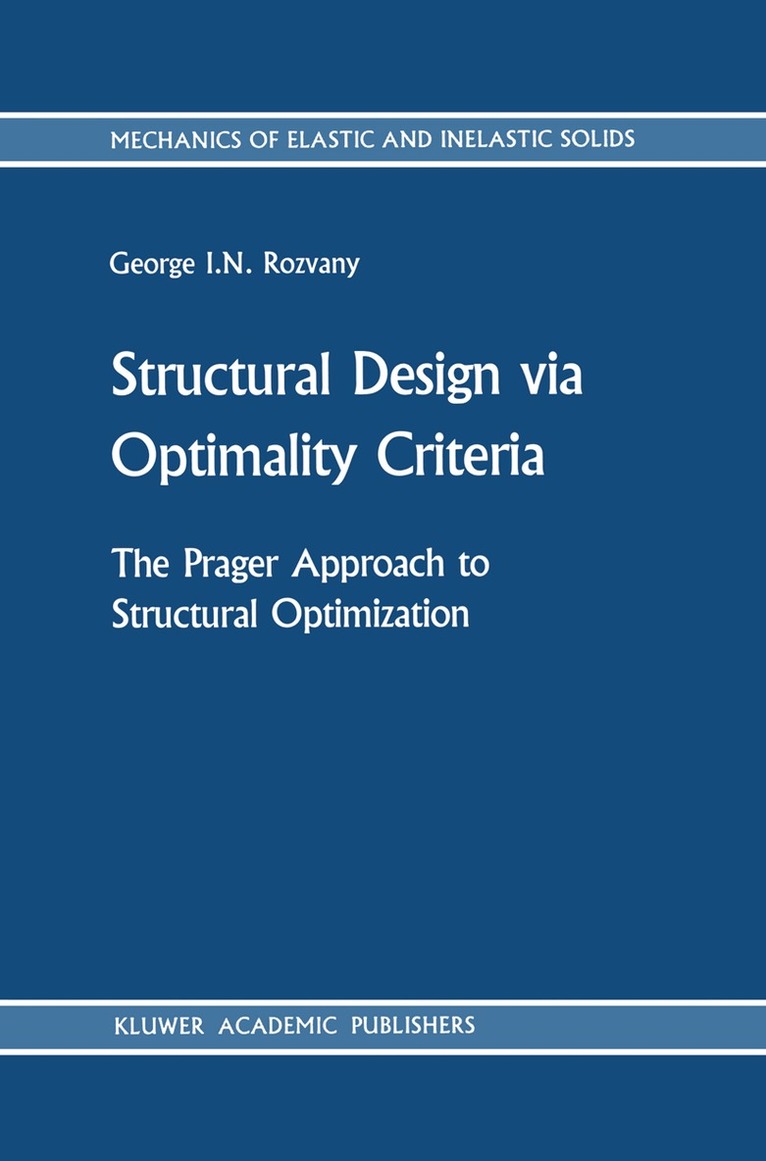
Structural Design via Optimality Criteria
The Prager Approach to Structural Optimization
Inbunden, 1989
2189 kr
Lägg i varukorg
"During the last two decades, research on structural optimization became increasingly concerned with two aspects: the application of general numeri- cal methods of optimization to structural design of complex real structures, and the analytical derivation of necessary and sufficient conditions for …
Structural Design via Optimality Criteria
The Prager Approach to Structural Optimization
E-bok, 2012
2925 kr
Lägg i varukorg
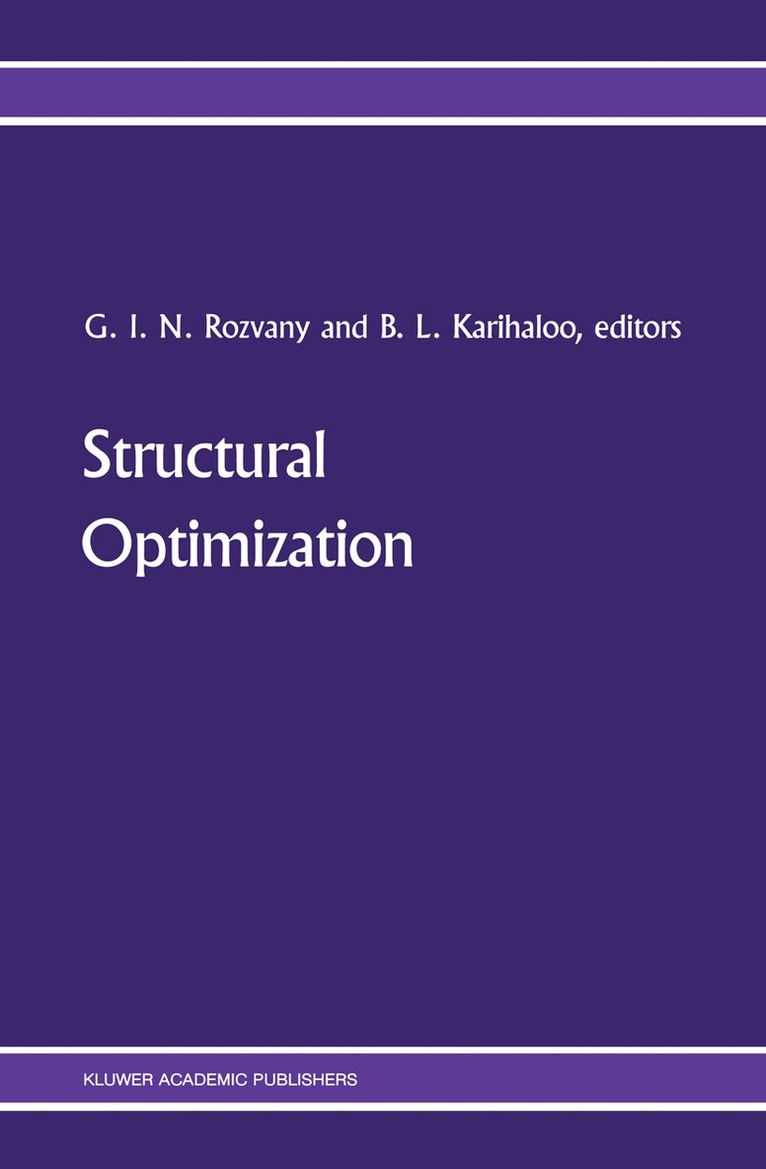
Structural Optimization
Proceedings of the IUTAM Symposium on Structural Optimization, Melbourne, Australia, 9–13 February 1988
Av B.L. Karihaloo, George I. N. Rozvany
E-bok, 2012
734 kr
Lägg i varukorg
Structural Design via Optimality Criteria
The Prager Approach to Structural Optimization
Häftad, 2011
2189 kr
Lägg i varukorg
"During the last two decades, research on structural optimization became increasingly concerned with two aspects: the application of general numeri- cal methods of optimization to structural design of complex real structures, and the analytical derivation of necessary and sufficient conditions for …
Structural Optimization
Proceedings of the IUTAM Symposium on Structural Optimization, Melbourne, Australia, 9–13 February 1988
Av George I. N. Rozvany, B.L. Karihaloo
Häftad, 2011
552 kr
Lägg i varukorg
Proceedings of the IUTAM Symposium on Structural Optimization, Melbourne, Australia, February 9-13, 1988
Optimization of Large Structural Systems
E-bok, 2013
734 kr
Lägg i varukorg
G.I.N. Rozvany ASI Director, Professor of Structural Design, FB 10, Essen University, Essen, Germany Structural optimization deals with the optimal design of all systems that consist, at least partially, of solids and are subject to stresses and deformations. This inte grated discipline plays an …
Optimization of Large Structural Systems
2014
651 kr
Lägg i varukorg
G.I.N. Rozvany ASI Director, Professor of Structural Design, FB 10, Essen University, Essen, Germany Structural optimization deals with the optimal design of all systems that consist, at least partially, of solids and are subject to stresses and deformations. This inte grated discipline plays an …