Gerald Midgley - Böcker
Visar alla böcker från författaren Gerald Midgley. Handla med fri frakt och snabb leverans.
9 produkter
9 produkter
1 907 kr
Skickas inom 10-15 vardagar
This book aims to rethink systemic intervention to enhance its relevance for supporting social change in the 21st century. It offers a new systems philosophy and methodology, focusing upon the fundamental importance of exploring value and boundary judgements as part of the intervention process. It includes four detailed examples of the practice of systemic intervention.
Community Operational Research
OR and Systems Thinking for Community Development
Inbunden, Engelska, 2004
1 590 kr
Skickas inom 10-15 vardagar
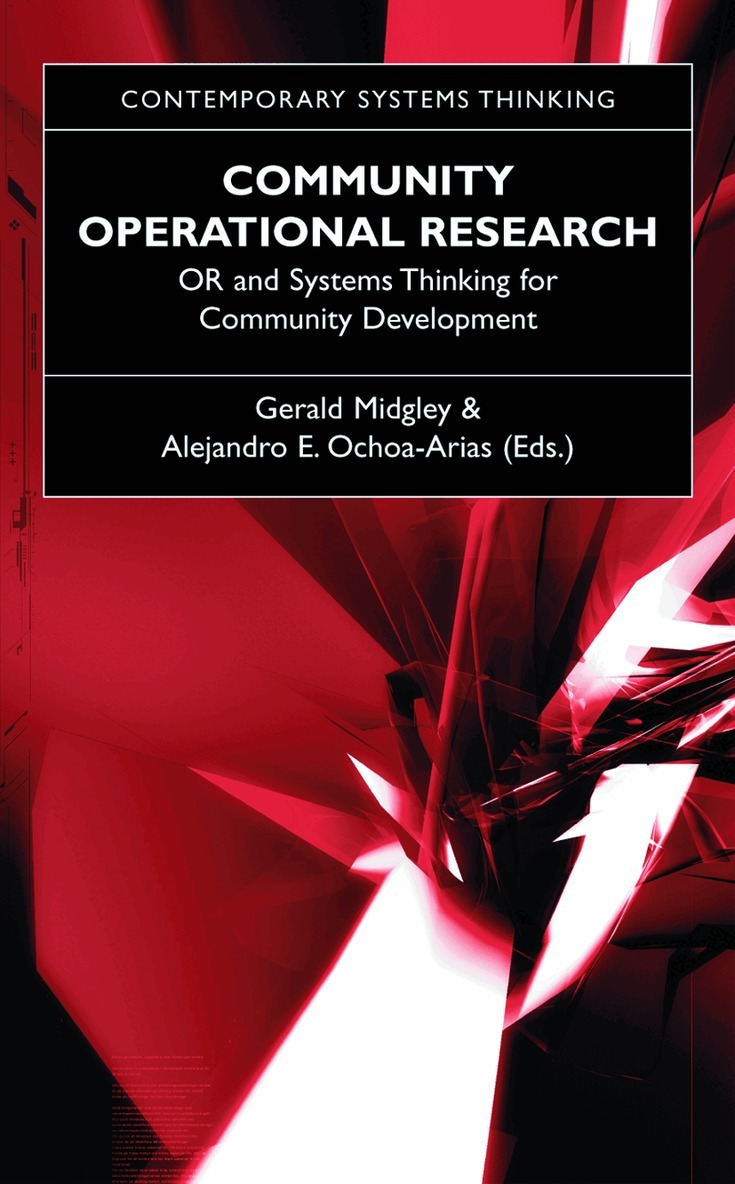
Community Operational Research: OR and Systems Thinking for Community Development sets out the current concerns of Community Operational Research (Community OR for short) and explores new possibilities for its development. Leading Community OR writers, international reputations in operational research and systems, have contributed chapters that illuminate different aspects of Community OR theory and practice. Following a introductory chapter by the editors on Community OR, the book is presented in three sections: - Section One presents "The History and Development of Community OR". Exploring the institutional development of Community OR and people's motivations for engaging in it. Methodological issues are also discussed. - Section Two covers "Local Action for Community Development". Even though the emphasis is on dealing with local issues, all the authors use methods and techniques to support widely informed decision making. In every case, the impacts of a complex variety of phenomena are taken into account. Even when authors are not using a systems methodology, the ideal of comprehensiveness (one of the hallmarks of systems thinking) is plain to see.- Section Three is entitled "Dealing Locally with Global Issues". Here, the themes of community development are taken one stage further. This includes authors who are explicitly seeking to address global issues (e.g., environmental problems and the international dimensions of poverty) through widely informed local action. - Finally, Section Four, "The Politics of Systemic Intervention", discusses two themes; the political nature of Community OR practice; and the value of systems thinking to community development. 'This is the book I have been waiting for. Community Operational Research has shown that analysis can be used not only for, but also with, community groups, helping them to gain more control of their situations. What Midgley and Ochoa-Arias' volume does is provide not only rich examples of grass-roots practice, but also thought-provoking theoretical explorations. The editors have a point of view, but they allow space for debate with those who interpret Community OR differently.' Jonathan Rosenhead (Emeritus Professor of Operational Research, London School of Economics and Political Science; Ex-President of the Operational Research Society) '.What the many authors in this book have in common is a commitment to serve the interests of all those affected by a community's behavior - its stakeholders.This is acquiring a new significance as we decreasingly conceptualize corporations and organizations in general as organisms, and begin to think of them, as Charles Handy has, as communities.' Russell Ackoff (Professor Emeritus of the Wharton Business School, University of Pennsylvania; Ex-President of ORSA; Vice President of TIMS)
942 kr
Kommande
297 kr
Kommande
9 636 kr
Tillfälligt slut
Systems Thinking brings together classic and contemporary writings that cross the entire breadth of the systems field. The four-volume set includes the most influential theoretical papers, as well as applications in domains as diverse as global environmental modelling, business strategy, public sector planning, family therapy and the management of organizations.Key critiques of the leading writers allow the researcher to understand how and why paradigm breaks took place, and to grasp the extraordinary diversification of systems theory and practice we see today.Systems Thinking will be an essential reference for all libraries of business, management and organization studies.International Advisory BoardPeter Allen, Cranfield University, UKBela H Banathy, Saybrook Institute, USA & International Systems Institute, USAKenneth Bausch, Institute for 21st Century Agoras, USARichard Bawden, Michigan State University, USASøren Brier, Royal Veterinary and Agricultural University, DenmarkDavid Campbell, Tavistock Clinic, UKFritjof Capra, Center for Ecoliteracy, USAPeter Checkland, Lancaster University, UKJosé Córdoba, University of Hull, UKPeter Corning, Institute for the Study of Complex Systems, USADonald de Raadt, Luleå University, SwedenEric Dent, University of Maryland, University College, USAPeter Dudley, Integra Management Systems Ltd., UKRobert Flood, Maastricht University, The NetherlandsJoyce Fortune, Open University, UKWojciech Gasparski, Institute of Philosophy and Sociology of the Polish Academy of Sciences, PolandWendy Gregory, University of Hull, UKJifa Gu, JAIST, Japan & Institute of Systems Science, Chinese Academy of Sciences, ChinaEnrique Herrscher, IDEA, ArgentinaKristo Ivanov, Umea University, SwedenMike Jackson, University of Hull, UKJames Kay, University of Waterloo, CanadaLisl Klein, Bayswater Institute, UKGeorge Klir, Binghampton University, USAErvin Laszlo, Club of Budapest, HungaryHarold Linstone, Portland State University, USASid Luckett, University of Natal, South AfricaGianfranco Minati, Italian Systems Society, ItalyJohn Mingers, Warwick University, UKHeiner M ller Merbach, Universität Kaiserslautern, GermanyP N Murthy, Tata Consultancy Services, IndiaYoshiteru Nakamori, Japan Advanced Institute for Science and Technology (JAIST), JapanHarold Nelson, Advance Design Institute, Seattle, USARoger Packham, University of Western Sydney, AustraliaYong Pil Rhee, Seoul National University, South KoreaKurt Richardson, Institute for the Study of Coherence and Emergence, USAFenton Robb, Independent Author, UKRicardo Rodríguez-Ulloa, Instituto Andino de Sistemas, PeruSimanta Roy-Chowdhury, Barnet, Enfield and Harringay NHS Trust & University of East London, UKJohn Sterman, Massachusetts Institute of Technology, USASytse Strijbos, Free University of Amsterdam, NetherlandsStuart Umpleby, George Washington University, USAJohn Van Gigch, California State University, USAJohn Warfield, George Mason University, USAJennifer Wilby, The University of York, UKEric Wolstenholme, Cognitus Ltd., UKMaurice Yolles, Liverpool John Moores University, UK
712 kr
Skickas inom 5-8 vardagar
253 kr
Skickas inom 5-8 vardagar
Community Operational Research
OR and Systems Thinking for Community Development
Häftad, Engelska, 2012
1 590 kr
Skickas inom 10-15 vardagar
Community Operational Research: OR and Systems Thinking for Community Development sets out the current concerns of Community Operational Research (Community OR for short) and explores new possibilities for its continued development. Leading Community OR writers, with international reputations in operational research and systems thinking, have contributed chapters that illuminate different aspects of Community OR theory and practice. There is a focus on the value of systems approaches, and other significant perspectives are also represented. The result is a rich mix of theories, methodologies and case studies that will be a significant resource for both practitioners and academics engaged in community development.
1 897 kr
Skickas inom 10-15 vardagar
This book aims to rethink systemic intervention to enhance its relevance for supporting social change in the 21st Century. It offers a new systems philosophy and methodology, focusing upon the fundamental importance of exploring value and boundary judgements as part of the intervention process. A pluralist practice is also promoted, and the reader learns how s/he can draw upon a wide variety of theories and methods to maximise flexibility and responsiveness during interventions. Four detailed examples of the practice of systemic intervention are also provided, each of which is used to illustrate a different aspect of the methodology outlined in the book.