Gerry Altmann - Böcker
Visar alla böcker från författaren Gerry Altmann. Handla med fri frakt och snabb leverans.
5 produkter
5 produkter
19 717 kr
Skickas inom 10-15 vardagar
These volumes reprint articles from a variety of international journals, book chapters and key technical reports, to take a broad look at how the field has developed from the turn of theTwentieth Century through to the turn of the twenty-first.Since the 1960s, there has been a boom in research on how the human mind both produces and comprehends language. Psycholinguistics - as a product of this boom - represents a synthesis between linguistics and psychology.The set covers the following topics:* Language Acquisition* The Mental Lexicon* Sentence Processing* Discourse and Meaning* Spoken Language Production* Reading* Disorders of Language and Production* Computational Models of Language Learning and Adult * Language Use
559 kr
Skickas inom 10-15 vardagar
A comprehensive review for those interested in the range of theoretical concerns in speech and language processing.
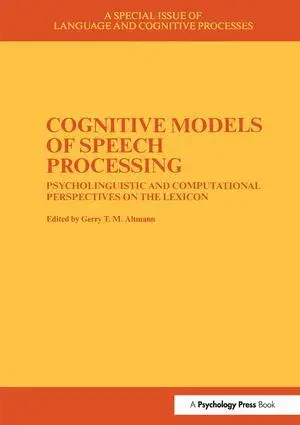
Cognitive Models of Speech Processing
A Special Issue of Language and Cognitive Processes
Inbunden, Engelska, 1998
2 044 kr
Skickas inom 10-15 vardagar
This collection of papers and abstracts stems from the third meeting in the series of Sperlonga workshops on Cognitive Models of Speech Processing. It presents current research on the structure and organization of the mental lexicon, and on the processes that access that lexicon. The volume starts with discussion of issues in acquisition and consideration of questions such as, 'What is the relationship between vocabulary growth and the acquisition of syntax?', and, 'How does prosodic information, concerning the melodies and rhythms of the language, influence the processes of lexical and syntactic acquisition?'. From acquisition, the papers move on to consider the manner in which contemporary models of spoken word recognition and production can map onto neural models of the recognition and production processes. The issue of exactly what is recognised, and when, is dealt with next - the empirical findings suggest that the function of something to which a word refers is accessed with a different time-course to the form of that something. This has considerable implications for the nature, and content, of lexical representations. Equally important are the findings from the studies of disordered lexical processing, and two papers in this volume address the implications of these disorders for models of lexical representation and process (borrowing from both empirical data and computational modelling). The final paper explores whether neural networks can successfully model certain lexical phenomena that have elsewhere been assumed to require rule-based processes.
335 kr
Skickas inom 10-15 vardagar
A comprehensive review for those interested in the range of theoretical concerns in speech and language processing.
Cognitive Models of Speech Processing
A Special Issue of Language and Cognitive Processes
Häftad, Engelska, 2018
651 kr
Skickas inom 10-15 vardagar
This collection of papers and abstracts stems from the third meeting in the series of Sperlonga workshops on Cognitive Models of Speech Processing. It presents current research on the structure and organization of the mental lexicon, and on the processes that access that lexicon. The volume starts with discussion of issues in acquisition and consideration of questions such as, 'What is the relationship between vocabulary growth and the acquisition of syntax?', and, 'How does prosodic information, concerning the melodies and rhythms of the language, influence the processes of lexical and syntactic acquisition?'. From acquisition, the papers move on to consider the manner in which contemporary models of spoken word recognition and production can map onto neural models of the recognition and production processes. The issue of exactly what is recognised, and when, is dealt with next - the empirical findings suggest that the function of something to which a word refers is accessed with a different time-course to the form of that something. This has considerable implications for the nature, and content, of lexical representations. Equally important are the findings from the studies of disordered lexical processing, and two papers in this volume address the implications of these disorders for models of lexical representation and process (borrowing from both empirical data and computational modelling). The final paper explores whether neural networks can successfully model certain lexical phenomena that have elsewhere been assumed to require rule-based processes.