Giuseppe Di Palma - Böcker
Visar alla böcker från författaren Giuseppe Di Palma. Handla med fri frakt och snabb leverans.
6 produkter
6 produkter
518 kr
Skickas inom 3-6 vardagar
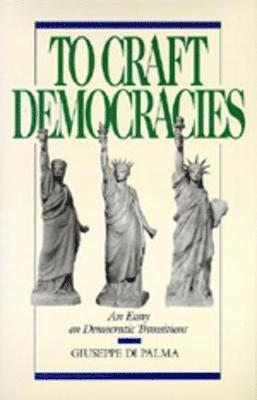
Is democracy a hot-house plant? And is it difficult to transplant it into new soil? The fall of so many dictatorships in the last few years - first in Southern Europe, then in Latin America, now in Eastern Europe - opens new, more optimistic perspectives on democratic development. The crises of dictatorships and the search for a new political order offer fertile ground for an examination of how best to effect democratic transitions. By focusing on the objective conditions that make democracy probable, sociological and historical theories of democracy often lose sight of what is possible. Here Giuseppe Di Palma instead explores those conciliatory political undertakings that political actors on all sides now engage in to make the improbable possible. His emphasis is on political crafting: in regard to constitutional choices, to alliances and convergences between contestants, to trade-offs, to the pacing of the transitions.Di Palma also examines the reasons - stalemate, the high cost of repression, a loss of goals, international constraints and inducements - that may motivate incumbents and nondemocratic political actors to accept democracy, even in those cases, as in Central America and Eastern Europe, where acceptance would seem least likely. An original and imaginative work that, in the light of recent transitions, challenges our assumptions about fledgling democracies and breaks new theoretical ground, "To Craft Democracies" will appeal to anyone interested in the way we forge our political communities today.
519 kr
Skickas
Surviving Without Governing: The Italian Parties in Parliament by Giuseppe Di Palma examines the paradox at the heart of postwar Italian politics: a system of extraordinary social and economic upheaval, marked by chronic instability and yet surprising endurance. Written in the midst of the 1970s political crisis, the book traces how Italy weathered a turbulent period of labor unrest, student mobilization, terrorism, and economic malaise, while its governments—thirty-four since the end of the war—struggled to provide continuity and authority. Di Palma situates these developments within Italy’s broader reputation as Europe’s grande malade, highlighting the deep contradictions of a society simultaneously modernizing and fragmenting.At the center of this study is the role of Parliament as both a crucible of political conflict and a key institution hampered by unresolved tensions between majority and opposition. Di Palma shows how the inability of Italian parties to forge stable governing coalitions, even in the era of the much-heralded Center-Left, undercut efforts at reform and fueled widespread disaffection. Yet he also underscores the resilience of Italian society, pointing to rapid secularization, expanded civil liberties, and grassroots participation as countercurrents to political malaise. Surviving Without Governing offers a penetrating analysis of the Italian political system’s performance, illuminating how parties, institutions, and society negotiated an ongoing crisis that continues to inform debates on governance, legitimacy, and democracy in Europe.This title is part of UC Press's Voices Revived program, which commemorates University of California Press’s mission to seek out and cultivate the brightest minds and give them voice, reach, and impact. Drawing on a backlist dating to 1893, Voices Revived makes high-quality, peer-reviewed scholarship accessible once again using print-on-demand technology. This title was originally published in 1977.
1 469 kr
Skickas inom 3-6 vardagar
Surviving Without Governing: The Italian Parties in Parliament by Giuseppe Di Palma examines the paradox at the heart of postwar Italian politics: a system of extraordinary social and economic upheaval, marked by chronic instability and yet surprising endurance. Written in the midst of the 1970s political crisis, the book traces how Italy weathered a turbulent period of labor unrest, student mobilization, terrorism, and economic malaise, while its governments—thirty-four since the end of the war—struggled to provide continuity and authority. Di Palma situates these developments within Italy’s broader reputation as Europe’s grande malade, highlighting the deep contradictions of a society simultaneously modernizing and fragmenting.At the center of this study is the role of Parliament as both a crucible of political conflict and a key institution hampered by unresolved tensions between majority and opposition. Di Palma shows how the inability of Italian parties to forge stable governing coalitions, even in the era of the much-heralded Center-Left, undercut efforts at reform and fueled widespread disaffection. Yet he also underscores the resilience of Italian society, pointing to rapid secularization, expanded civil liberties, and grassroots participation as countercurrents to political malaise. Surviving Without Governing offers a penetrating analysis of the Italian political system’s performance, illuminating how parties, institutions, and society negotiated an ongoing crisis that continues to inform debates on governance, legitimacy, and democracy in Europe.This title is part of UC Press's Voices Revived program, which commemorates University of California Press’s mission to seek out and cultivate the brightest minds and give them voice, reach, and impact. Drawing on a backlist dating to 1893, Voices Revived makes high-quality, peer-reviewed scholarship accessible once again using print-on-demand technology. This title was originally published in 1977.
397 kr
Skickas inom 7-10 vardagar
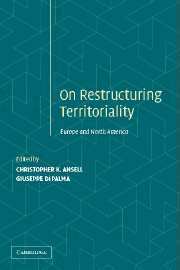
The bundling of political authority into mutually exclusive territorial boundaries - territoriality - is a fundamental principle of modern political organization. Indeed, it provides the foundation for other cherished institutions - national sovereignty, citizenship, the modern welfare state, and democracy. Are globalization, internationalization, and Europeanization conspiring to unbundle territoriality? If so, are sovereignty, citizenship, the welfare state, and democracy unravelling as well? Is a new post-national, non-territorial form of political organization, heralded by the European Union, being born? With a focus on Europe, this volume explores these issues from various substantive and theoretical perspectives. The authors find evidence of the diffusion of authority both within and beyond the state, producing novel institutional arrangements and new modes of governance. But the United States may provide more useful insights into the new dispensation than the idea of a post-national, non-territorial politics. Interest in contemporary challenges to democracy run throughout this volume.
995 kr
Skickas inom 7-10 vardagar
The bundling of political authority into mutually exclusive territorial boundaries - territoriality - is a fundamental principle of modern political organization. Indeed, it provides the foundation for other cherished institutions - national sovereignty, citizenship, the modern welfare state, and democracy. Are globalization, internationalization, and Europeanization conspiring to unbundle territoriality? If so, are sovereignty, citizenship, the welfare state, and democracy unravelling as well? Is a new post-national, non-territorial form of political organization, heralded by the European Union, being born? With a focus on Europe, this volume explores these issues from various substantive and theoretical perspectives. The authors find evidence of the diffusion of authority both within and beyond the state, producing novel institutional arrangements and new modes of governance. But the United States may provide more useful insights into the new dispensation than the idea of a post-national, non-territorial politics. Interest in contemporary challenges to democracy run throughout this volume.
371 kr
Skickas inom 5-8 vardagar